Endoscopic Discectomy Overview
Endoscopic discectomy is a minimally invasive surgical procedure used to treat a herniated disc in the cervical (neck), thoracic (mid-back), or lumbar (lower back) region of the spine. A herniated disc occurs when the soft, jelly-like material inside a disc bulges or ruptures through a crack in the disc’s outer layer. This can pressure the spinal cord or nerve roots and cause pain, numbness, and weakness.
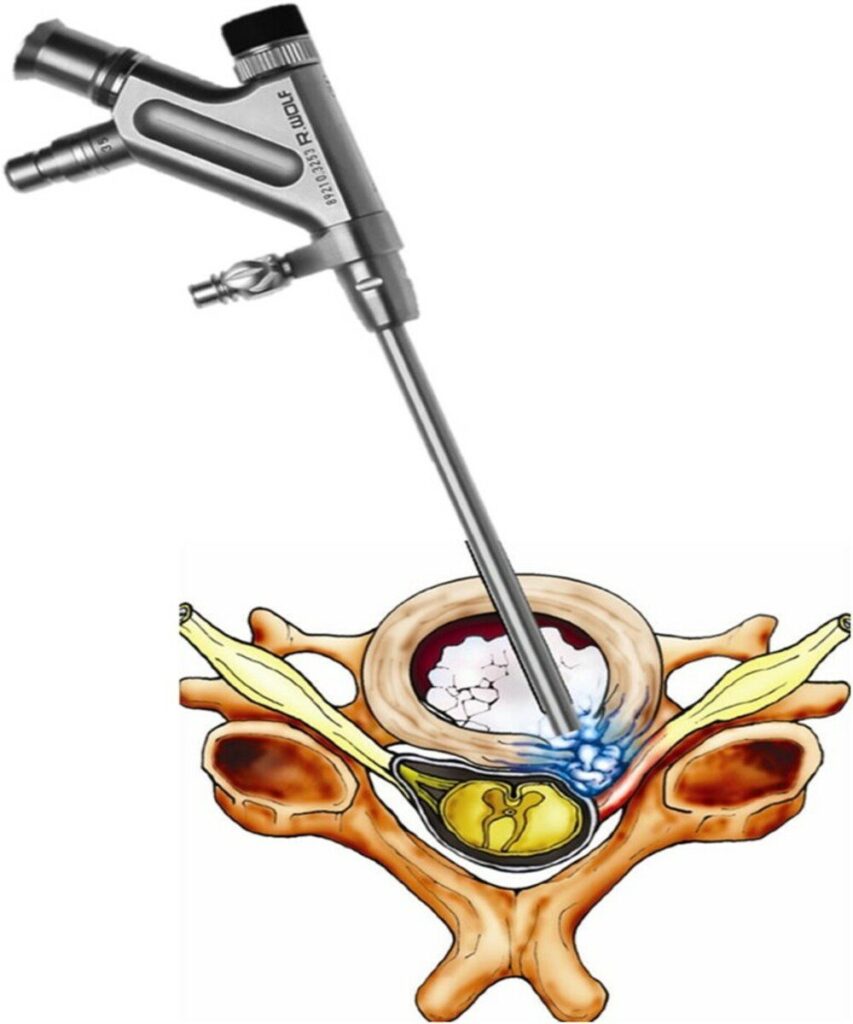
During the procedure, the surgeon makes a small incision in the skin and uses a special instrument, such as endoscope or laser, to remove the herniated portion of the disc. The procedure is typically performed using local anesthesia or conscious sedation and does not require a hospital stay.
Endoscopic discectomy is a safe and effective treatment option for many people with a herniated disc. It can help relieve pain and improve mobility and has a faster recovery time than traditional open surgery. However, it is not suitable for all patients, and the surgeon will carefully evaluate the patient’s condition to determine if this procedure is the best option.
When a herniated disc keeps pressing on a nerve — sending pain, numbness, or weakness down your leg or arm — endoscopic discectomy can relieve that pressure through an opening smaller than a fingertip. Our physicians offer minimally invasive disc care across Long Island and northern New Jersey, with offices in Plainview, New Hyde Park, and Ronkonkoma, NY, and Clifton, Montville, and Plainfield, NJ.
The short version
- Endoscopic discectomy removes the small piece of herniated disc that’s pressing on a nerve, using a tiny camera and a very small incision.
- It’s used for herniated discs in the lower back (lumbar) and mid-back (thoracic); neck discs are handled with our specialized cervical approach.
- It’s typically outpatient, done under local anesthesia or light sedation, with no hospital stay.
- Most people return to light activity within one to two weeks, though recovery varies.
What endoscopic discectomy treats
A herniated disc happens when the soft center of a spinal disc pushes through its tougher outer layer. If that bulge presses on a nearby nerve root, it can cause pain, numbness, tingling, or weakness — often radiating down the leg (from the lower back) or into the arm. Endoscopic discectomy removes just the portion of disc causing that pressure.
Using a small tube and an endoscope (a tiny camera with a light), the physician reaches the disc through a small opening, guided by imaging. As the American Academy of Orthopaedic Surgeons describes, endoscopic spine surgery is a minimally invasive way to remove herniated disc material, most commonly in the lower back. Because the opening is small, there’s less disruption to surrounding muscle than with traditional open surgery.
Which part of the spine?
Endoscopic disc treatment can apply to different regions of the spine, and the approach differs by area:
- Lumbar (lower back) — the most common use, typically for a single-level disc herniation causing leg pain, numbness, or weakness
- Thoracic (mid-back) — less common, for herniated discs in the middle of the spine
- Cervical (neck) — handled with our specialized Akhnoukh Cervical Ultrasound Technique (ACUT), which adds ultrasound guidance for the delicate structures of the neck
Are you a candidate?
Endoscopic discectomy may be worth discussing when:
- Imaging confirms a herniated disc pressing on a nerve
- Your main symptom is radiating pain, numbness, or weakness in a leg or arm
- Conservative care — therapy, medication, and often injections — hasn’t given you enough relief
- You’d prefer a minimally invasive option before considering larger surgery
Not every herniated disc needs surgery, and many improve with conservative care. Published research suggests endoscopic discectomy can provide faster early pain and functional improvement in the first several months, while non-surgical management can reach comparable results over longer periods — so timing and your specific situation matter. We’ll give you a straight read on whether it’s warranted.
What to expect
The procedure is typically done on an outpatient basis under local anesthesia or conscious sedation, so there’s usually no hospital stay. The physician makes a small incision, removes the herniated portion of disc through the endoscope, and closes with minimal disruption to the surrounding tissue.
Recovery varies by person, but many people return to light activities within one to two weeks and resume more normal activity over the following weeks. Your physician will give you specific guidance based on your procedure.
An honest note: Surgery relieves the nerve pressure, but it isn’t a guarantee that every symptom disappears or that a disc can never cause trouble again. We treat it as one part of a plan that includes rehab and staying active, and we’ll be honest about what to expect.
How it compares to traditional open surgery
| Endoscopic discectomy | Traditional open discectomy | |
|---|---|---|
| Incision | Very small (roughly 1 cm) | Larger |
| Anesthesia | Often local or light sedation | Usually general |
| Hospital stay | Typically outpatient | May require a stay |
| Muscle disruption | Less | More |
Why patients across Long Island and North Jersey choose Empire
We’re a local pain and orthopedic practice, not a national hospital system — so your evaluation, procedure, and follow-up all happen close to home with the same team.
- New York: Plainview, New Hyde Park, and Ronkonkoma — across Nassau and Suffolk
- New Jersey: Clifton, Montville, and Plainfield — serving Passaic, Morris, and Union County communities
- Interventional pain management and orthopedics under one roof
- Advanced techniques, including our own cervical ultrasound-guided approach
Insurance
Coverage varies by plan and by location, and we accept many major insurance plans across our New York and New Jersey offices. The simplest way to know exactly what your plan covers is to call — our team will verify your benefits before your visit, so there are no surprises. Whether you’re on Long Island or in North Jersey, reach out and we’ll walk you through your options.
Frequently asked questions
How painful is an endoscopic discectomy?
Because there’s no large incision and little muscle disruption, most people report relatively mild discomfort compared with open surgery. Some soreness afterward is normal and settles over the following days.
What is the recovery time?
Many people return to light activities within one to two weeks and resume more normal activity over the following weeks. Individual recovery varies with the disc treated and your overall health.
Is it major surgery?
It’s a minimally invasive procedure done through a very small incision, often around a centimeter, usually without a hospital stay. It’s far less invasive than traditional open back surgery.
What’s the difference from microdiscectomy?
Both remove herniated disc material. Endoscopic discectomy uses an endoscope through a smaller opening and is most often used for a single-level disc herniation. Your physician can explain which is more appropriate for you.
Does it treat neck discs too?
Neck (cervical) discs are handled with our specialized cervical approach, ACUT, which adds ultrasound guidance for the delicate structures of the neck. This page focuses on lower-back and mid-back discs.
Will my herniated disc come back?
Surgery relieves the current nerve pressure, but no procedure guarantees a disc will never cause trouble again. Staying active and following your rehab plan gives you the best chance of a lasting result.
Herniated disc pain running down your leg or arm?
Our physicians see patients across Long Island, NY and northern New Jersey. We’ll review your imaging and tell you honestly whether endoscopic discectomy is a reasonable option for you.
New York: 516-229-1443 | New Jersey: 732-630-7246
AA
Medically reviewed by Dr. Andrew J. Appel, M.D. — Board-certified Orthopedic Spine Surgeon
Last reviewed July 2026 · Empire Minimally Invasive Spine & Pain
What Our Patients Say
Medicare, Workers Comp,
No Fault & Others.
We accept most major insurance plans across our New York and New Jersey offices. Select your state to see accepted plans.
Accepted at our New York Locations
Workers' Compensation
No-Fault (NY & NJ)
Lien Cases
Medicare
Empire BCBS
BCBS / Anthem
Cigna
Aetna
Empire NYSHIP
Oxford (PPO)
United Health Care
GHI / Emblem Health
Humana (PPO)
Magnacare (PPO)
Northwell Direct
1199 SEIU
Self Pay
Accepted at our New Jersey Locations
Workers' Compensation
No-Fault (NJ)
Lien Cases
Horizon BCBS
Empire NYSHIP
BCBS / Anthem (PPO)
Cigna
Aetna (PPO)
GHI / Emblem (PPO)
Port Authority UHC
Verizon Plan
Carpenter & Trade Unions
Self Pay
Medicare and Medicaid are not accepted at our New Jersey locations. Not sure about your plan? Call us and we'll verify before your visit.
Not sure about your plan?
Call Us — 516-229-1443
Verify Your Coverage for FREE
Enter your information and our team will confirm your benefits before your visit.
✓ HIPAA Compliant
✓ No Obligation
✓ Same-Day Response
Your information is encrypted and secure. By submitting, you consent to receive communications regarding your appointment. You may opt out at any time.
Meet Our Pain Management & Orthopedic Specialists
Board-certified physicians dedicated to accurate diagnosis and minimally invasive care.

Pain Management
John Akhnoukh, M.D.
Board Certified Anesthesiologist & Interventional Pain Management Physician
Visit Profile



Pain Management
James Yu, D.O.
Board Certified Anesthesiologist & Interventional Pain Management Physician
Visit Profile

Pain Management
Benjamin Souferi, D.O.
Fellowship-Trained Interventional Pain Medicine Physician (Cleveland Clinic)
Visit ProfilePain Conditions Affecting Daily Life
Improve your quality of life with our comprehensive approach to pain management
We are dedicated to finding individualized treatment options tailored to fit your needs. Our team is dedicated to helping you lead a productive and active life, free from pain and disruption.
Our Locations
Pain management and orthopedic care across New York and New Jersey.