Carpal Tunnel Release Surgery
Performed By Dr. Salvatore Corso & Dr. Jeffrey Guttman
Call us today to make an appointment — we serve patients across New York and New Jersey, including communities such as Plainview, Ronkonkoma, New Hyde Park, Montville, and Plainfield.
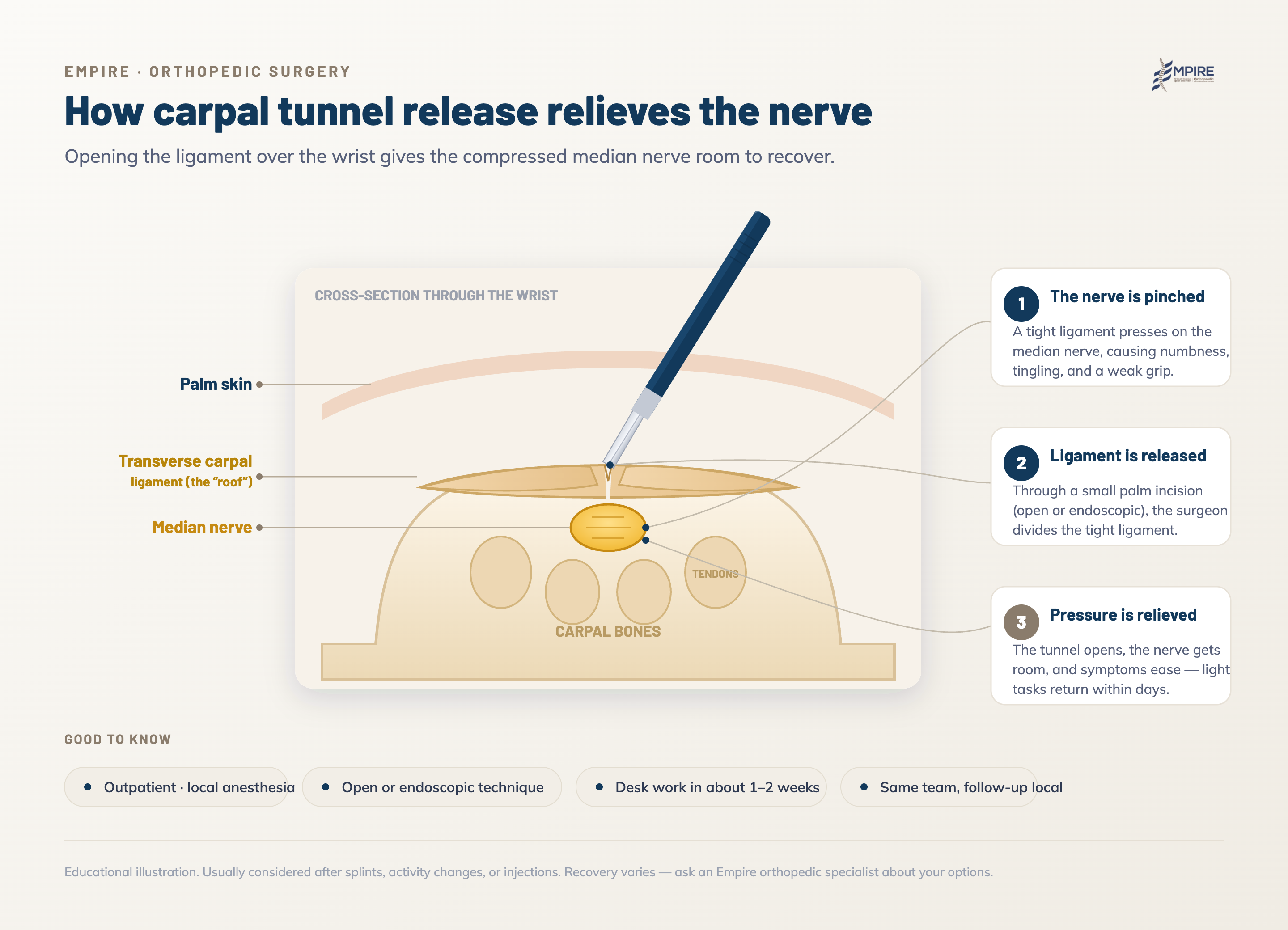
Carpal tunnel release surgery treats carpal tunnel syndrome, a condition caused by compression of the median nerve as it passes through the carpal tunnel in the wrist. That compression can cause pain, numbness, tingling, and weakness in the hand and fingers. The procedure involves releasing the transverse carpal ligament to relieve pressure on the nerve.
When carpal tunnel syndrome has you waking up with numb, tingling fingers and a weakening grip — and splints or injections haven’t fixed it — carpal tunnel release surgery can take the pressure off the nerve for good. Our orthopedic team performs this procedure across Long Island and northern New Jersey, with offices in Plainview, New Hyde Park, and Ronkonkoma, NY, and Clifton, Montville, and Plainfield, NJ.
The short version
- Carpal tunnel release relieves pressure on the median nerve at the wrist by opening the ligament pressing on it.
- It’s done two ways — open or endoscopic — both as quick outpatient procedures.
- Most people use the hand for light tasks within days and return to desk work in about 1–2 weeks.
- It’s usually considered after splinting, activity changes, or injections haven’t given lasting relief.
What carpal tunnel release treats
Carpal tunnel syndrome happens when the median nerve — which runs through a narrow passage in your wrist called the carpal tunnel — gets compressed. That pressure causes numbness, tingling, and pain in the thumb, index, and middle fingers, often worse at night, along with a weakening grip. When symptoms persist, carpal tunnel release surgery opens the ligament that forms the roof of the tunnel, giving the nerve more room and relieving the pressure.
It’s typically considered when non-surgical care — wrist splinting, activity changes, and steroid injections — hasn’t given you lasting relief, or when nerve testing shows the compression is significant.
Open vs. endoscopic release
There are two proven approaches, and they reach the same goal:
| Open release | Endoscopic release | |
|---|---|---|
| Incision | Small incision in the palm | One or two tiny incisions |
| Return to light activity | Slightly longer | Often a bit quicker |
| Anesthesia | Usually local | Usually local |
| Result | Relieves nerve pressure | Relieves nerve pressure |
Your surgeon will recommend the approach that best fits your anatomy and situation.
Are you a candidate?
Surgery may be worth discussing when:
- Numbness, tingling, or pain in the hand has persisted despite splinting and other conservative care
- Symptoms wake you at night or interfere with daily tasks
- Your grip is weakening, or you’re dropping things
- Nerve testing confirms meaningful median nerve compression
What to expect during recovery
Carpal tunnel release is an outpatient procedure, usually done under local anesthesia, and you go home the same day. Afterward your hand will be bandaged, and it’s normal to have some soreness. Keeping the hand elevated and moving your fingers gently helps reduce swelling and stiffness.
According to Hospital for Special Surgery, most patients can resume daily activities within a few days, with more strenuous activity coming later. Desk workers often return in about 1–2 weeks, while people in manual-labor jobs may need 4–8 weeks. As Kaiser Permanente and other sources note, it commonly takes around 3–4 months to recover fully, and up to a year for full hand strength to return — the amount varies from person to person.
Straight talk: Carpal tunnel release is one of the most common and reliable hand procedures, but no surgery is risk-free. As Johns Hopkins Medicine notes, possible risks include bleeding, infection, injury to the nerve or nearby vessels, and a sensitive scar. Numbness usually improves, though in long-standing cases some symptoms can take months to settle. We’ll review your specific risks before you decide.
Related hand procedures
Hand and wrist problems often come in pairs. If a finger is also catching or locking, our trigger finger release page covers that common companion condition.
Why patients across Long Island and North Jersey choose Empire
We’re a local orthopedic and pain practice, so your evaluation, procedure, and follow-up all happen close to home with the same team — no hospital-system runaround.
- New York: Plainview, New Hyde Park, and Ronkonkoma — across Nassau and Suffolk
- New Jersey: Clifton, Montville, and Plainfield — serving Passaic, Morris, and Union County communities
- Orthopedics and interventional pain management under one roof
- Open and endoscopic techniques offered
Insurance
Coverage varies by plan and by location, and we accept many major insurance plans across our New York and New Jersey offices. The simplest way to know exactly what your plan covers is to call — our team will verify your benefits before your visit, so there are no surprises. Whether you’re on Long Island or in North Jersey, reach out and we’ll walk you through your options.
Frequently asked questions
How painful is recovery after carpal tunnel surgery?
Most people have manageable soreness in the palm for a week or two, controlled with over-the-counter or prescribed medication. Elevating the hand and gentle finger movement help. Sharp or worsening pain should be reported to your surgeon.
How soon can I use my hand?
Light tasks like eating and dressing are usually fine within days. Heavier use, gripping, and repetitive motions are limited for a few weeks. Your surgeon will give you a specific schedule.
When can I go back to work?
Desk workers often return in about 1–2 weeks; manual-labor jobs may need 4–8 weeks depending on the demands. It also depends on which hand and which technique was used.
What are the risks?
Risks are low but real — bleeding, infection, nerve or vessel injury, and a tender scar. Your surgeon will review these and how they apply to you before surgery.
Will the numbness go away?
Numbness and tingling often improve, sometimes quickly. In long-standing or severe cases, full recovery of sensation can take months, and results vary from person to person.
Do I need surgery, or can I try other things first?
Many people start with splinting, activity changes, and injections. Surgery is generally considered when those haven’t given lasting relief or when nerve compression is significant. We’ll help you decide where you are in that process.
Numb, tingling hands keeping you up at night?
Our orthopedic team sees patients across Long Island, NY and northern New Jersey. We’ll evaluate your hand and tell you honestly whether carpal tunnel release is the right step for you.
New York: 516-229-1443 | New Jersey: 732-630-7246
SC
Medically reviewed by Dr. Salvatore Corso, M.D. — Board-certified Orthopedic & Sports Medicine Surgeon
Last reviewed July 2026 · Empire Minimally Invasive Spine & Pain
What Our Patients Say
Our Plainview office has moved
Find us at our new location:
520 Old Country Rd
Plainview, NY 11803
Same doctors, same phone numbers.
Most Major Plans,
No-Fault & Personal Injury.
We accept most major insurance plans across our New York and New Jersey offices. Select your state to see accepted plans.
Accepted at our New York Locations
Workers' Compensation
No-Fault (NY & NJ)
Lien Cases
Medicare
Empire BCBS
BCBS / Anthem
Cigna
Aetna
Empire NYSHIP
Oxford (PPO)
United Health Care
GHI / Emblem Health
Humana (PPO)
Magnacare (PPO)
Northwell Direct
1199 SEIU
Self Pay
Accepted at our New Jersey Locations
No-Fault (NJ)
Lien Cases
Horizon BCBS
Empire NYSHIP
BCBS / Anthem (PPO)
Cigna
Aetna (PPO)
GHI / Emblem (PPO)
Port Authority UHC
Verizon Plan
Carpenter & Trade Unions
Self Pay
Medicare, Medicaid and Workers' Compensation are not accepted at our New Jersey locations. Not sure about your plan? Call us and we'll verify before your visit.
Not sure about your plan?
Call Us — 516-229-1443
Verify Your Coverage for FREE
Enter your information and our team will confirm your benefits before your visit.
✓ HIPAA Compliant
✓ No Obligation
✓ Same-Day Response
Your information is encrypted and secure. By submitting, you consent to receive communications regarding your appointment. You may opt out at any time.
Meet Our Pain Management & Orthopedic Specialists
Board-certified physicians dedicated to accurate diagnosis and minimally invasive care.

Pain Management
John Akhnoukh, M.D.
Board Certified Anesthesiologist & Interventional Pain Management Physician
Visit Profile



Pain Management
James Yu, D.O.
Board Certified Anesthesiologist & Interventional Pain Management Physician
Visit Profile

Pain Management
Benjamin Souferi, D.O.
Fellowship-Trained Interventional Pain Medicine Physician (Cleveland Clinic)
Visit ProfilePain Conditions Affecting Daily Life
Improve your quality of life with our comprehensive approach to pain management
We are dedicated to finding individualized treatment options tailored to fit your needs. Our team is dedicated to helping you lead a productive and active life, free from pain and disruption.
Our Locations
Pain management and orthopedic care across New York and New Jersey.