Sympathetic Nerve Block Overview:
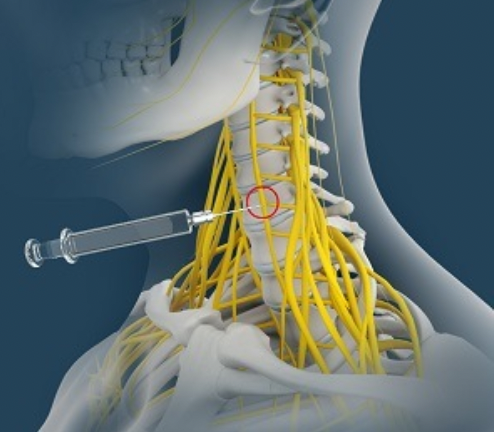
Sympathetic blocks are a type of medical procedure in which an anesthetic medication is injected near a sympathetic nerve or ganglion (a group of nerve cells) in order to block the transmission of nerve impulses and reduce pain. Sympathetic nerves are part of the sympathetic nervous system, a network of nerves that helps regulate certain body functions, such as heart rate, blood pressure, and the dilation and constriction of blood vessels.
Sympathetic blocks are typically used to treat chronic pain conditions that involve the sympathetic nervous system, such as complex regional pain syndrome (CRPS), reflex sympathetic dystrophy (RSD), and sympathetic-maintained pain. They may also treat other types of chronic pain, such as nerve and neuropathic pain.
For burning, out-of-proportion pain in an arm or leg — the kind seen with complex regional pain syndrome (CRPS) and similar nerve conditions — a sympathetic nerve block can both help find the source and calm the pain. Our pain physicians perform these blocks across Long Island and northern New Jersey, with offices in Plainview, New Hyde Park, and Ronkonkoma, NY, and Clifton, Montville, and Plainfield, NJ.
The short version
- A sympathetic nerve block injects numbing medication near the sympathetic nerves that can drive certain chronic pain.
- It’s used most for CRPS and other sympathetically-mediated nerve pain in the limbs.
- The first block is often diagnostic — if it helps, a short series may follow.
- It’s a quick, image-guided outpatient injection, usually about 15 to 30 minutes.
What a sympathetic nerve block treats
Your sympathetic nerves run alongside your spine and help control automatic body functions like blood flow. In some chronic pain conditions, these nerves stay overactive and keep sending pain signals long after they should have quieted. A sympathetic nerve block places local anesthetic near the relevant cluster of these nerves to interrupt that cycle.
According to NIH’s StatPearls reference, sympathetic blocks are widely used for neuropathic, visceral, ischemic, and sympathetically-mediated pain. The most common reason we use them is complex regional pain syndrome (CRPS), sometimes called reflex sympathetic dystrophy — a condition of severe, burning limb pain that’s often out of proportion to any injury.
Types of sympathetic nerve blocks
Where the injection goes depends on where your pain is:
- Stellate ganglion block — targets nerves in the neck to address pain in the head, face, neck, and arm
- Lumbar sympathetic block — targets nerves in the lower back for pain in the leg, often for CRPS of the lower limb
- Celiac plexus block — used for certain abdominal pain
How it works as both a test and a treatment
The first block often serves two purposes at once. If numbing these specific nerves relieves your pain, that’s strong evidence your pain is sympathetically-mediated — useful diagnostic information. It also gives you relief. As Johns Hopkins Medicine describes, when the initial diagnostic block helps, a physician may recommend a series of injections, often combined with physical therapy, to build longer-lasting control.
Straight talk: A sympathetic block doesn’t help everyone, and relief can be temporary, especially at first. That’s exactly why we use it step by step — the early block tells us whether this pathway is the right target before going further, and we’ll be honest with you about what it shows.
What to expect
The injection is done in-office on an outpatient basis using live X-ray guidance for accuracy, and typically takes about 15 to 30 minutes. You may receive light sedation. Afterward you rest briefly and go home the same day — arrange a driver if you’re sedated. Some soreness at the injection site is normal, and you may notice temporary warmth in the treated limb as the block takes effect.
Why patients across Long Island and North Jersey choose Empire
We’re a local pain and orthopedic practice, so your evaluation, injection, and follow-up all happen close to home with the same team — no hospital-system runaround.
- New York: Plainview, New Hyde Park, and Ronkonkoma — across Nassau and Suffolk
- New Jersey: Clifton, Montville, and Plainfield — serving Passaic, Morris, and Union County communities
- Interventional pain management and orthopedics under one roof
- Image-guided technique for precise, targeted injections
Insurance
Coverage varies by plan and by location, and we accept many major insurance plans across our New York and New Jersey offices. The simplest way to know exactly what your plan covers is to call — our team will verify your benefits before your visit, so there are no surprises. Whether you’re on Long Island or in North Jersey, reach out and we’ll walk you through your options.
Frequently asked questions
Is a sympathetic nerve block painful?
The skin and deeper tissue are numbed first with a thin needle, so most people tolerate it well. You may feel pressure during the injection and some soreness at the site afterward.
How long does the relief last?
It varies. Early relief can be temporary, which is normal. If the first block helps, a series of injections is often used to build longer-lasting control, frequently alongside physical therapy.
What conditions is it used for?
Most commonly complex regional pain syndrome (CRPS) and other sympathetically-mediated nerve pain in the limbs. It’s also used for certain other pain conditions your physician can discuss.
What happens if it doesn’t work?
If numbing these nerves doesn’t relieve your pain, that itself is useful information — it suggests the pain is coming from a different source, and we’ll redirect the plan rather than repeat a block that isn’t helping.
Are there side effects?
Temporary effects can include soreness, warmth in the treated limb, and — with neck (stellate ganglion) blocks — short-lived hoarseness or a droopy eyelid that resolves as the anesthetic wears off. Your physician will review these with you.
How much does it cost?
Cost depends on your plan and the specific block. Our team will verify your benefits and explain any out-of-pocket cost before you schedule, so there are no surprises.
Burning limb pain that doesn’t add up?
Our pain physicians see patients across Long Island, NY and northern New Jersey. We’ll evaluate your pain and tell you whether a sympathetic nerve block is the right next step for you.
New York: 516-229-1443 | New Jersey: 732-630-7246
JA
Medically reviewed by Dr. John Akhnoukh, M.D. — Board-certified in Anesthesiology & Interventional Pain Management
Last reviewed July 2026 · Empire Minimally Invasive Spine & Pain
What Our Patients Say
Our Plainview office has moved
Find us at our new location:
520 Old Country Rd
Plainview, NY 11803
Same doctors, same phone numbers.
Most Major Plans,
No-Fault & Personal Injury.
We accept most major insurance plans across our New York and New Jersey offices. Select your state to see accepted plans.
Accepted at our New York Locations
Workers' Compensation
No-Fault (NY & NJ)
Lien Cases
Medicare
Empire BCBS
BCBS / Anthem
Cigna
Aetna
Empire NYSHIP
Oxford (PPO)
United Health Care
GHI / Emblem Health
Humana (PPO)
Magnacare (PPO)
Northwell Direct
1199 SEIU
Self Pay
Accepted at our New Jersey Locations
No-Fault (NJ)
Lien Cases
Horizon BCBS
Empire NYSHIP
BCBS / Anthem (PPO)
Cigna
Aetna (PPO)
GHI / Emblem (PPO)
Port Authority UHC
Verizon Plan
Carpenter & Trade Unions
Self Pay
Medicare, Medicaid and Workers' Compensation are not accepted at our New Jersey locations. Not sure about your plan? Call us and we'll verify before your visit.
Not sure about your plan?
Call Us — 516-229-1443
Verify Your Coverage for FREE
Enter your information and our team will confirm your benefits before your visit.
✓ HIPAA Compliant
✓ No Obligation
✓ Same-Day Response
Your information is encrypted and secure. By submitting, you consent to receive communications regarding your appointment. You may opt out at any time.
Meet Our Pain Management & Orthopedic Specialists
Board-certified physicians dedicated to accurate diagnosis and minimally invasive care.

Pain Management
John Akhnoukh, M.D.
Board Certified Anesthesiologist & Interventional Pain Management Physician
Visit Profile



Pain Management
James Yu, D.O.
Board Certified Anesthesiologist & Interventional Pain Management Physician
Visit Profile

Pain Management
Benjamin Souferi, D.O.
Fellowship-Trained Interventional Pain Medicine Physician (Cleveland Clinic)
Visit ProfilePain Conditions Affecting Daily Life
Improve your quality of life with our comprehensive approach to pain management
We are dedicated to finding individualized treatment options tailored to fit your needs. Our team is dedicated to helping you lead a productive and active life, free from pain and disruption.
Our Locations
Pain management and orthopedic care across New York and New Jersey.