Torn Meniscus Pain Overview
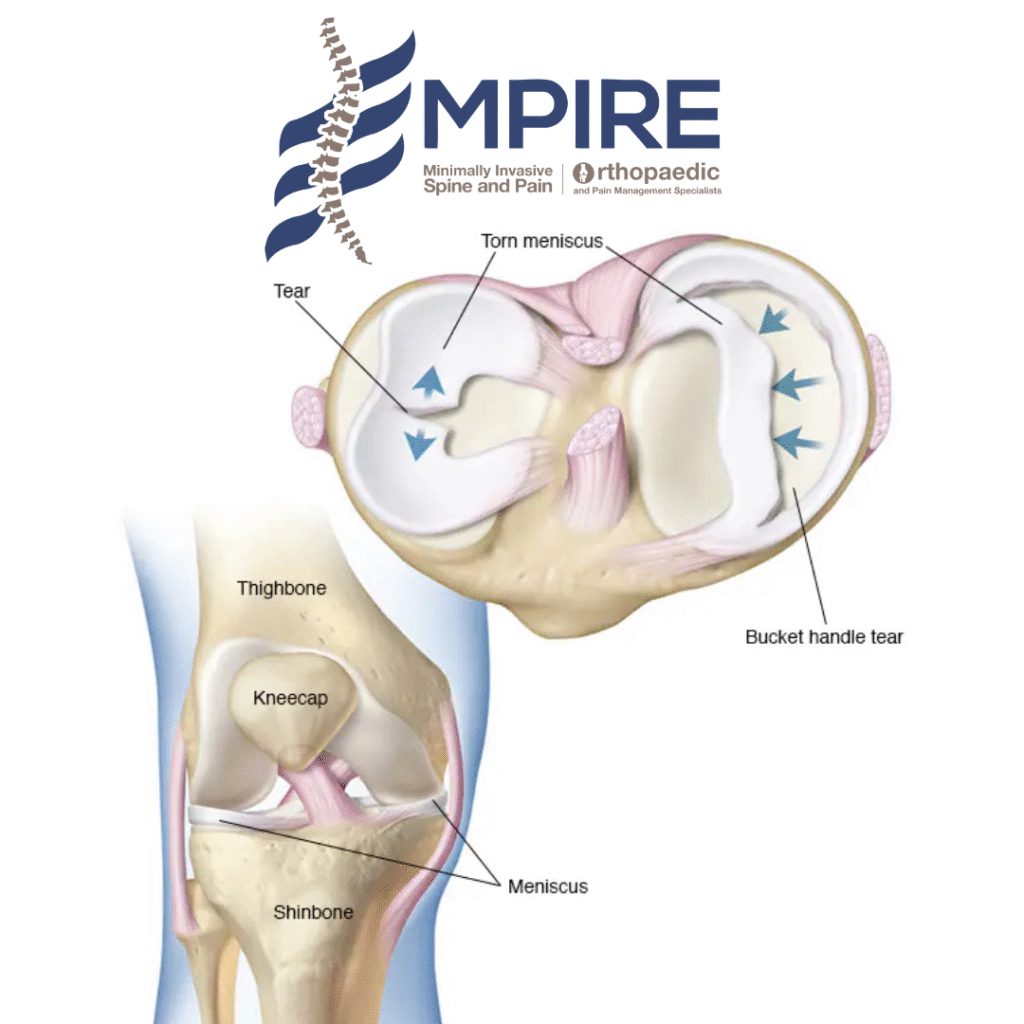
A torn meniscus can make your knee catch, lock, or swell — and it’s one of the most common knee injuries, whether from a sports twist or simply from wear over time. Our orthopedic team treats meniscus injuries across Long Island and northern New Jersey, with offices in Plainview, New Hyde Park, and Ronkonkoma, NY, and Clifton, Montville, and Plainfield, NJ.
The short version
- The meniscus is the C-shaped cartilage that cushions and stabilizes your knee.
- Tears happen from twisting the knee (often in sport) or from gradual wear with age.
- Common symptoms are pain, swelling, and a catching or locking feeling.
- Many tears improve with conservative care; some need arthroscopic treatment.
What a torn meniscus is
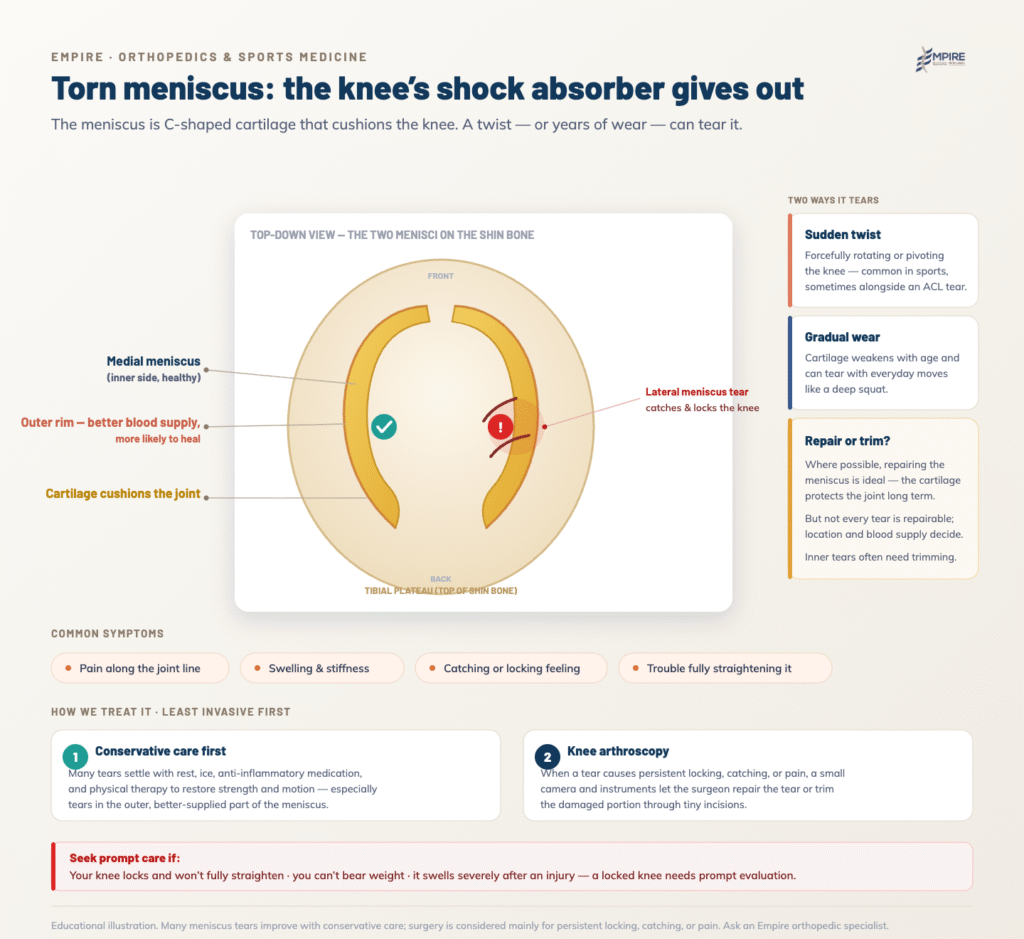
Each knee has two menisci — wedges of tough cartilage that act as shock absorbers between the thigh and shin bones. A tear can occur suddenly, from forcefully twisting or rotating the knee (common in sports), or gradually, as the cartilage weakens with age and tears with everyday movements like squatting.
As Mayo Clinic notes, after a meniscus tear it may take a day or so for pain and swelling to set in, and you may feel your knee catching or giving way. Symptoms often include pain along the joint line, stiffness, swelling, and difficulty fully straightening the knee.
How torn meniscus is treated
Treatment depends on the size, type, and location of the tear, plus your symptoms and activity level:
- Conservative care first — many tears settle with rest, ice, anti-inflammatory medication, and physical therapy to restore strength and motion.
- Knee arthroscopy — when a tear causes persistent locking, catching, or pain, knee arthroscopy allows the surgeon to repair the tear or trim the damaged portion through small incisions.
Repair or trim? Where possible, preserving the meniscus by repairing it is ideal, since the cartilage protects the joint long term. But not every tear is repairable — location and blood supply matter. Your surgeon will explain which approach fits your specific tear.
Seek prompt care if: your knee locks and won’t fully straighten, you can’t bear weight, or it swells severely after an injury. A locked knee in particular should be evaluated promptly.
Related conditions
Meniscus tears sometimes occur with ligament injuries. See our ACL tear and ligament injuries pages, or return to our knee pain overview.
Why patients across Long Island and North Jersey choose Empire
We’re a local orthopedic and pain practice, so your evaluation, procedure if needed, and rehab all happen close to home with the same team.
- New York: Plainview, New Hyde Park, and Ronkonkoma — across Nassau and Suffolk
- New Jersey: Clifton, Montville, and Plainfield — serving Passaic, Morris, and Union County communities
- Orthopedics and sports medicine under one roof
- Arthroscopic, minimally invasive techniques
Insurance
Coverage varies by plan and by location, and we accept many major insurance plans across our New York and New Jersey offices. The simplest way to know exactly what your plan covers is to call — our team will verify your benefits before your visit, so there are no surprises. Whether you’re on Long Island or in North Jersey, reach out and we’ll walk you through your options.
Frequently asked questions
Does a torn meniscus always need surgery?
No. Many tears improve with rest, physical therapy, and time. Surgery is considered mainly when a tear causes persistent locking, catching, or pain that doesn’t settle with conservative care.
What does a meniscus tear feel like?
Often pain along the joint line, swelling, stiffness, and a catching or locking sensation. You may have trouble fully straightening the knee.
Can a meniscus heal on its own?
Tears in the outer part of the meniscus, which has better blood supply, can sometimes heal or settle with conservative care. Tears in the inner portion are less likely to heal on their own.
What’s the recovery like after arthroscopy?
It depends on whether the tear is repaired or trimmed. Trimming generally allows a quicker return to activity; a repair protects the cartilage but needs more time. Your surgeon will explain your timeline.
Is it bad to walk on a torn meniscus?
Gentle movement is usually fine, but a knee that locks or gives way should be evaluated. Pushing through significant pain can risk further damage.
How is a torn meniscus diagnosed?
Through your history, a physical exam with specific knee tests, and imaging such as MRI to confirm the tear and guide treatment.
Knee catching, locking, or swollen?
Our orthopedic team sees patients across Long Island, NY and northern New Jersey. We’ll confirm whether it’s a meniscus tear and recommend the least invasive fix.
New York: 516-229-1443 | New Jersey: 732-630-7246
Related reading:
JG
Medically reviewed by Dr. Jeffrey Guttman, M.D. — Board-certified Orthopedic & Sports Medicine Surgeon
Last reviewed July 2026 · Empire Minimally Invasive Spine & Pain
What Our Patients Say
Our Plainview office has moved
Find us at our new location:
520 Old Country Rd
Plainview, NY 11803
Same doctors, same phone numbers.
Most Major Plans,
No-Fault & Personal Injury.
We accept most major insurance plans across our New York and New Jersey offices. Select your state to see accepted plans.
Accepted at our New York Locations
Workers' Compensation
No-Fault (NY & NJ)
Lien Cases
Medicare
Empire BCBS
BCBS / Anthem
Cigna
Aetna
Empire NYSHIP
Oxford (PPO)
United Health Care
GHI / Emblem Health
Humana (PPO)
Magnacare (PPO)
Northwell Direct
1199 SEIU
Self Pay
Accepted at our New Jersey Locations
No-Fault (NJ)
Lien Cases
Horizon BCBS
Empire NYSHIP
BCBS / Anthem (PPO)
Cigna
Aetna (PPO)
GHI / Emblem (PPO)
Port Authority UHC
Verizon Plan
Carpenter & Trade Unions
Self Pay
Medicare, Medicaid and Workers' Compensation are not accepted at our New Jersey locations. Not sure about your plan? Call us and we'll verify before your visit.
Not sure about your plan?
Call Us — 516-229-1443
Verify Your Coverage for FREE
Enter your information and our team will confirm your benefits before your visit.
✓ HIPAA Compliant
✓ No Obligation
✓ Same-Day Response
Your information is encrypted and secure. By submitting, you consent to receive communications regarding your appointment. You may opt out at any time.
Meet Our Pain Management & Orthopedic Specialists
Board-certified physicians dedicated to accurate diagnosis and minimally invasive care.

Pain Management
John Akhnoukh, M.D.
Board Certified Anesthesiologist & Interventional Pain Management Physician
Visit Profile



Pain Management
James Yu, D.O.
Board Certified Anesthesiologist & Interventional Pain Management Physician
Visit Profile

Pain Management
Benjamin Souferi, D.O.
Fellowship-Trained Interventional Pain Medicine Physician (Cleveland Clinic)
Visit ProfilePain Conditions Affecting Daily Life
Improve your quality of life with our comprehensive approach to pain management
We are dedicated to finding individualized treatment options tailored to fit your needs. Our team is dedicated to helping you lead a productive and active life, free from pain and disruption.
Our Locations
Pain management and orthopedic care across New York and New Jersey.