Neck Pain Overview
Neck pain is one of the most common ailments experienced by people of all ages. It can range from mild discomfort to sharp and persistent pain, and a variety of underlying conditions can cause it. If you’re experiencing neck pain, it’s essential to understand what might be causing it so that you can get the proper treatment. Let’s take a closer look at neck pain and the causes behind it.
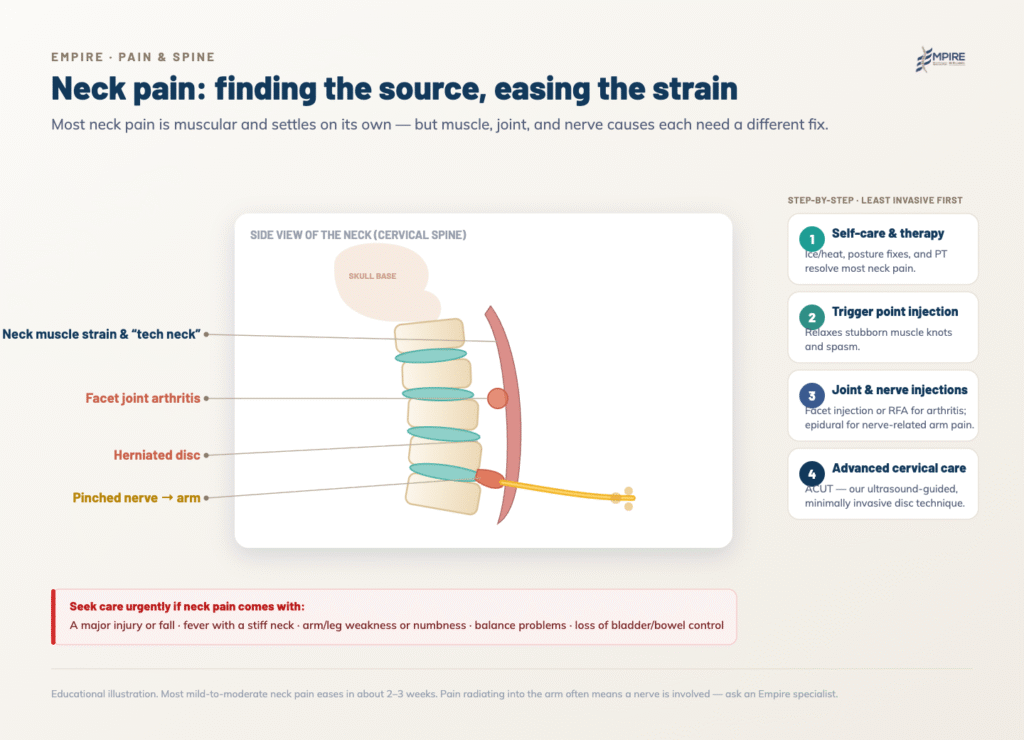
Neck pain can make it hard to concentrate at work, turn your head while driving, or get a good night’s sleep. Most of the time it’s muscular and settles on its own — but when it lingers or radiates into the arm, the right diagnosis makes all the difference. Our pain and spine specialists treat neck pain across Long Island and northern New Jersey, with offices in Plainview, New Hyde Park, and Ronkonkoma, NY, and Clifton, Montville, and Plainfield, NJ.
The short version
- Most mild to moderate neck pain improves within about two to three weeks with simple self-care.
- Common causes are posture, “tech neck,” muscle strain, whiplash, arthritis, and herniated discs.
- Pain that spreads into the shoulder or arm often means a nerve is involved and may need targeted treatment.
- We start conservative and only advance to injections or procedures when needed.
What causes neck pain
The neck supports the weight of your head all day, so it’s vulnerable to strain. The most common causes we see include:
- Posture and “tech neck” — long hours looking down at a phone or hunched at a computer
- Muscle strain — from overuse, sleeping in an awkward position, or carrying a heavy bag on one shoulder
- Whiplash — often after a car accident or sudden jolt
- Arthritis — wear of the facet joints in the neck over time
- Herniated discs and pinched nerves — which can send pain, numbness, or tingling into the shoulder and arm
As Mayo Clinic notes, most of the time neck pain is not a sign of a serious problem, and it improves with simple care. When it doesn’t, identifying whether the source is muscle, joint, or nerve is what points to the right treatment.
When neck pain comes from a damaged cervical disc and conservative care hasn’t helped, surgical options include ACDF (anterior cervical discectomy and fusion) or, for the right candidate, motion-preserving cervical disc replacement.
How we treat neck pain — step by step
We follow a conservative-first, step-and-ladder approach:
- Self-care and therapy — ice or heat, posture correction, and physical therapy resolve most neck pain.
- Trigger point injections — for stubborn muscle knots and spasm, a trigger point injection can help the muscle relax.
- Facet-focused treatment — when arthritic neck joints are the source, a facet joint injection and, if it confirms the source, radiofrequency ablation can give lasting relief.
- Nerve-related pain — if a disc is pressing on a nerve and sending pain into the arm, a cervical epidural steroid injection can calm it.
- Advanced cervical care — for the right disc problems, our own Akhnoukh Cervical Ultrasound Technique (ACUT) offers an ultrasound-guided, minimally invasive approach developed here at Empire.
Our approach: Most neck pain never needs a procedure. We recommend one only when conservative care hasn’t worked and a specific, treatable source has been identified — and we’ll tell you honestly where you stand.
When to seek care urgently: Get prompt medical attention if neck pain follows a serious accident or fall, or comes with high fever and a stiff neck, weakness or numbness in the arms or legs, problems with balance or coordination, or loss of bladder or bowel control. These can signal something that needs immediate evaluation.
Why patients across Long Island and North Jersey choose Empire
We’re a local pain and spine practice, so your evaluation, treatment, and follow-up all happen close to home with the same team — including advanced cervical care you won’t find everywhere.
- New York: Plainview, New Hyde Park, and Ronkonkoma — across Nassau and Suffolk
- New Jersey: Clifton, Montville, and Plainfield — serving Passaic, Morris, and Union County communities
- Interventional pain management and spine care under one roof
- Home of the Akhnoukh Cervical Ultrasound Technique for cervical disc care
Insurance
Coverage varies by plan and by location, and we accept many major insurance plans across our New York and New Jersey offices. The simplest way to know exactly what your plan covers is to call — our team will verify your benefits before your visit, so there are no surprises. Whether you’re on Long Island or in North Jersey, reach out and we’ll walk you through your options.
Frequently asked questions
What helps relieve neck pain fast?
For a typical strain, ice in the first day or so, then heat to relax the muscles, along with gentle movement and an over-the-counter anti-inflammatory, usually helps most. Avoid staying frozen in one position.
What should I not do with neck pain?
Avoid prolonged stillness, aggressive self-cracking, and long stretches hunched over a phone or screen. If a movement sharply worsens the pain, ease off it and get evaluated if it persists.
What’s the best sleeping position for neck pain?
Sleeping on your back or side tends to be easiest on the neck, using a pillow that supports its natural curve. Avoid sleeping on your stomach, which twists the neck for hours.
How long should neck pain last before I see a doctor?
Most mild to moderate neck pain eases within two to three weeks. If yours lasts longer, keeps returning, or radiates into the arm with numbness or weakness, it’s worth an evaluation.
What’s a red flag for neck pain?
Neck pain with fever and stiffness, weakness or numbness in the limbs, balance problems, loss of bladder or bowel control, or pain after a major injury all warrant urgent care.
When does neck pain need a specialist?
When conservative care hasn’t helped, or the pain involves a nerve. A pain and spine specialist can pinpoint the source and offer targeted options — from injections to advanced cervical procedures — which is what our team does. To book, see a neck pain doctor at our Long Island or New Jersey offices.
Neck pain that won’t let up?
Our pain and spine specialists see patients across Long Island, NY and northern New Jersey. We’ll find the source — muscle, joint, or nerve — and start you on the least invasive treatment that works.
New York: 516-229-1443 | New Jersey: 732-630-7246
JA
Medically reviewed by Dr. John Akhnoukh, M.D. — Board-certified in Anesthesiology & Interventional Pain Management
Last reviewed July 2026 · Empire Minimally Invasive Spine & Pain
What Our Patients Say
Our Plainview office has moved
Find us at our new location:
520 Old Country Rd
Plainview, NY 11803
Same doctors, same phone numbers.
Most Major Plans,
No-Fault & Personal Injury.
We accept most major insurance plans across our New York and New Jersey offices. Select your state to see accepted plans.
Accepted at our New York Locations
Workers' Compensation
No-Fault (NY & NJ)
Lien Cases
Medicare
Empire BCBS
BCBS / Anthem
Cigna
Aetna
Empire NYSHIP
Oxford (PPO)
United Health Care
GHI / Emblem Health
Humana (PPO)
Magnacare (PPO)
Northwell Direct
1199 SEIU
Self Pay
Accepted at our New Jersey Locations
No-Fault (NJ)
Lien Cases
Horizon BCBS
Empire NYSHIP
BCBS / Anthem (PPO)
Cigna
Aetna (PPO)
GHI / Emblem (PPO)
Port Authority UHC
Verizon Plan
Carpenter & Trade Unions
Self Pay
Medicare, Medicaid and Workers' Compensation are not accepted at our New Jersey locations. Not sure about your plan? Call us and we'll verify before your visit.
Not sure about your plan?
Call Us — 516-229-1443
Verify Your Coverage for FREE
Enter your information and our team will confirm your benefits before your visit.
✓ HIPAA Compliant
✓ No Obligation
✓ Same-Day Response
Your information is encrypted and secure. By submitting, you consent to receive communications regarding your appointment. You may opt out at any time.
Meet Our Pain Management & Orthopedic Specialists
Board-certified physicians dedicated to accurate diagnosis and minimally invasive care.

Pain Management
John Akhnoukh, M.D.
Board Certified Anesthesiologist & Interventional Pain Management Physician
Visit Profile



Pain Management
James Yu, D.O.
Board Certified Anesthesiologist & Interventional Pain Management Physician
Visit Profile

Pain Management
Benjamin Souferi, D.O.
Fellowship-Trained Interventional Pain Medicine Physician (Cleveland Clinic)
Visit ProfilePain Conditions Affecting Daily Life
Improve your quality of life with our comprehensive approach to pain management
We are dedicated to finding individualized treatment options tailored to fit your needs. Our team is dedicated to helping you lead a productive and active life, free from pain and disruption.
Our Locations
Pain management and orthopedic care across New York and New Jersey.