Patellofemoral Stress Syndrome
Patellofemoral Stress Syndrome treatment by Empire Pain Management, Minimally Invasive Spine & Orthopedic Specialists. Call us today to make an appointment we serve patients across New York and New Jersey, including communities such as Plainview, Ronkonkoma, New Hyde Park, Montville, and Plainfield.
Patellofemoral Stress Syndrome Overview
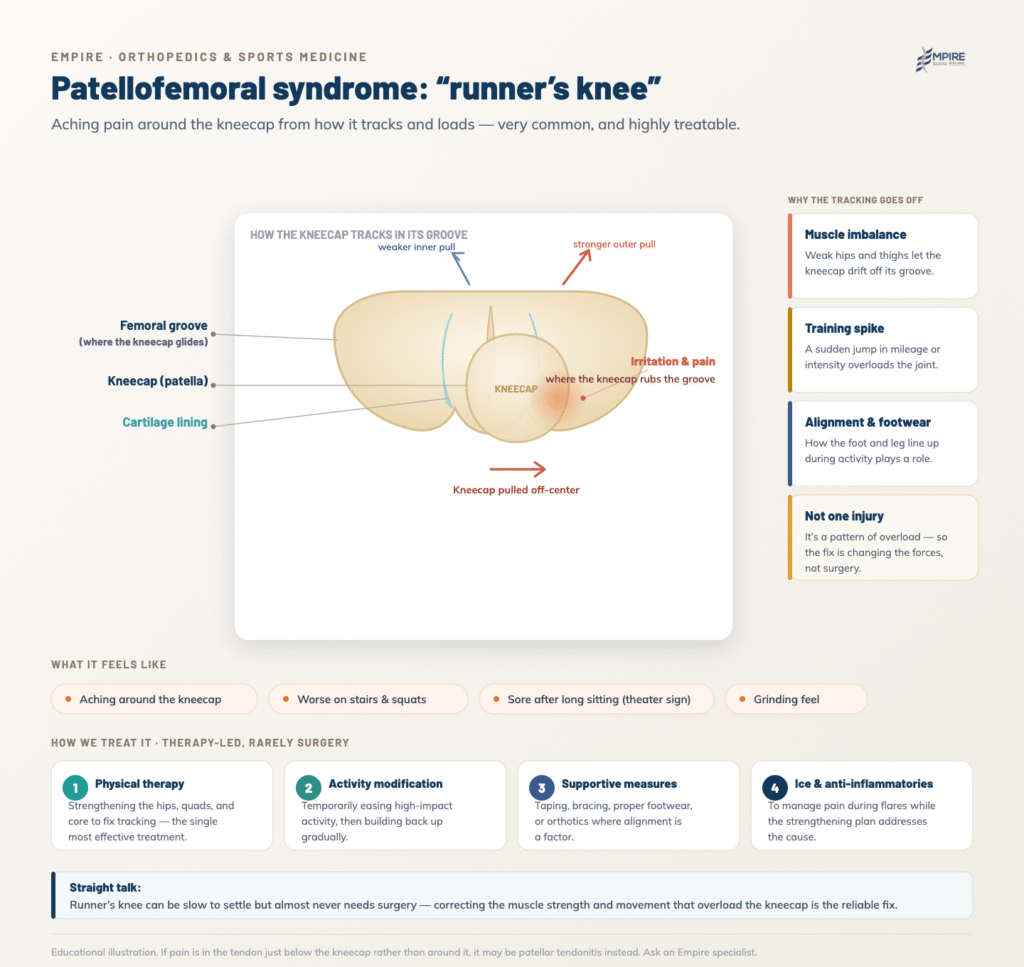
Patellofemoral stress syndrome — better known as “runner’s knee” — is aching pain around or behind the kneecap that flares with running, stairs, squatting, or long sitting. It’s very common and highly treatable, usually without surgery. Our orthopedic and sports medicine team treats it across Long Island and northern New Jersey, with offices in Plainview, New Hyde Park, and Ronkonkoma, NY, and Clifton, Montville, and Plainfield, NJ.
The short version
- Patellofemoral syndrome is pain around or behind the kneecap, related to how the kneecap tracks and loads.
- It’s common in runners and active people, and also from muscle imbalance or overuse.
- Hallmarks are front-knee pain with stairs, squatting, or sitting a long time (the “theater sign”).
- It responds very well to physical therapy and activity changes — surgery is rarely needed.
What patellofemoral syndrome is
Your kneecap glides in a groove at the end of the thigh bone as you bend and straighten the knee. When that tracking is off, or the joint is simply overloaded, the tissue around the kneecap gets irritated and painful. Because it’s not a single structural injury but a pattern of overload, it’s usually treated by changing the forces on the kneecap rather than by surgery.
Contributing factors include muscle imbalance or weakness (especially in the hips and thighs), a sudden increase in training, and biomechanics like how your foot and leg align during activity.
Symptoms
- A dull, aching pain around or behind the kneecap
- Pain that worsens with stairs, squatting, kneeling, or running
- Discomfort after sitting for a long time with the knee bent (the “theater sign”)
- Sometimes a grinding or clicking sensation in the kneecap
How patellofemoral syndrome is treated
The foundation is conservative, and it works well for most people:
- Physical therapy — strengthening the hips, quadriceps, and core to improve how the kneecap tracks is the single most effective treatment.
- Activity modification — temporarily reducing high-impact activity and building back gradually.
- Supportive measures — taping, bracing, proper footwear, or orthotics where alignment is a factor.
- Ice and anti-inflammatories — to manage pain during flares.
Straight talk: Runner’s knee can be frustrating and slow to settle, but it almost never needs surgery. The reliable fix is correcting the muscle strength and movement patterns that overload the kneecap — which takes a bit of patience and a good therapy plan.
Are you a candidate for treatment?
It’s worth being evaluated when:
- You have ongoing front-knee pain with stairs, squatting, or activity
- Home care and rest haven’t resolved it
- The pain keeps returning when you get back to running or sport
- You want a plan to fix the underlying cause, not just the symptoms
Related conditions
If your pain is specifically in the tendon just below the kneecap rather than around it, see our patellar tendonitis page, or return to our knee pain overview.
Why patients across Long Island and North Jersey choose Empire
We’re a local orthopedic and sports medicine practice, so your evaluation, therapy, and follow-up all happen close to home with the same team.
- New York: Plainview, New Hyde Park, and Ronkonkoma — across Nassau and Suffolk
- New Jersey: Clifton, Montville, and Plainfield — serving Passaic, Morris, and Union County communities
- Orthopedics and sports medicine under one roof
- Conservative, therapy-led care that fixes the root cause
Insurance
Coverage varies by plan and by location, and we accept many major insurance plans across our New York and New Jersey offices. The simplest way to know exactly what your plan covers is to call — our team will verify your benefits before your visit, so there are no surprises. Whether you’re on Long Island or in North Jersey, reach out and we’ll walk you through your options.
Frequently asked questions
What causes runner’s knee?
It’s usually a combination of overload and how the kneecap tracks — often linked to muscle imbalance or weakness in the hips and thighs, a spike in training, or biomechanics. It’s rarely a single structural injury.
How is it treated?
Mainly with physical therapy to strengthen the hips and thighs, plus activity changes and supportive measures. This resolves the large majority of cases.
Do I need surgery?
Almost never. Patellofemoral syndrome responds to conservative care in nearly all cases. Surgery is a rare last resort for specific structural problems.
Can I keep running?
Often you can continue some activity while reducing the load that flares it, then build back gradually. Your therapist will help you find the right balance.
Why does my knee hurt after sitting?
Sitting with the knee bent for a long time loads the kneecap, which is why pain after a movie or long drive — the “theater sign” — is a classic feature of this condition.
How long until it gets better?
Many people improve within several weeks of consistent therapy, though it varies. Sticking with the strengthening program is what makes the improvement last.
Aching pain around your kneecap?
Our orthopedic and sports medicine team sees patients across Long Island, NY and northern New Jersey. We’ll confirm it’s runner’s knee and build a plan to fix the cause.
New York: 516-229-1443 | New Jersey: 732-630-7246
JG
Medically reviewed by Dr. Jeffrey Guttman, M.D. — Board-certified Orthopedic & Sports Medicine Surgeon
Last reviewed July 2026 · Empire Minimally Invasive Spine & Pain
What Our Patients Say
Our Plainview office has moved
Find us at our new location:
520 Old Country Rd
Plainview, NY 11803
Same doctors, same phone numbers.
Most Major Plans,
No-Fault & Personal Injury.
We accept most major insurance plans across our New York and New Jersey offices. Select your state to see accepted plans.
Accepted at our New York Locations
Workers' Compensation
No-Fault (NY & NJ)
Lien Cases
Medicare
Empire BCBS
BCBS / Anthem
Cigna
Aetna
Empire NYSHIP
Oxford (PPO)
United Health Care
GHI / Emblem Health
Humana (PPO)
Magnacare (PPO)
Northwell Direct
1199 SEIU
Self Pay
Accepted at our New Jersey Locations
No-Fault (NJ)
Lien Cases
Horizon BCBS
Empire NYSHIP
BCBS / Anthem (PPO)
Cigna
Aetna (PPO)
GHI / Emblem (PPO)
Port Authority UHC
Verizon Plan
Carpenter & Trade Unions
Self Pay
Medicare, Medicaid and Workers' Compensation are not accepted at our New Jersey locations. Not sure about your plan? Call us and we'll verify before your visit.
Not sure about your plan?
Call Us — 516-229-1443
Verify Your Coverage for FREE
Enter your information and our team will confirm your benefits before your visit.
✓ HIPAA Compliant
✓ No Obligation
✓ Same-Day Response
Your information is encrypted and secure. By submitting, you consent to receive communications regarding your appointment. You may opt out at any time.
Meet Our Pain Management & Orthopedic Specialists
Board-certified physicians dedicated to accurate diagnosis and minimally invasive care.

Pain Management
John Akhnoukh, M.D.
Board Certified Anesthesiologist & Interventional Pain Management Physician
Visit Profile



Pain Management
James Yu, D.O.
Board Certified Anesthesiologist & Interventional Pain Management Physician
Visit Profile
Pain Management
Benjamin Souferi, D.O.
Fellowship-Trained Interventional Pain Medicine Physician (Cleveland Clinic)
Visit ProfilePain Conditions Affecting Daily Life
Improve your quality of life with our comprehensive approach to pain management
We are dedicated to finding individualized treatment options tailored to fit your needs. Our team is dedicated to helping you lead a productive and active life, free from pain and disruption.
Our Locations
Pain management and orthopedic care across New York and New Jersey.