Lumbar Spinal Fusion
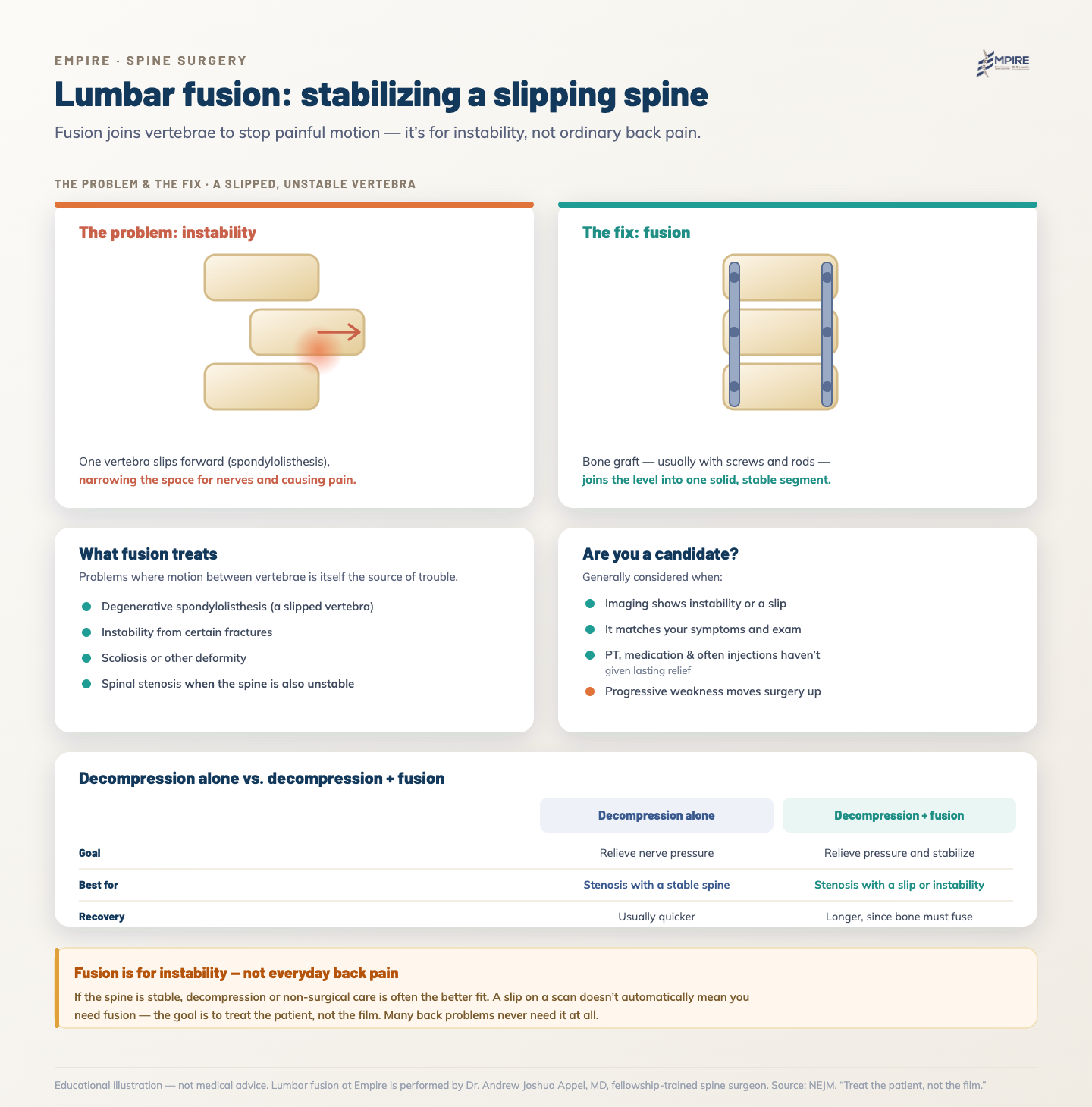
Lumbar fusion is a spine surgery that permanently joins two or more vertebrae in the lower back so they heal into one solid, stable segment. Its job is to stop painful, abnormal motion — so it’s used mainly when the spine is unstable or slipping, not for ordinary back pain. Empire’s fellowship-trained spine surgeon, Dr. Andrew Joshua Appel, recommends fusion only when the diagnosis truly calls for it, across our Long Island, New York offices in Plainview, New Hyde Park, and Ronkonkoma.
The short version
- Lumbar fusion joins vertebrae with bone graft, and usually screws and rods, to stop painful motion.
- It’s used for instability — such as spondylolisthesis (a slipped vertebra), certain fractures, or deformity.
- It is not a routine fix for everyday back pain; the diagnosis has to point to instability.
- Recovery is longer than a decompression alone, because the bone has to fuse.
What lumbar fusion treats
Fusion is aimed at problems where movement between vertebrae is itself the source of pain or nerve trouble. The most common reason is degenerative spondylolisthesis — when one vertebra slips forward on another and narrows the space for the nerves. It’s also used for instability from certain fractures, scoliosis or other deformity, and sometimes for spinal stenosis when the spine is also unstable. When stenosis is the problem but the spine is stable, a laminectomy alone is often enough.
Fusion is for instability, not ordinary back pain: If your spine is stable, fusion usually isn’t the answer — decompression or non-surgical care is often a better fit. Research published in the New England Journal of Medicine found that adding fusion to decompression for a slipped vertebra modestly improved quality of life compared with decompression alone, while decompression by itself avoids the added recovery and risks of fusion.
Are you a candidate?
Lumbar fusion is generally considered when imaging shows instability or a slip that matches your symptoms, and when a fair trial of non-surgical care — physical therapy, medication, activity changes, and often epidural steroid injections — hasn’t given lasting relief. Progressive weakness or worsening nerve compression can move surgery up the list. Because a slip on a scan doesn’t automatically mean you need fusion, Dr. Appel confirms your imaging, symptoms, and exam all agree first — the goal is to treat the patient, not the film.
What to expect
During fusion, the surgeon stabilizes the affected level with bone graft and usually screws and rods, often after decompressing the pinched nerves. Minimally invasive approaches can reduce muscle disruption for suitable cases. Because the bone needs time to knit into a solid fusion, recovery is more gradual than a decompression alone — many people are up and walking soon after surgery, with a staged return to activity over several weeks to months and physical therapy along the way.
Decompression alone vs. fusion
| Decompression alone | Decompression + fusion | |
|---|---|---|
| Goal | Relieve nerve pressure | Relieve pressure and stabilize |
| Best for | Stenosis with a stable spine | Stenosis with a slip or instability |
| Recovery | Usually quicker | Longer, since bone must fuse |
Meet your surgeon — Dr. Andrew Joshua Appel, MD
Dr. Appel is a fellowship-trained orthopedic spine surgeon who completed his orthopedic residency and dual fellowships in trauma and spine surgery at Brown University. He favors the least invasive option that solves the problem, guided by his rule: “treat the patient, not the film.”
Why patients across Long Island choose Empire
We’re a local orthopedic and pain practice serving Long Island, New York — your evaluation, surgery, and follow-up happen close to home with the same team.
- New York: Plainview, New Hyde Park, and Ronkonkoma — across Nassau and Suffolk
- Conservative care first; fusion reserved for cases that truly need stabilizing
- Fellowship-trained spine surgery, close to home
Insurance
Coverage varies by plan, and we accept many major insurance plans across our New York offices. Call and our team will verify your benefits before your visit so there are no surprises.
Frequently asked questions
Is lumbar fusion the right fix for back pain?
Not usually on its own. Fusion is aimed at instability — like a slipped vertebra — rather than ordinary back pain. If your spine is stable, other treatments are often a better fit, which is why an accurate diagnosis comes first.
How long is recovery after lumbar fusion?
It’s more gradual than a decompression alone because the bone has to fuse. Many people walk soon after surgery and return to activity in stages over several weeks to months, guided by physical therapy.
Will fusion limit how I move?
Fusing one or two lower-back levels removes motion there, but the rest of the spine compensates, and most people manage daily activities well. Your surgeon will explain what to expect for your case.
Can I avoid fusion?
Often, yes — many back problems never need it. When the spine is stable, decompression or non-surgical care may be enough. Fusion is reserved for genuine instability, and we’ll be honest about whether you need it.
Back pain from a slipped or unstable spine?
Dr. Appel diagnoses whether your pain comes from instability and recommends fusion only when it’s truly warranted, across Long Island, NY.
New York: 516-229-1443
AA
Medically reviewed by Dr. Andrew J. Appel, M.D. — Board-certified Orthopedic Spine Surgeon
Last reviewed July 2026 · Empire Minimally Invasive Spine & Pain
What Our Patients Say
Our Plainview office has moved
Find us at our new location:
520 Old Country Rd
Plainview, NY 11803
Same doctors, same phone numbers.
Most Major Plans,
No-Fault & Personal Injury.
We accept most major insurance plans across our New York and New Jersey offices. Select your state to see accepted plans.
Accepted at our New York Locations
Workers' Compensation
No-Fault (NY & NJ)
Lien Cases
Medicare
Empire BCBS
BCBS / Anthem
Cigna
Aetna
Empire NYSHIP
Oxford (PPO)
United Health Care
GHI / Emblem Health
Humana (PPO)
Magnacare (PPO)
Northwell Direct
1199 SEIU
Self Pay
Accepted at our New Jersey Locations
No-Fault (NJ)
Lien Cases
Horizon BCBS
Empire NYSHIP
BCBS / Anthem (PPO)
Cigna
Aetna (PPO)
GHI / Emblem (PPO)
Port Authority UHC
Verizon Plan
Carpenter & Trade Unions
Self Pay
Medicare, Medicaid and Workers' Compensation are not accepted at our New Jersey locations. Not sure about your plan? Call us and we'll verify before your visit.
Not sure about your plan?
Call Us — 516-229-1443
Verify Your Coverage for FREE
Enter your information and our team will confirm your benefits before your visit.
✓ HIPAA Compliant
✓ No Obligation
✓ Same-Day Response
Your information is encrypted and secure. By submitting, you consent to receive communications regarding your appointment. You may opt out at any time.
Meet Our Pain Management & Orthopedic Specialists
Board-certified physicians dedicated to accurate diagnosis and minimally invasive care.

Pain Management
John Akhnoukh, M.D.
Board Certified Anesthesiologist & Interventional Pain Management Physician
Visit Profile



Pain Management
James Yu, D.O.
Board Certified Anesthesiologist & Interventional Pain Management Physician
Visit Profile

Pain Management
Benjamin Souferi, D.O.
Fellowship-Trained Interventional Pain Medicine Physician (Cleveland Clinic)
Visit ProfilePain Conditions Affecting Daily Life
Improve your quality of life with our comprehensive approach to pain management
We are dedicated to finding individualized treatment options tailored to fit your needs. Our team is dedicated to helping you lead a productive and active life, free from pain and disruption.
Our Locations
Pain management and orthopedic care across New York and New Jersey.