Sciatica Pain Overview
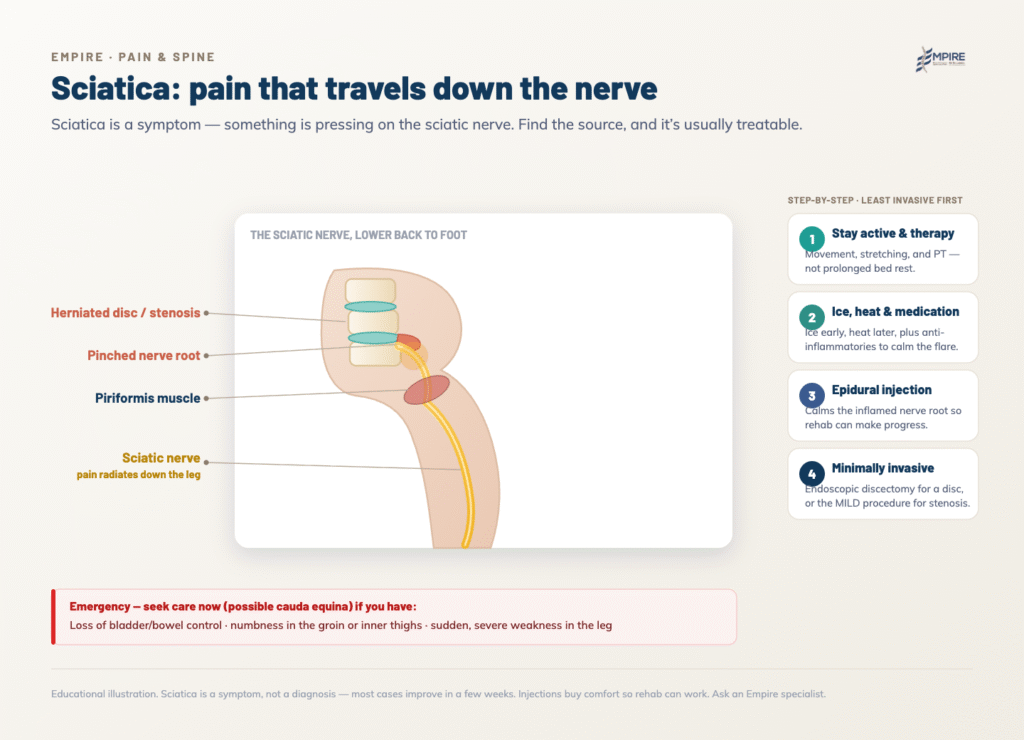
Sciatica is pain that radiates along the sciatic nerve, which runs from your lower back through your hips and buttocks and down each leg. It happens when the sciatic nerve becomes compressed or irritated — often by a herniated disc, a bone spur, spinal stenosis, or piriformis syndrome. This can cause pain, numbness, tingling, or weakness in the lower back, buttocks, and legs, making it hard to stand, walk, or sit comfortably. Our specialists start with a thorough evaluation — a review of your medical history, a physical exam, and imaging such as X-rays, MRI, or CT scans — to find the actual source of the nerve compression before recommending treatment.
The short version
- Sciatica is pain along the sciatic nerve — from the lower back through the buttock and down the leg.
- It’s a symptom, not a diagnosis: something is pressing on the nerve, usually a herniated disc or stenosis.
- Most people recover with staying active, stretching, and conservative care.
- When it persists, an epidural steroid injection often calms the inflamed nerve so rehab can work.
What causes sciatica
Sciatica is a symptom that points to an underlying problem putting pressure on the sciatic nerve or its roots. According to Mayo Clinic, the cause is usually a herniated disc or a bone spur pressing on the nerve roots. Common sources include:
- Herniated or bulging disc — the most common cause; disc material presses on a nerve root
- Spinal stenosis — narrowing of the spinal canal that crowds the nerves
- Bone spurs — from arthritis of the spine
- Piriformis syndrome — a deep buttock muscle irritating the nerve
Because sciatica is a symptom rather than a diagnosis, we start with a thorough evaluation — history, physical exam, and imaging like MRI when needed — to find the actual source of the compression before treating it.
How we treat sciatica — step by step
Most sciatica is handled conservatively, and we escalate only if needed:
- Stay active and use therapy — as Cleveland Clinic and HSS note, most people recover with movement, stretching, and physical therapy. Prolonged bed rest tends to make it worse.
- Ice, heat, and medication — ice early, heat later, plus anti-inflammatories to calm the flare.
- Epidural steroid injection — when leg pain persists, an epidural steroid injection can reduce inflammation around the nerve root and open a window to make progress in rehab.
- Minimally invasive procedures — if a herniated disc is the culprit, endoscopic discectomy can remove the fragment; for stenosis, the MILD procedure relieves pressure without open surgery.
The honest picture: There’s no single “cure” that works for everyone, and sciatica can take weeks to settle. An injection isn’t the whole answer on its own — it buys comfort so you can do the strengthening and movement that produce lasting relief. We’ll be straight with you about what fits your case.
Seek urgent care if: sciatica comes with loss of bladder or bowel control, numbness in the groin or inner thighs, or sudden severe weakness in the leg. These can signal a serious problem (cauda equina) that needs emergency evaluation.
Related conditions
Sciatica often overlaps with other spine problems. See our back pain and spinal nerve pain pages for more on the underlying causes.
Why patients across Long Island and North Jersey choose Empire
We’re a local pain and spine practice, so your evaluation, treatment, and follow-up all happen close to home with the same team.
- New York: Plainview, New Hyde Park, and Ronkonkoma — across Nassau and Suffolk
- New Jersey: Clifton, Montville, and Plainfield — serving Passaic, Morris, and Union County communities
- Interventional pain management and spine care under one roof
- A conservative-first approach that finds the true source of the nerve pain
Insurance
Coverage varies by plan and by location, and we accept many major insurance plans across our New York and New Jersey offices. The simplest way to know exactly what your plan covers is to call — our team will verify your benefits before your visit, so there are no surprises. Whether you’re on Long Island or in North Jersey, reach out and we’ll walk you through your options.
Frequently asked questions
What helps sciatica immediately?
For a flare, ice in the first couple of days, gentle movement rather than bed rest, and an over-the-counter anti-inflammatory usually help most. Staying reasonably active tends to speed recovery.
What’s the worst thing you can do for sciatica?
Prolonged bed rest and staying completely still. Gentle activity and stretching generally help sciatica settle faster than immobility.
What’s the most successful treatment for sciatica?
It depends on the cause. Most cases respond to activity, therapy, and time; persistent cases often respond well to an epidural steroid injection, and disc- or stenosis-related sciatica may benefit from a minimally invasive procedure. Matching treatment to the source is what works.
What’s the best sleeping position for sciatica?
Many people are most comfortable on their side with a pillow between the knees, or on their back with a pillow under the knees, to reduce pressure on the nerve.
How long does sciatica last?
Many cases improve within a few weeks. If yours lasts longer, keeps returning, or the leg is getting weaker, it’s worth an evaluation to find and treat the source.
When is sciatica an emergency?
Loss of bladder or bowel control, groin numbness, or sudden significant leg weakness require emergency care. Otherwise, persistent or worsening sciatica warrants a scheduled evaluation.
Pain shooting down your leg?
Our pain and spine specialists see patients across Long Island, NY and northern New Jersey. We’ll find what’s pressing on the nerve and start you on the least invasive treatment that works.
New York: 516-229-1443 | New Jersey: 732-630-7246
JA
Medically reviewed by Dr. John Akhnoukh, M.D. — Board-certified in Anesthesiology & Interventional Pain Management
Last reviewed July 2026 · Empire Minimally Invasive Spine & Pain
What Our Patients Say
Medicare, Workers Comp,
No Fault & Others.
We accept most major insurance plans across our New York and New Jersey offices. Select your state to see accepted plans.
Accepted at our New York Locations
Workers' Compensation
No-Fault (NY & NJ)
Lien Cases
Medicare
Empire BCBS
BCBS / Anthem
Cigna
Aetna
Empire NYSHIP
Oxford (PPO)
United Health Care
GHI / Emblem Health
Humana (PPO)
Magnacare (PPO)
Northwell Direct
1199 SEIU
Self Pay
Accepted at our New Jersey Locations
Workers' Compensation
No-Fault (NJ)
Lien Cases
Horizon BCBS
Empire NYSHIP
BCBS / Anthem (PPO)
Cigna
Aetna (PPO)
GHI / Emblem (PPO)
Port Authority UHC
Verizon Plan
Carpenter & Trade Unions
Self Pay
Medicare and Medicaid are not accepted at our New Jersey locations. Not sure about your plan? Call us and we'll verify before your visit.
Not sure about your plan?
Call Us — 516-229-1443
Verify Your Coverage for FREE
Enter your information and our team will confirm your benefits before your visit.
✓ HIPAA Compliant
✓ No Obligation
✓ Same-Day Response
Your information is encrypted and secure. By submitting, you consent to receive communications regarding your appointment. You may opt out at any time.
Meet Our Pain Management & Orthopedic Specialists
Board-certified physicians dedicated to accurate diagnosis and minimally invasive care.

Pain Management
John Akhnoukh, M.D.
Board Certified Anesthesiologist & Interventional Pain Management Physician
Visit Profile



Pain Management
James Yu, D.O.
Board Certified Anesthesiologist & Interventional Pain Management Physician
Visit Profile

Pain Management
Benjamin Souferi, D.O.
Fellowship-Trained Interventional Pain Medicine Physician (Cleveland Clinic)
Visit ProfilePain Conditions Affecting Daily Life
Improve your quality of life with our comprehensive approach to pain management
We are dedicated to finding individualized treatment options tailored to fit your needs. Our team is dedicated to helping you lead a productive and active life, free from pain and disruption.
Our Locations
Pain management and orthopedic care across New York and New Jersey.