Cubital Tunnel Syndrome Pain & Treatment
Cubital tunnel syndrome happens when the ulnar nerve is compressed or irritated as it passes through the cubital tunnel at the inside of the elbow. Call us today to make an appointment — we serve patients across New York and New Jersey, including communities such as Plainview, Ronkonkoma, New Hyde Park, Montville, Clifton and Plainfield.
Cubital Tunnel Syndrome Overview
Cubital tunnel syndrome happens when the ulnar nerve — the same nerve behind your “funny bone” — gets compressed or irritated at the inner elbow. It causes tingling, numbness, and weakness in the hand, and catching it early matters. Our orthopedic and sports medicine team treats it across Long Island and northern New Jersey, with offices in Plainview, New Hyde Park, and Ronkonkoma, NY, and Clifton, Montville, and Plainfield, NJ.
The short version
- Cubital tunnel syndrome is compression of the ulnar nerve at the inside of the elbow.
- It causes tingling and numbness in the ring and little fingers, often worse when the elbow is bent.
- Mild cases usually improve with activity changes, bracing, and splinting — especially at night.
- Persistent or worsening cases, or those with muscle weakness, may need a surgical release.
What cubital tunnel syndrome is
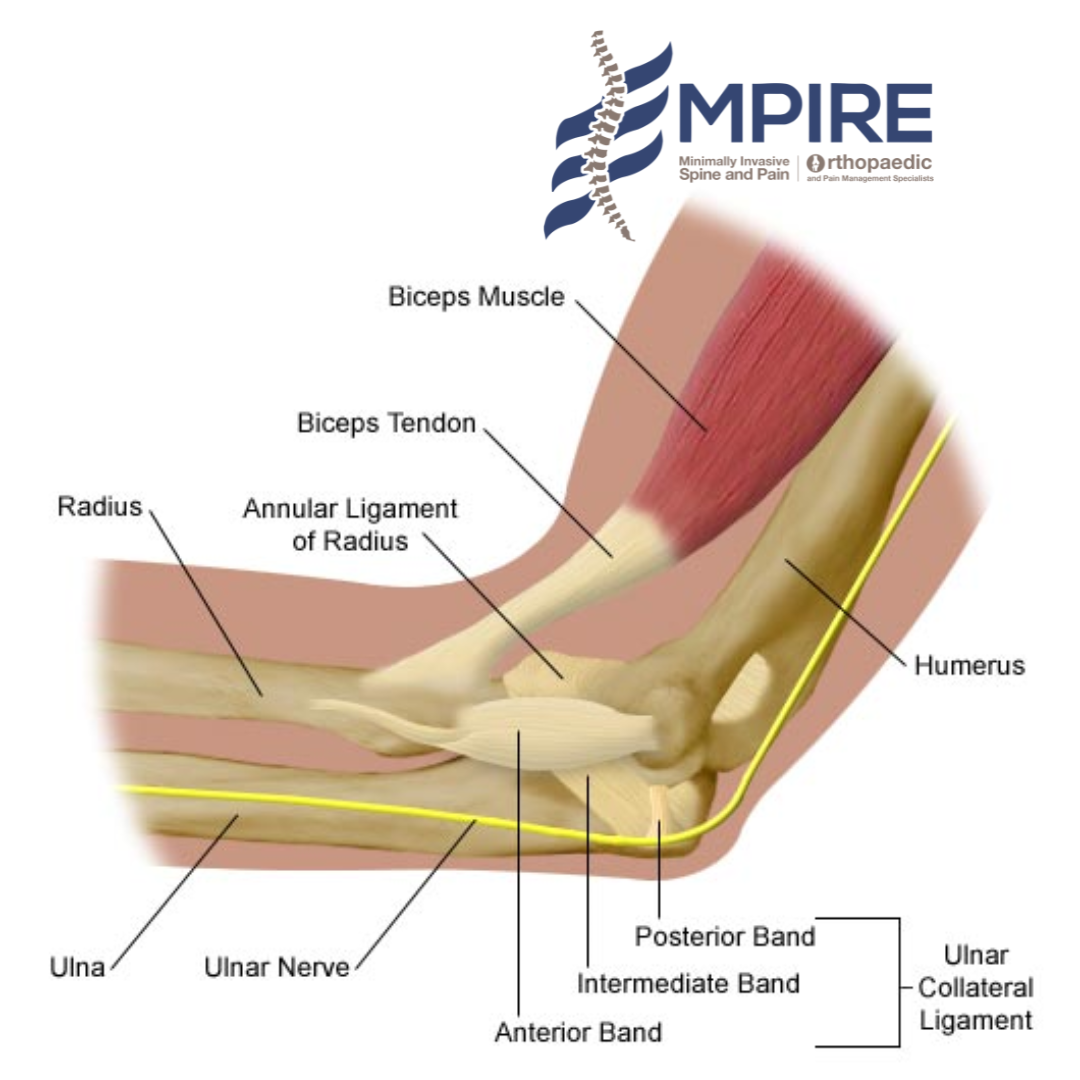
The ulnar nerve runs along the inside of your elbow through a narrow passage called the cubital tunnel. When it’s compressed or stretched there — often from leaning on the elbow, keeping it bent for long periods, or repetitive bending — it can’t send signals properly. That produces tingling, numbness, and eventually weakness in the parts of the hand the nerve supplies.
It’s a nerve problem, not a tendon problem, which is why it’s treated differently from tennis or golfer’s elbow. Classic symptoms include tingling or numbness in the ring and little fingers, pain on the inner elbow, a weakening grip, and symptoms that flare when the elbow is bent — such as while holding a phone or sleeping.
How cubital tunnel syndrome is treated
Treatment depends on how severe the compression is and whether there’s muscle weakness:
- Activity changes — avoiding leaning on the elbow and reducing prolonged or repeated elbow bending.
- Bracing or night splinting — keeping the elbow from bending too much, especially during sleep, is often very effective for milder cases.
- Physical therapy — nerve-gliding exercises and activity guidance can help.
- Surgical release — if symptoms persist, worsen, or there’s muscle weakness or wasting, a procedure to relieve pressure on the ulnar nerve may be recommended.
Why early evaluation matters: Unlike a tendon strain, an ongoing nerve compression can, over time, lead to lasting weakness or muscle wasting in the hand if it’s not addressed. If you have persistent numbness or a weakening grip, it’s worth getting evaluated sooner rather than later.
Seek prompt care if: you notice progressive weakness in the hand, difficulty with fine movements (like buttoning a shirt), or visible thinning of the hand muscles. These signal the nerve compression may be advancing and need timely evaluation.
Related conditions
Cubital tunnel is a nerve-compression problem, closely related to carpal tunnel syndrome (which compresses a different nerve at the wrist). If your elbow pain is tendon-related instead, see our tennis elbow and golfer’s elbow pages, or return to our elbow pain overview.
Why patients across Long Island and North Jersey choose Empire
We’re a local orthopedic and pain practice, so your evaluation, treatment, and follow-up all happen close to home with the same team.
- New York: Plainview, New Hyde Park, and Ronkonkoma — across Nassau and Suffolk
- New Jersey: Clifton, Montville, and Plainfield — serving Passaic, Morris, and Union County communities
- Orthopedics, sports medicine, and interventional pain under one roof
- Full range of care from splinting to surgical release
Insurance
Coverage varies by plan and by location, and we accept many major insurance plans across our New York and New Jersey offices. The simplest way to know exactly what your plan covers is to call — our team will verify your benefits before your visit, so there are no surprises. Whether you’re on Long Island or in North Jersey, reach out and we’ll walk you through your options.
Frequently asked questions
What does cubital tunnel syndrome feel like?
Tingling or numbness in the ring and little fingers, pain on the inner elbow, and a weakening grip. Symptoms often flare when the elbow is bent, such as when holding a phone or sleeping.
How is it different from carpal tunnel?
Both are nerve compressions, but in different places: cubital tunnel compresses the ulnar nerve at the elbow (ring and little fingers), while carpal tunnel compresses the median nerve at the wrist (thumb, index, and middle fingers).
Can cubital tunnel syndrome heal without surgery?
Mild cases often improve with activity changes and night splinting to keep the elbow from bending too much. Surgery is considered when symptoms persist, worsen, or there’s muscle weakness.
Why are my symptoms worse at night?
Many people sleep with the elbow bent, which stretches and compresses the ulnar nerve. A night splint that keeps the elbow straighter often helps significantly.
What happens if it’s left untreated?
Ongoing compression can lead to lasting weakness or muscle wasting in the hand. That’s why persistent numbness or a weakening grip should be evaluated promptly.
How is it diagnosed?
Through your history, a physical exam, and often a nerve conduction study to measure how well the ulnar nerve is working and how severe the compression is.
Tingling or numbness in your ring and little fingers?
Our orthopedic and sports medicine team sees patients across Long Island, NY and northern New Jersey. We’ll assess the nerve and recommend the right treatment — from splinting to release.
New York: 516-229-1443 | New Jersey: 732-630-7246
SC
Medically reviewed by Dr. Salvatore Corso, M.D. — Board-certified Orthopedic & Sports Medicine Surgeon
Last reviewed July 2026 · Empire Minimally Invasive Spine & Pain
What Our Patients Say
Medicare, Workers Comp,
No Fault & Others.
We accept most major insurance plans across our New York and New Jersey offices. Select your state to see accepted plans.
Accepted at our New York Locations
Workers' Compensation
No-Fault (NY & NJ)
Lien Cases
Medicare
Empire BCBS
BCBS / Anthem
Cigna
Aetna
Empire NYSHIP
Oxford (PPO)
United Health Care
GHI / Emblem Health
Humana (PPO)
Magnacare (PPO)
Northwell Direct
1199 SEIU
Self Pay
Accepted at our New Jersey Locations
Workers' Compensation
No-Fault (NJ)
Lien Cases
Horizon BCBS
Empire NYSHIP
BCBS / Anthem (PPO)
Cigna
Aetna (PPO)
GHI / Emblem (PPO)
Port Authority UHC
Verizon Plan
Carpenter & Trade Unions
Self Pay
Medicare and Medicaid are not accepted at our New Jersey locations. Not sure about your plan? Call us and we'll verify before your visit.
Not sure about your plan?
Call Us — 516-229-1443
Verify Your Coverage for FREE
Enter your information and our team will confirm your benefits before your visit.
✓ HIPAA Compliant
✓ No Obligation
✓ Same-Day Response
Your information is encrypted and secure. By submitting, you consent to receive communications regarding your appointment. You may opt out at any time.
Meet Our Pain Management & Orthopedic Specialists
Board-certified physicians dedicated to accurate diagnosis and minimally invasive care.

Pain Management
John Akhnoukh, M.D.
Board Certified Anesthesiologist & Interventional Pain Management Physician
Visit Profile



Pain Management
James Yu, D.O.
Board Certified Anesthesiologist & Interventional Pain Management Physician
Visit Profile

Pain Management
Benjamin Souferi, D.O.
Fellowship-Trained Interventional Pain Medicine Physician (Cleveland Clinic)
Visit ProfilePain Conditions Affecting Daily Life
Improve your quality of life with our comprehensive approach to pain management
We are dedicated to finding individualized treatment options tailored to fit your needs. Our team is dedicated to helping you lead a productive and active life, free from pain and disruption.
Our Locations
Pain management and orthopedic care across New York and New Jersey.