Trigger Point Injections Treatment Near You
Trigger point injections (TPIs) are a type of medical treatment used to alleviate pain and muscle spasms. Call us today to make an appointment for trigger point injections treatment we serve patients across New York and New Jersey, including communities such as Plainview, Ronkonkoma, New Hyde Park, Clifton Montville, and Plainfield.
Trigger Point Injections Overview
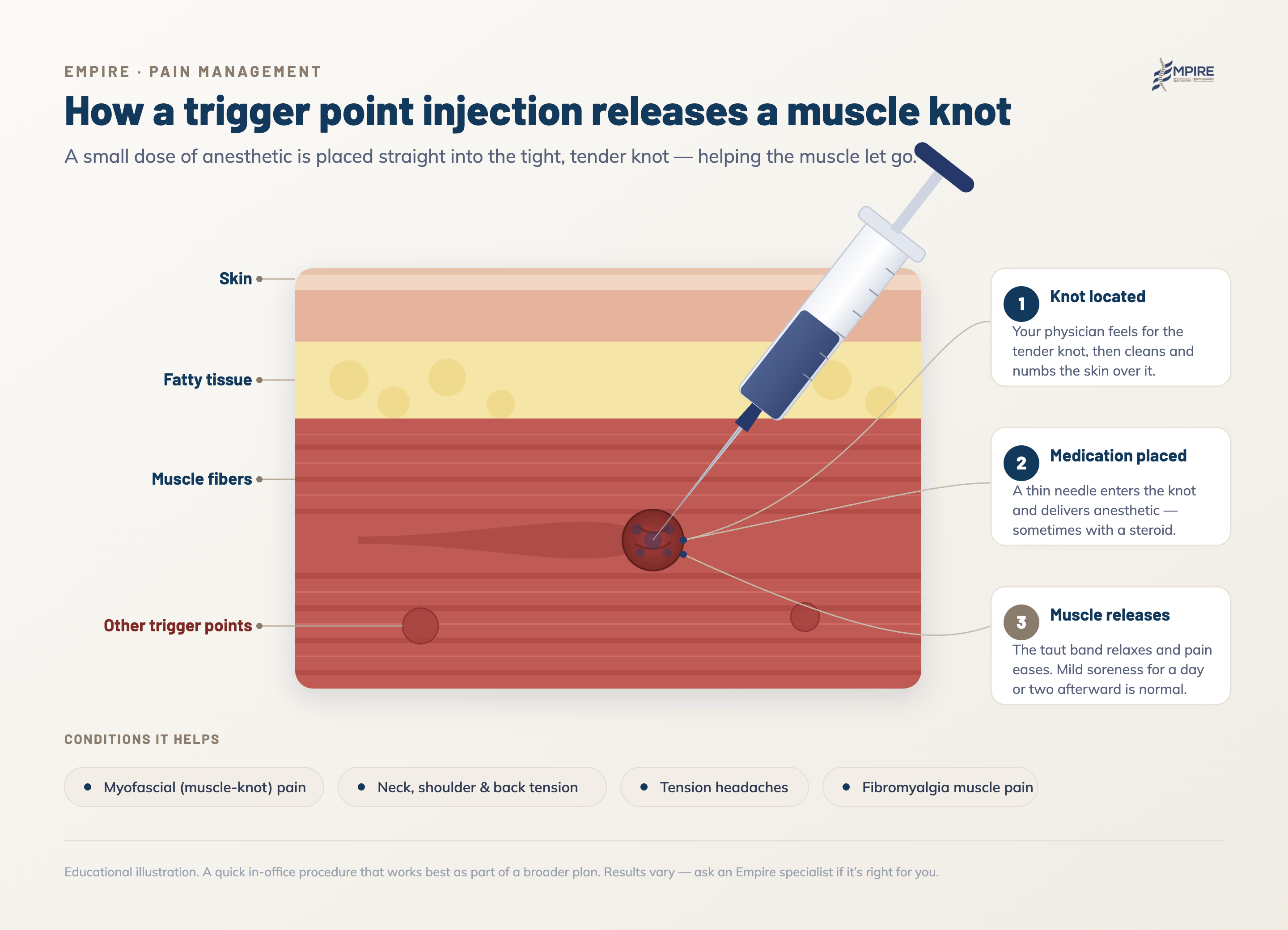
Trigger point injections (TPIs) are a type of medical treatment used to alleviate pain and muscle spasms. A trigger point is a tight area within a muscle that can cause pain in other parts of the body when pressed. TPIs involves injecting a small anesthetic medication and sometimes a corticosteroid into the trigger point to relax the muscle and reduce pain.
When a tight, painful “knot” in a muscle won’t let go — in your neck, shoulders, or back — a trigger point injection can help relax the muscle and quiet the pain. Our physicians offer trigger point injections across Long Island and northern New Jersey, with offices in Plainview, New Hyde Park, and Ronkonkoma, NY, and Clifton, Montville, and Plainfield, NJ.
The short version
- A trigger point injection puts a small amount of local anesthetic (sometimes with a steroid) into a painful muscle knot.
- It’s used for myofascial pain — muscle-knot pain — in the neck, shoulders, and back, and related conditions.
- It’s a quick, in-office procedure that takes only a few minutes.
- Some soreness for a day or two afterward is normal, and it works best as part of a broader plan.
What trigger point injections treat
A trigger point is a tight, tender knot within a muscle. Press on it and it can hurt right there — and sometimes refer pain to another area. This kind of muscle-knot pain is called myofascial pain. A trigger point injection delivers a small amount of local anesthetic, sometimes combined with a steroid, directly into the knot to help the muscle relax and reduce the pain.
As Cleveland Clinic and Hospital for Special Surgery describe, these injections are used for painful, palpable knots in the muscle tissue of the neck, shoulders, and back. They’re also used for related problems such as tension headaches, myofascial pain syndrome, and muscle pain associated with fibromyalgia.
Are you a candidate?
Trigger point injections may be worth discussing when:
- You have one or more tender muscle knots causing ongoing pain
- The pain hasn’t settled with stretching, therapy, or medication
- Your physician can feel a distinct trigger point on exam
- You want a targeted step alongside physical therapy and activity changes
According to NIH’s StatPearls reference, trigger point injections can be an effective primary or add-on therapy for musculoskeletal pain — but they aren’t right for everyone, and your physician will confirm whether they fit your situation.
What to expect
The procedure is quick and done in-office. Your physician locates the trigger point by feel, cleans and numbs the skin, and inserts a thin needle into the knot to inject the medication. Several trigger points can sometimes be treated in one visit. The whole thing usually takes just a few minutes, and there’s typically no downtime.
Worth knowing: It’s common to feel some soreness at the injection site for a day or two — occasionally the area feels a bit worse before it feels better as the muscle settles. That’s a normal part of the process, not a sign something went wrong. Applying ice and gentle movement usually helps.
Why patients across Long Island and North Jersey choose Empire
We’re a local pain and orthopedic practice, so your evaluation, injection, and follow-up all happen close to home with the same team.
- New York: Plainview, New Hyde Park, and Ronkonkoma — across Nassau and Suffolk
- New Jersey: Clifton, Montville, and Plainfield — serving Passaic, Morris, and Union County communities
- Interventional pain management and orthopedics under one roof
- A step-by-step approach that pairs injections with the rest of your plan
Insurance
Coverage varies by plan and by location, and we accept many major insurance plans across our New York and New Jersey offices. The simplest way to know exactly what your plan covers is to call — our team will verify your benefits before your visit, so there are no surprises. Whether you’re on Long Island or in North Jersey, reach out and we’ll walk you through your options.
Frequently asked questions
Do trigger point injections hurt?
The skin is numbed first, so most people tolerate it well. You may feel a brief cramp or twitch as the needle reaches the knot, and some soreness afterward is normal.
Why might I feel worse before better?
Temporary soreness at the injection site for a day or two is common as the muscle settles. Ice and gentle movement usually help, and it typically eases on its own.
How is this different from a cortisone shot?
A trigger point injection targets a specific muscle knot, usually with local anesthetic and sometimes a small amount of steroid. A standard cortisone shot is aimed mainly at reducing inflammation in a joint or tendon. They serve different purposes.
How many can I have at once?
Several trigger points can sometimes be treated in a single visit. Your physician will decide how many is appropriate for you.
What conditions do they help?
Mainly myofascial (muscle-knot) pain in the neck, shoulders, and back, plus related problems like tension headaches, myofascial pain syndrome, and fibromyalgia-related muscle pain.
Who should not get them?
They aren’t right for everyone. Your physician will review your health history and let you know if a trigger point injection is a suitable option for you.
Stubborn muscle knots that won’t release?
Our physicians see patients across Long Island, NY and northern New Jersey. We’ll examine the painful area and tell you whether a trigger point injection is a sensible step for you.
New York: 516-229-1443 | New Jersey: 732-630-7246
Related reading: Trigger Point Injections for Muscle Pain: What to Expect
JA
Medically reviewed by Dr. John Akhnoukh, M.D. — Board-certified in Anesthesiology & Interventional Pain Management
Last reviewed July 2026 · Empire Minimally Invasive Spine & Pain
What Our Patients Say
Medicare, Workers Comp,
No Fault & Others.
We accept most major insurance plans across our New York and New Jersey offices. Select your state to see accepted plans.
Accepted at our New York Locations
Workers' Compensation
No-Fault (NY & NJ)
Lien Cases
Medicare
Empire BCBS
BCBS / Anthem
Cigna
Aetna
Empire NYSHIP
Oxford (PPO)
United Health Care
GHI / Emblem Health
Humana (PPO)
Magnacare (PPO)
Northwell Direct
1199 SEIU
Self Pay
Accepted at our New Jersey Locations
Workers' Compensation
No-Fault (NJ)
Lien Cases
Horizon BCBS
Empire NYSHIP
BCBS / Anthem (PPO)
Cigna
Aetna (PPO)
GHI / Emblem (PPO)
Port Authority UHC
Verizon Plan
Carpenter & Trade Unions
Self Pay
Medicare and Medicaid are not accepted at our New Jersey locations. Not sure about your plan? Call us and we'll verify before your visit.
Not sure about your plan?
Call Us — 516-229-1443
Verify Your Coverage for FREE
Enter your information and our team will confirm your benefits before your visit.
✓ HIPAA Compliant
✓ No Obligation
✓ Same-Day Response
Your information is encrypted and secure. By submitting, you consent to receive communications regarding your appointment. You may opt out at any time.
Meet Our Pain Management & Orthopedic Specialists
Board-certified physicians dedicated to accurate diagnosis and minimally invasive care.

Pain Management
John Akhnoukh, M.D.
Board Certified Anesthesiologist & Interventional Pain Management Physician
Visit Profile



Pain Management
James Yu, D.O.
Board Certified Anesthesiologist & Interventional Pain Management Physician
Visit Profile

Pain Management
Benjamin Souferi, D.O.
Fellowship-Trained Interventional Pain Medicine Physician (Cleveland Clinic)
Visit ProfilePain Conditions Affecting Daily Life
Improve your quality of life with our comprehensive approach to pain management
We are dedicated to finding individualized treatment options tailored to fit your needs. Our team is dedicated to helping you lead a productive and active life, free from pain and disruption.
Our Locations
Pain management and orthopedic care across New York and New Jersey.