Endoscopic Discectomy: Minimally Invasive Relief for Herniated Discs
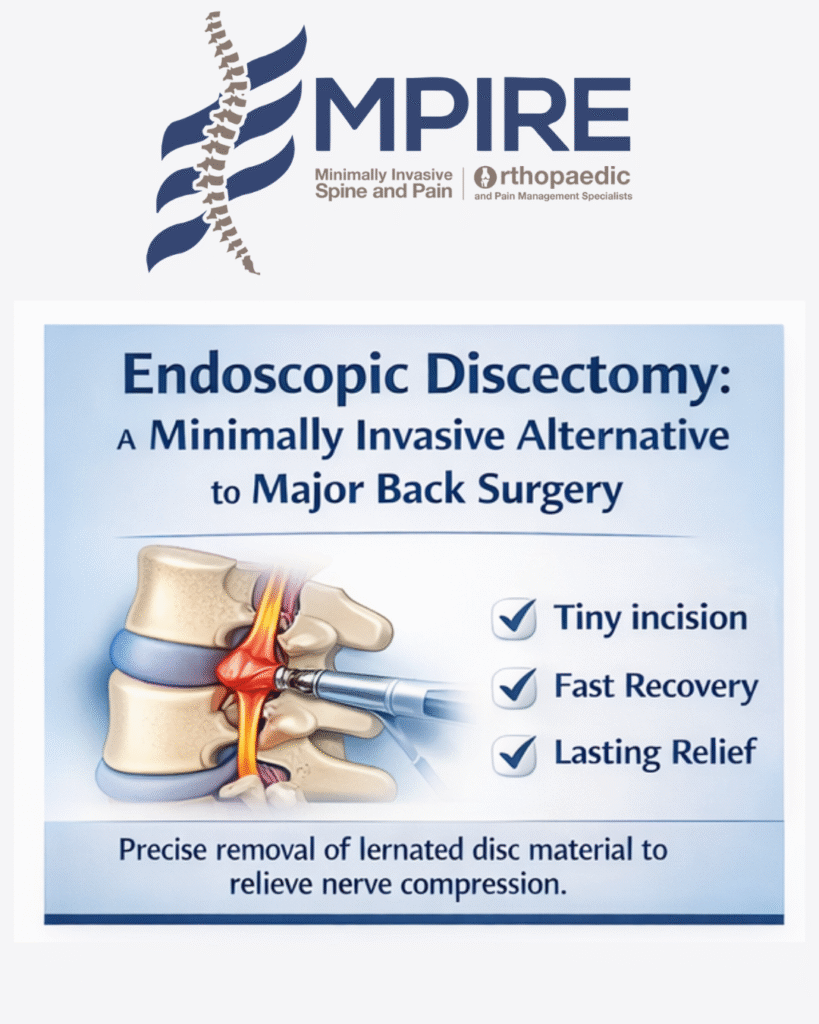
Endoscopic discectomy is a minimally invasive spine procedure that relieves herniated disc pain without the risks of traditional open back surgery. Through a tiny incision, compressed nerves are precisely decompressed while preserving surrounding muscle and tissue — leading to less pain, faster recovery, and often same-day mobility. At Empire Minimally Invasive Spine & Pain, patients across New York and New Jersey receive advanced, image-guided endoscopic care focused on restoring function, reducing downtime, and delivering lasting relief.
Herniated disc pain doesn’t always require major back surgery. Endoscopic Discectomy relieves nerve pressure through a tiny incision with faster recovery and less downtime. At Empire Minimally Invasive Spine & Pain, we help NY and NJ patients return to normal life — safely and minimally invasively.
Persistent back or leg pain caused by a herniated disc can disrupt every aspect of daily life — from walking and sleeping to working and driving. Many patients delay care because they fear “major back surgery,” long recovery times, or permanent limitations. Endoscopic discectomy offers a modern, minimally invasive alternative designed to relieve nerve compression while preserving healthy tissue, reducing downtime, and helping patients return to normal life faster. At Empire Minimally Invasive Spine & Pain, we specialize in advanced endoscopic spine procedures for patients across New York and New Jersey, combining precision technology with expert pain management to deliver lasting relief without unnecessary surgery.
What Is an Endoscopic Discectomy?
An endoscopic discectomy is a minimally invasive spine procedure used to remove herniated or damaged disc material that is compressing spinal nerves. Using a thin endoscopic camera, specialized instruments, and real-time imaging, the surgeon accesses the spine through a small incision (often less than 1 cm). Unlike traditional open surgery, muscles are gently separated — not cut — significantly reducing tissue trauma.
What Is Endoscopic Lumbar Discectomy?
An endoscopic lumbar discectomy specifically treats herniated discs in the lower back (L4-L5, L5-S1), which are the most common sources of:
- Sciatica
- Leg pain
- Numbness or tingling
- Weakness or balance issues
This technique allows precise removal of disc material while preserving spinal stability.
What Is Percutaneous Endoscopic Lumbar Discectomy (ELD)?
Endoscopic lumbar discectomy refers to accessing the spine through the skin using ultra-small instruments, often via a transforaminal approach (from the side of the spine).
What Is Transforaminal Discectomy?
This approach allows surgeons to reach the disc without disturbing spinal bones, making it one of the least invasive spine procedures available today.
What Is Endoscopic Laser Discectomy?
Endoscopic laser discectomy uses laser energy in combination with endoscopic tools to reduce disc pressure. While effective in select cases, laser techniques are typically used adjunctively, not as a standalone solution for large herniations. At Empire Spine & Pain, treatment selection is based on disc anatomy, nerve involvement, and symptom severity — not a one-size-fits-all approach.
Is Endoscopic Discectomy a Major Surgery?
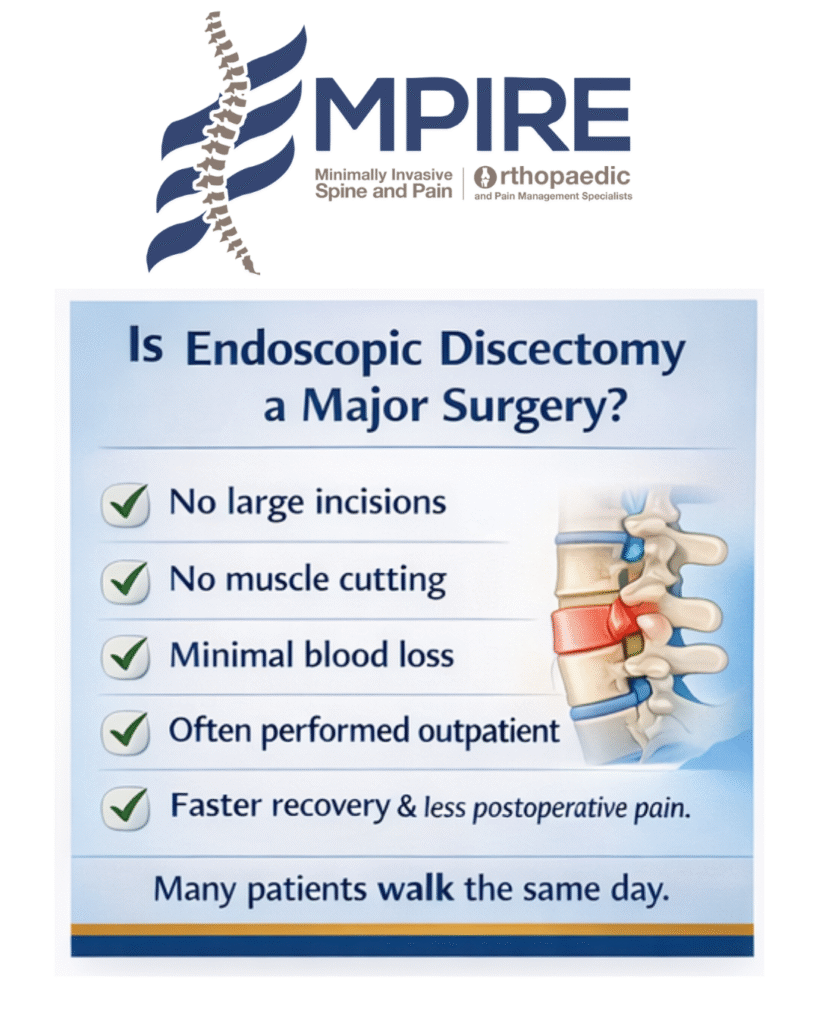
No, its not considered major surgery.
Key differences from traditional surgery:
- No large incisions
- No muscle cutting
- Minimal blood loss
- Often performed outpatient
- Faster recovery and less postoperative pain
Many patients walk the same day.
How Safe Is a Micro Endoscopic Discectomy?
Micro discectomy is considered very safe when performed by experienced specialists.
Safety advantages include:
- Reduced infection risk
- Lower nerve injury rates
- Minimal scarring
- Lower risk of spinal instability
When compared to open discectomy, complication rates are generally equal or lower, especially in experienced hands.
What Is the Success Rate of Endoscopic Spine Surgery?
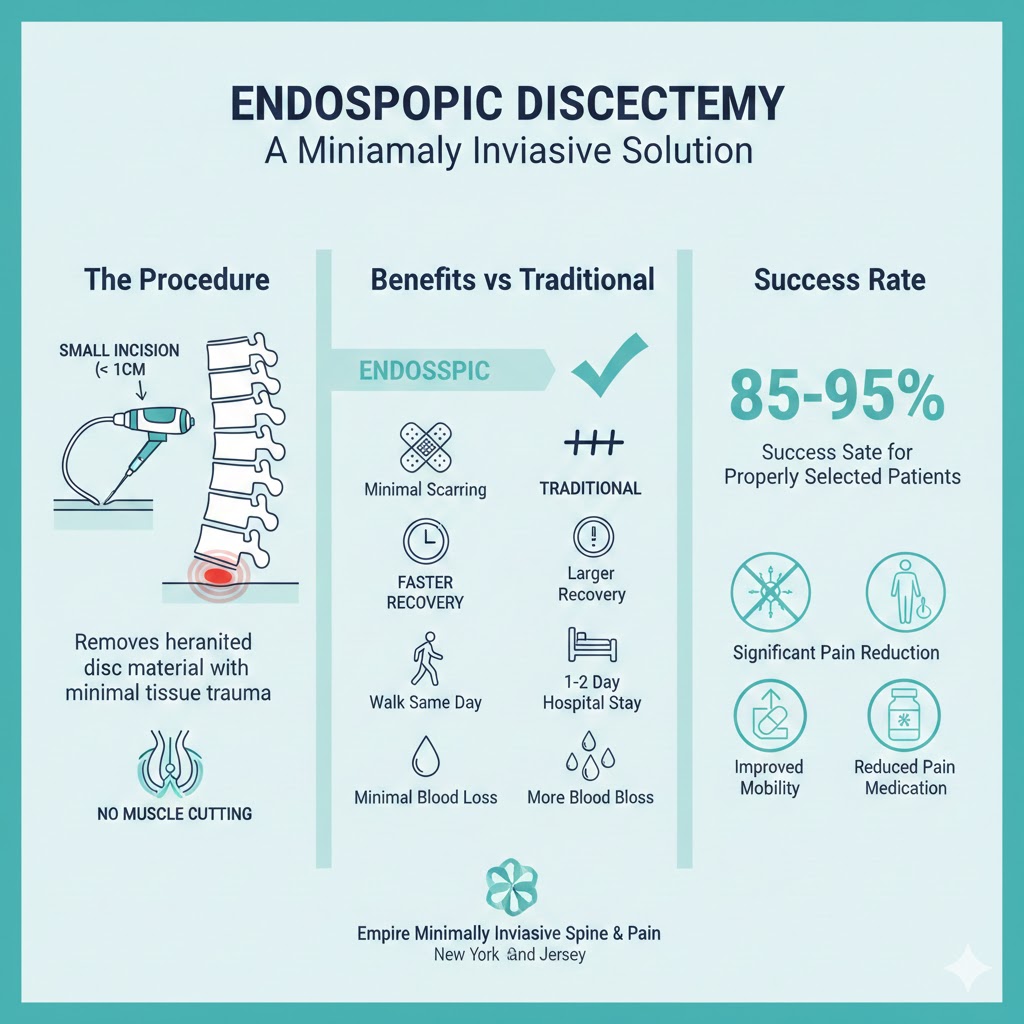
Clinical studies and real-world outcomes show success rates of 85–95% for properly selected patients.
Success means:
- Significant pain reduction
- Improved nerve function
- Increased mobility
- Reduced reliance on pain medication
Can Endoscopic Discectomy Help an Annular Tear?
Yes — in select cases.
If an annular tear is causing disc material to protrude and compress a nerve, endoscopic discectomy can:
- Remove the offending disc fragment
- Reduce inflammation
- Allow the annulus to heal naturally
However, isolated annular tears without nerve compression may be treated non-surgically.
Will Endoscopic Discectomy Help Drop Foot or Balance Issues?
If drop foot or balance problems are caused by nerve compression from a disc herniation, early endoscopic decompression can improve outcomes.
⚠️ Timing matters.Long-standing nerve damage may not fully reverse, which is why early evaluation is critical.
Who Is a Good Candidate for Endoscopic Discectomy?
You may be a good candidate if you have:
- Herniated lumbar disc
- Sciatica or leg pain
- Nerve compression symptoms
- Failed conservative treatment
- Desire to avoid open surgery
Who Cannot Have Endoscopic Discectomy?
Not ideal for:
- Severe spinal instability
- Large deformities
- Certain infections or tumors
A detailed evaluation determines eligibility.
What Is Recovery Time After Endoscopic Discectomy?
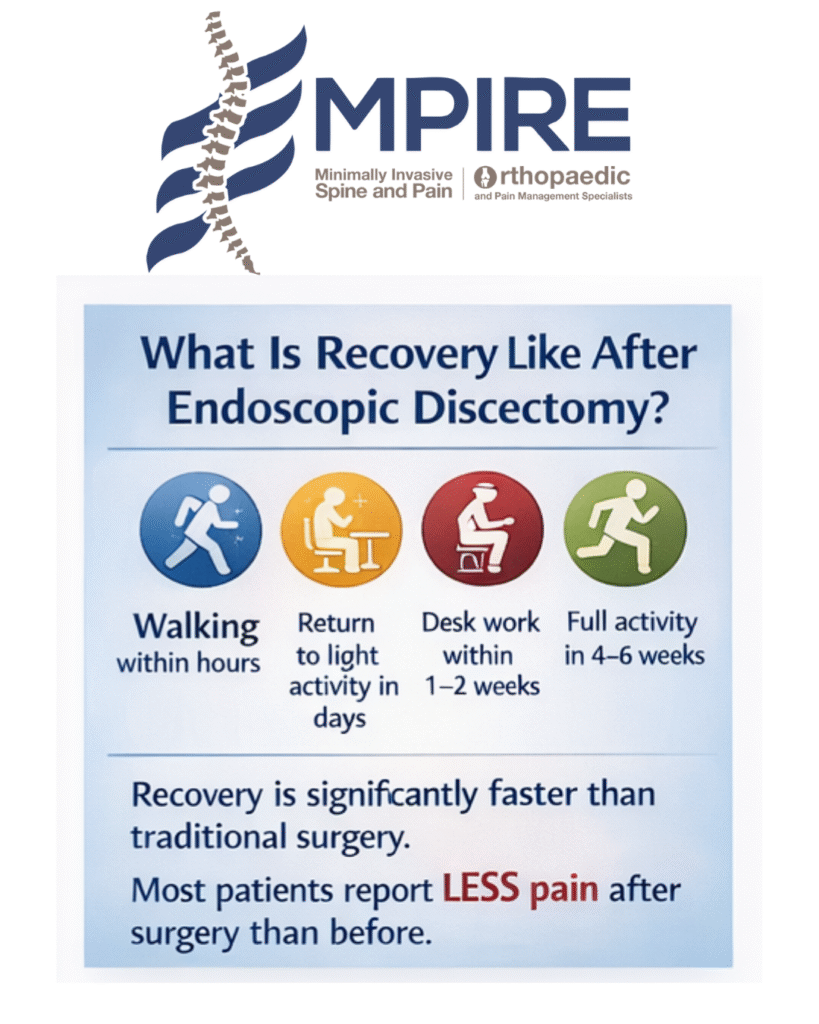
Most patients experience:
- Walking within hours
- Return to light activity in days
- Desk work within 1–2 weeks
- Full activity in 4–6 weeks (case dependent)
Recovery is significantly faster than traditional surgery.
Is Endoscopic Discectomy Painful?
Post-procedure discomfort is usually mild and well-controlled. Many patients report less pain after surgery than before due to immediate nerve decompression.
Endoscopic Discectomy vs Microdiscectomy: Which Is Better?
| Feature | Endoscopic | Microdiscectomy |
|---|---|---|
| Incision | Smaller | Larger |
| Muscle damage | Minimal | Moderate |
| Recovery | Faster | Longer |
| Hospital stay | Often same day | 1–2 days |
| Scarring | Minimal | More |
What Is Endoscopic Lumbar Discectomy
Are There Permanent Restrictions After Discectomy?
Most patients return to normal life. Long-term success depends on:
- Proper rehab
- Core strengthening
- Weight management
- Ergonomic habits
Permanent restrictions are rare.
What Are the Risks of Endoscopic Discectomy?
All procedures carry some risk, though endoscopic techniques minimize them:
- Infection (low)
- Bleeding (minimal)
- Re-herniation
- Temporary nerve irritation
Choosing an experienced center significantly reduces risk.
Why Choose Empire Minimally Invasive Spine & Pain?
Patients across New York and New Jersey choose Empire Spine & Pain because we offer:
✔️ Board-certified spine & pain specialists
✔️ Expertise in advanced endoscopic techniques
✔️ Image-guided precision procedures
✔️ Conservative-first philosophy
✔️ Surgery-avoidance focus
✔️ Personalized treatment planning
We do not rush patients into surgery. Our goal is lasting relief with the least invasive solution possible.
Serving New York & New Jersey Patients
With multiple locations across NY and NJ, we serve both local and out-of-state patients seeking cutting-edge minimally invasive spine care without long hospital stays or extended recovery.
Take the Next Step Toward Relief
If disc pain is limiting your life, endoscopic discectomy may offer the relief you’ve been waiting for — without the risks of traditional surgery. A comprehensive evaluation can determine if you’re a candidate and help you regain mobility, balance, and confidence.

Dr. John Akhnoukh
Articles: 12Medicare, Workers Comp,
No Fault & Others.
We accept most major insurance plans across our New York and New Jersey offices. Select your state to see accepted plans.
Accepted at our New York Locations
Workers' Compensation
No-Fault (NY & NJ)
Lien Cases
Medicare
Empire BCBS
BCBS / Anthem
Cigna
Aetna
Empire NYSHIP
Oxford (PPO)
United Health Care
GHI / Emblem Health
Humana (PPO)
Magnacare (PPO)
Northwell Direct
1199 SEIU
Self Pay
Accepted at our New Jersey Locations
No-Fault (NJ)
Lien Cases
Horizon BCBS
Empire NYSHIP
BCBS / Anthem (PPO)
Cigna
Aetna (PPO)
GHI / Emblem (PPO)
Port Authority UHC
Verizon Plan
Carpenter & Trade Unions
Self Pay
Medicare and Medicaid are not accepted at our New Jersey locations. Not sure about your plan? Call us and we'll verify before your visit.
Not sure about your plan?
Call Us — 516-229-1443
Verify Your Coverage for FREE
Enter your information and our team will confirm your benefits before your visit.
✓ HIPAA Compliant
✓ No Obligation
✓ Same-Day Response
Your information is encrypted and secure. By submitting, you consent to receive communications regarding your appointment. You may opt out at any time.
Meet Our Pain Management & Orthopedic Specialists
Board-certified physicians dedicated to accurate diagnosis and minimally invasive care.

Pain Management
John Akhnoukh, M.D.
Board Certified Anesthesiologist & Interventional Pain Management Physician
Visit Profile



Pain Management
James Yu, D.O.
Board Certified Anesthesiologist & Interventional Pain Management Physician
Visit Profile

Pain Management
Benjamin Souferi, D.O.
Fellowship-Trained Interventional Pain Medicine Physician (Cleveland Clinic)
Visit ProfilePain Conditions Affecting Daily Life
Improve your quality of life with our comprehensive approach to pain management
We are dedicated to finding individualized treatment options tailored to fit your needs. Our team is dedicated to helping you lead a productive and active life, free from pain and disruption.
We use an integrative approach to conduct a comprehensive evaluation and assess your condition.
Physical examination and review of your medical history. We assess the cause of your pain, determine its severity and duration, and help you develop an individualized treatment plan.
We provide a range of treatments and procedures to address your chronic pain. These include nerve blocks, injections, physical therapy, implantable therapies and more. We also offer health education to help you better manage your condition.