Anterior Cervical Discectomy and Fusion (ACDF)
ACDF eases neck-related arm pain, numbness, and weakness by removing a damaged cervical disc and stabilizing that level. Call today to book with Empire Minimally Invasive Spine & Pain, serving patients across Long Island, New York — including Plainview, New Hyde Park, and Ronkonkoma.
If you have neck-related arm pain, numbness, or weakness that hasn’t settled with therapy or injections, it may be coming from a damaged disc in your neck pressing on a nerve — and anterior cervical discectomy and fusion (ACDF) is one of the most reliable ways to fix it. Empire’s fellowship-trained spine surgeon, Dr. Andrew Joshua Appel, performs ACDF across our Long Island, New York offices in Plainview, New Hyde Park, and Ronkonkoma.
The short version
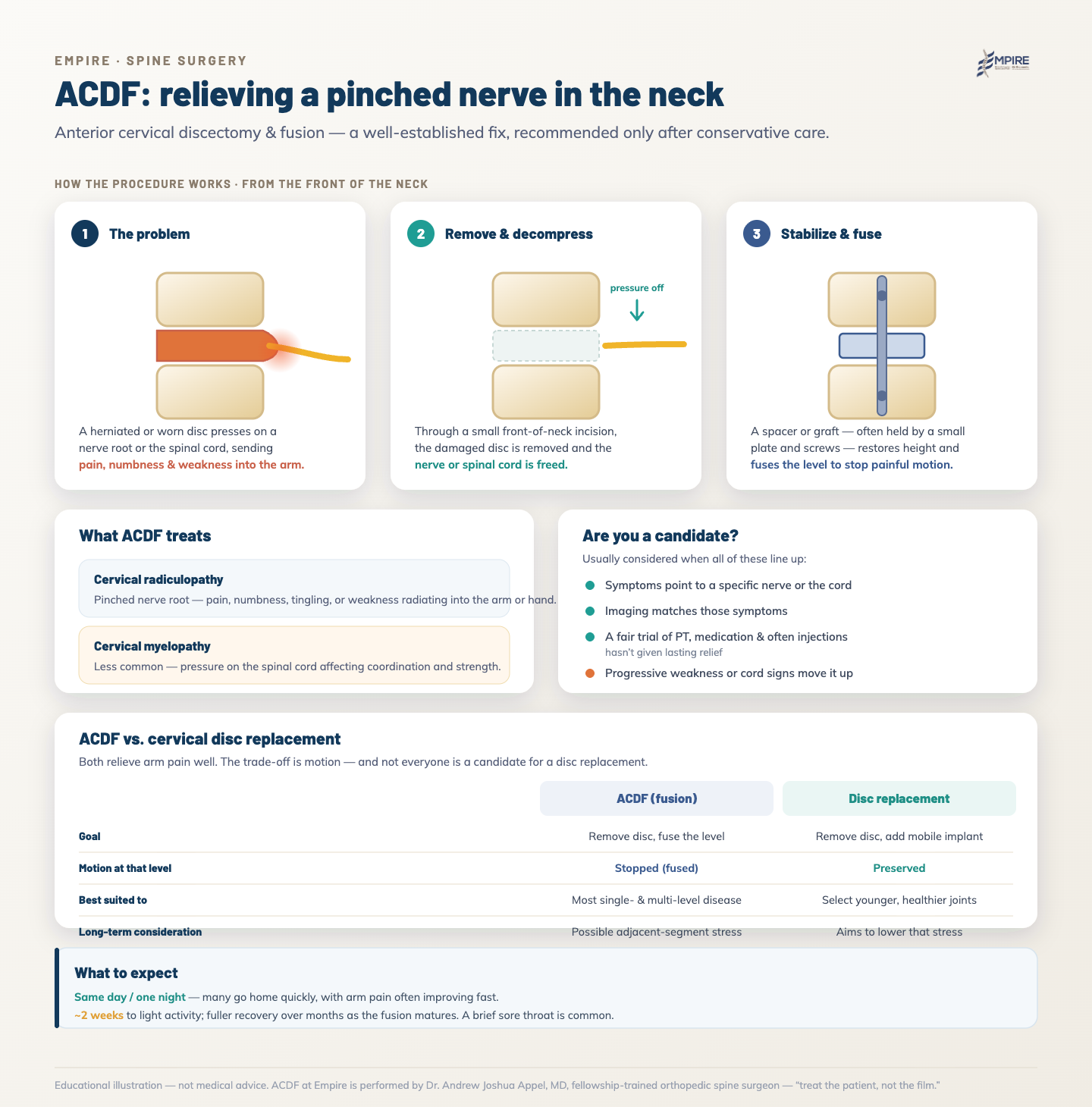
- ACDF removes a herniated or worn disc in the neck and fuses that level to stop painful motion.
- It treats arm pain, numbness, or weakness (radiculopathy), and pressure on the spinal cord (myelopathy).
- It’s done through a small front-of-neck incision, often outpatient or a one-night stay, and reliably relieves arm pain.
- A motion-preserving alternative — cervical disc replacement — suits some patients, so a careful evaluation comes first.
What ACDF treats
ACDF addresses pain and nerve problems that come from a cervical (neck) disc pressing on a nerve root or the spinal cord. According to the American Academy of Orthopaedic Surgeons, it’s used for cervical radiculopathy or myelopathy from a herniated disc or degenerative changes when symptoms persist despite non-surgical care or when there is neurologic impairment. In plain terms: the pain, numbness, or weakness runs into your shoulder, arm, or hand, and it hasn’t improved on its own.
ACDF is not your only option: ACDF fuses the treated level, while cervical disc replacement removes the disc and preserves motion with an artificial disc. Both relieve arm pain well; the right one depends on your anatomy, how many levels are involved, and the health of the joints in your neck.
Are you a candidate?
ACDF is usually considered when your symptoms point to a specific cervical nerve or the spinal cord, imaging matches those symptoms, and a fair trial of non-surgical care — physical therapy, medication, and often an epidural steroid injection — hasn’t given lasting relief. Progressive weakness or signs of cord compression can move surgery up the list. Because a scan alone doesn’t decide it, Dr. Appel confirms the imaging and your symptoms agree before recommending surgery — the guiding idea is to treat the patient, not the film.
What to expect
ACDF is done through a small incision at the front of the neck, which lets the surgeon reach the spine with little muscle disruption. The disc is removed, the nerve or spinal cord is decompressed, and a spacer or graft — often held with a small plate and screws — is placed to restore height and support fusion. Many people go home the same day or after one night, with arm pain often improving quickly. A temporary sore throat or mild swallowing discomfort is common and usually settles within days to weeks. Most return to light activity within a couple of weeks, with fuller recovery over the following months as the fusion matures.
ACDF vs. cervical disc replacement
| ACDF (fusion) | Cervical disc replacement | |
|---|---|---|
| Goal | Remove disc, fuse the level | Remove disc, replace with a mobile implant |
| Motion at that level | Stopped (fused) | Preserved |
| Best suited to | Most single- and multi-level disc disease | Select younger patients, healthier joints |
| Long-term consideration | Possible adjacent-segment stress | Aims to lower adjacent-segment stress |
Meet your surgeon — Dr. Andrew Joshua Appel, MD
ACDF at Empire is performed by Dr. Andrew Joshua Appel, a fellowship-trained orthopedic spine surgeon who completed his orthopedic residency and dual fellowships in trauma and spine surgery at Brown University. He focuses on minimally invasive and motion-preserving spine techniques, guided by a simple rule: “treat the patient, not the film.”
Why patients across Long Island choose Empire
We’re a local orthopedic and pain practice, not a national hospital system — so your evaluation, surgery, and follow-up all happen close to home with the same team.
- New York: Plainview, New Hyde Park, and Ronkonkoma — across Nassau and Suffolk
- Fellowship-trained spine surgery, with conservative care first whenever it’s reasonable
- A straight answer about whether surgery is truly warranted
Insurance
Coverage varies by plan, and we accept many major insurance plans across our New York offices. The simplest way to know what your plan covers is to call — our team will verify your benefits before your visit, so there are no surprises.
Frequently asked questions
How long is recovery after ACDF?
Many people return to light activity within about two weeks, with fuller recovery over the following months as the fusion heals. Your surgeon gives you specific guidance based on how many levels were treated.
Will ACDF limit my neck movement?
Fusing one level removes motion at that segment, but the rest of the neck compensates, and most people don’t notice a major loss in day-to-day movement. If preserving motion is a priority, ask whether cervical disc replacement is an option for you.
Is ACDF major surgery?
It’s a well-established procedure done through a small front-of-neck incision with little muscle disruption, and it’s often outpatient or a one-night stay. Like any surgery it carries risks, which your surgeon will review with you.
Do I have to try non-surgical treatment first?
In most cases, yes. ACDF is generally considered after physical therapy, medication, and often injections haven’t relieved the nerve symptoms — unless there’s progressive weakness or cord compression that calls for earlier surgery.
Neck or arm pain that isn’t getting better?
Dr. Appel reviews your imaging and symptoms together and recommends ACDF only when it’s truly warranted, across Long Island, NY.
New York: 516-229-1443
AA
Medically reviewed by Dr. Andrew J. Appel, M.D. — Board-certified Orthopedic Spine Surgeon
Last reviewed July 2026 · Empire Minimally Invasive Spine & Pain
What Our Patients Say
Medicare, Workers Comp,
No Fault & Others.
We accept most major insurance plans across our New York and New Jersey offices. Select your state to see accepted plans.
Accepted at our New York Locations
Workers' Compensation
No-Fault (NY & NJ)
Lien Cases
Medicare
Empire BCBS
BCBS / Anthem
Cigna
Aetna
Empire NYSHIP
Oxford (PPO)
United Health Care
GHI / Emblem Health
Humana (PPO)
Magnacare (PPO)
Northwell Direct
1199 SEIU
Self Pay
Accepted at our New Jersey Locations
Workers' Compensation
No-Fault (NJ)
Lien Cases
Horizon BCBS
Empire NYSHIP
BCBS / Anthem (PPO)
Cigna
Aetna (PPO)
GHI / Emblem (PPO)
Port Authority UHC
Verizon Plan
Carpenter & Trade Unions
Self Pay
Medicare and Medicaid are not accepted at our New Jersey locations. Not sure about your plan? Call us and we'll verify before your visit.
Not sure about your plan?
Call Us — 516-229-1443
Verify Your Coverage for FREE
Enter your information and our team will confirm your benefits before your visit.
✓ HIPAA Compliant
✓ No Obligation
✓ Same-Day Response
Your information is encrypted and secure. By submitting, you consent to receive communications regarding your appointment. You may opt out at any time.
Meet Our Pain Management & Orthopedic Specialists
Board-certified physicians dedicated to accurate diagnosis and minimally invasive care.

Pain Management
John Akhnoukh, M.D.
Board Certified Anesthesiologist & Interventional Pain Management Physician
Visit Profile



Pain Management
James Yu, D.O.
Board Certified Anesthesiologist & Interventional Pain Management Physician
Visit Profile
Pain Management
Benjamin Souferi, D.O.
Fellowship-Trained Interventional Pain Medicine Physician (Cleveland Clinic)
Visit ProfilePain Conditions Affecting Daily Life
Improve your quality of life with our comprehensive approach to pain management
We are dedicated to finding individualized treatment options tailored to fit your needs. Our team is dedicated to helping you lead a productive and active life, free from pain and disruption.
Our Locations
Pain management and orthopedic care across New York and New Jersey.