
Torn ACL: Do You Need Surgery, or Can It Heal On Its Own?

You felt a pop, your knee swelled up fast, and now it feels like it might give out. If a doctor says you tore your ACL, the first question is usually the same: do you need surgery, or will it heal on its own? The honest answer is that it depends on your knee and your goals — and for a lot of people, surgery isn’t the only path.
Here’s how to tell which group you’re likely in.
How the ACL Tears
The anterior cruciate ligament (ACL) sits in the middle of your knee and keeps your shinbone from sliding forward or twisting under your thighbone. It usually tears during a quick stop, a hard pivot, or an awkward landing — the kind of movement common in soccer, basketball, football, and skiing. It can also tear in a car accident or a fall.
Most people feel a pop, get sharp pain, and see the knee swell within a few hours. After that, the knee often feels loose or unstable. If any of that sounds familiar, it’s worth reading about the wider range of causes of knee pain and getting an exam, since ACL tears often come with other knee damage. The American Academy of Orthopaedic Surgeons has a helpful patient overview on OrthoInfo.
Can a Torn ACL Heal on Its Own?
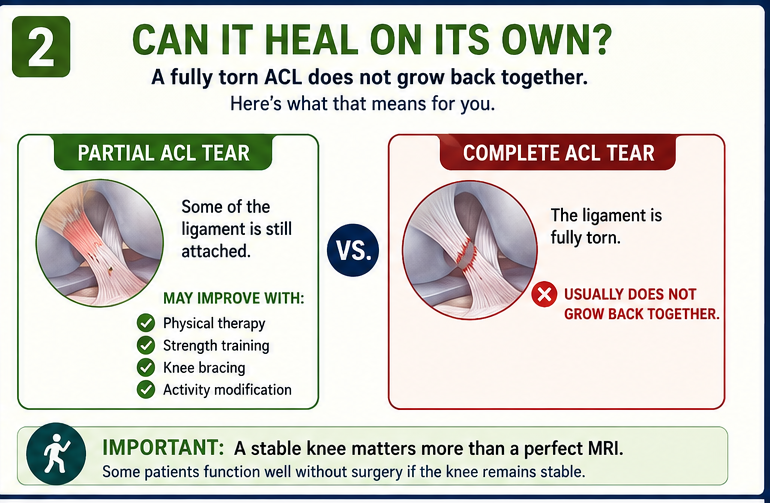
A fully torn ACL does not grow back together. Unlike a muscle strain, the two ends of a torn ligament usually can’t reconnect on their own inside the knee joint. So “waiting it out” won’t rebuild the ligament.
That said, healing the ligament and having a working knee aren’t the same thing. Some people build enough strength in the muscles around the knee that it stays stable for daily life, even without an intact ACL. Partial tears, where some of the ligament is still attached, may also do well without surgery. The goal isn’t a perfect ligament on a scan — it’s a knee that doesn’t give out when you use it.
When You Can Skip Surgery
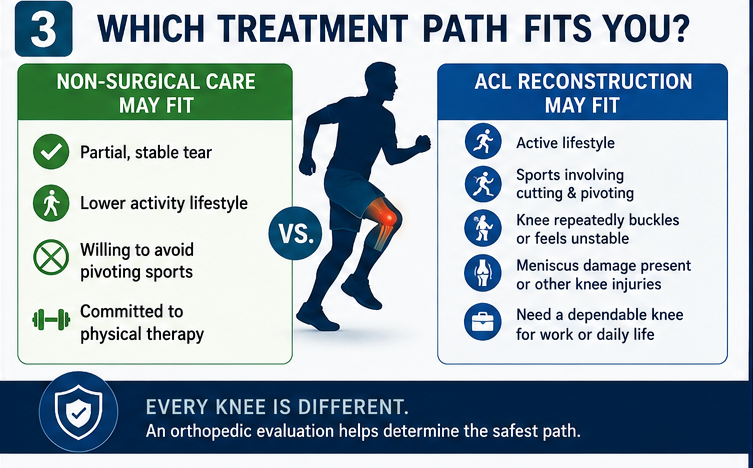
A non-surgical plan — a brace, physical therapy to strengthen the leg, and some changes to high-risk activities — can work well for the right person. That often means:
- The tear is partial and the knee feels stable
- You have a less active or lower-impact lifestyle
- You’re willing to avoid cutting and pivoting sports
- You’ll commit to a real physical therapy program
For these patients, months of guided rehab can restore enough strength and control to get back to walking, working, and low-impact exercise without the knee buckling.
When Surgery Is the Better Choice
ACL reconstruction rebuilds the ligament using a graft — a new piece of tendon that acts as a new ACL. It’s usually the better path when you want to return to demanding activity or the knee won’t stay stable. Reconstruction often fits when:
- You’re young or active and want to return to cutting or pivoting sports
- Your knee keeps giving out during everyday activities
- Other structures, like the meniscus, are also torn
- Your job or daily life demands a stable, dependable knee
Reconstruction is done arthroscopically, through a few small incisions, and most patients go home the same day. You can read more about the procedure, graft options, and recovery on our ACL reconstruction page, or see our full range of knee surgery options. To have your injury evaluated, connect with an ACL & knee surgeon near you.
Surgery vs. non-surgical, side by side
| ACL reconstruction | Non-surgical care | |
|---|---|---|
| Best for | Active people, unstable knees, pivoting sports | Stable knees, lower-impact lifestyles |
| Main tool | Arthroscopic surgery + graft, then rehab | Bracing + physical therapy |
| Return to sport | Often around 9–12 months, after passing tests | Limited return to cutting/pivoting sports |
| Main trade-off | Surgery and a longer rehab commitment | Knee may stay unstable for high demands |
What Happens If You Leave a Torn ACL Untreated
Living with an untreated ACL tear is possible, but repeated episodes of the knee giving way can damage the cartilage and meniscus over time. That’s why even people who choose not to have surgery should still be evaluated and follow a strengthening plan — protecting the rest of the knee matters as much as the ligament itself.
Get checked early. Quick swelling, a knee that won’t bear weight, or a joint that keeps buckling all deserve a prompt exam. Early diagnosis helps protect the cartilage and meniscus inside your knee.
How We Decide With You
At Empire, we use a step-up approach: we start with the least invasive option that can get you back to your life, and recommend reconstruction only when it’s the right fit for your knee and goals. That means a hands-on exam, a look at your imaging, and an honest talk about what you need your knee to do — whether that’s returning to the field or simply walking without worry. Because we combine orthopedic surgery and pain management in one practice, you don’t need a separate referral for care along the way.
Frequently Asked Questions
Can an ACL heal without surgery?
A full tear won’t grow back together. Some people with a partial tear or a stable, lower-demand knee do well with bracing and physical therapy. Others need reconstruction to keep the knee from giving out.
How do I know if I need ACL surgery?
It comes down to how unstable your knee is and how active you want to be. If the knee keeps buckling or you want to return to pivoting sports, surgery is often the better choice. A surgeon can tell you after an exam and a look at your imaging.
How long can I wait to have ACL surgery?
There’s often no rush to operate the same week — many surgeons wait for swelling to settle and motion to return first. But leaving an unstable knee unaddressed for a long time can wear on the cartilage, so it’s worth being evaluated soon.
Will I be able to play sports again?
Many people return to sports after ACL reconstruction, usually around 9–12 months, once they pass strength and stability tests. No surgeon can promise a specific outcome, but a good rehab plan gives you the best chance.
Wondering which path fits your knee?
Get an evaluation with a board-certified sports medicine surgeon. We’ll examine your knee, review your imaging, and build a plan around your goals.
Long Island, NY: (516) 229-1443 · New Jersey: (732) 630-7246
What Our Patients Say