Knee Osteoarthritis: Symptoms, Causes, and Treatment
In this article
If your knee aches with activity, stiffens up after you sit, and creaks or grinds when you move it, osteoarthritis is a likely cause. It’s the most common form of knee arthritis — and while the cartilage damage can’t be undone, the pain and stiffness can usually be managed well without surgery. This guide explains what’s happening in the joint, what helps, and when it’s time to consider a procedure.
Key takeaways
- Knee osteoarthritis is the gradual wearing of the cartilage that cushions the knee.
- The main signs are pain with activity, stiffness after rest, swelling, and grinding.
- Most people improve with weight management, exercise, and injections — not surgery.
- Staying active in the right way protects the joint; resting completely tends to make it stiffer.
- Knee replacement is reserved for advanced arthritis that no longer responds to other care.
What is knee osteoarthritis?
Osteoarthritis is the “wear and tear” form of arthritis. In the knee, the smooth cartilage that caps the ends of the bones gradually thins and roughens. That cartilage normally lets the joint glide and absorbs shock, so as it wears, the bones move less smoothly, the joint can become inflamed, and bone spurs may form. The result is the familiar pattern of pain, stiffness, and grinding that tends to build slowly over years.
Healthy knee
Osteoarthritis
Thick, smooth cartilage
Worn cartilage, bone spurs
Symptoms of knee osteoarthritis
- Pain that worsens with activity — walking, stairs, kneeling — and eases with rest
- Stiffness after sitting a while or first thing in the morning that loosens as you move
- Swelling and a feeling of warmth in the joint
- Grinding, clicking, or a catching sensation with movement
- A knee that feels like it might buckle, and a slowly shrinking range of motion
What causes knee osteoarthritis?
The biggest factors are age and use — cartilage tends to wear over time. Extra body weight is a major, and changeable, contributor, because every pound adds several pounds of force across the knee with each step. Previous knee injuries such as an ACL tear or a meniscus injury, repetitive high-impact activity, family history, and being female all raise the risk. Often several of these overlap.
How is knee osteoarthritis diagnosed?
Diagnosis starts with your history and an exam to check the knee’s motion, swelling, alignment, and where it hurts. X-rays are the key test — they show narrowing of the joint space, bone spurs, and other changes that confirm arthritis and gauge its severity. An MRI is occasionally added to look at the cartilage, meniscus, and ligaments in detail. Getting the diagnosis right guides the treatment plan and rules out other causes of knee pain.
How is knee osteoarthritis treated?
Treatment steps up only as far as it needs to, and the large majority of people manage well without surgery.
Weight management and exercise
Losing even a modest amount of weight meaningfully lowers the load on the knee, and low-impact exercise — walking, cycling, swimming — keeps the joint moving and strengthens the muscles that support it. Counterintuitively, staying active protects the knee; complete rest tends to make it stiffer and weaker.
Physical therapy and bracing
A therapist can strengthen the muscles around the knee, improve alignment, and reduce pain. A brace or the right footwear can offload the worn part of the joint.
Medications and injections
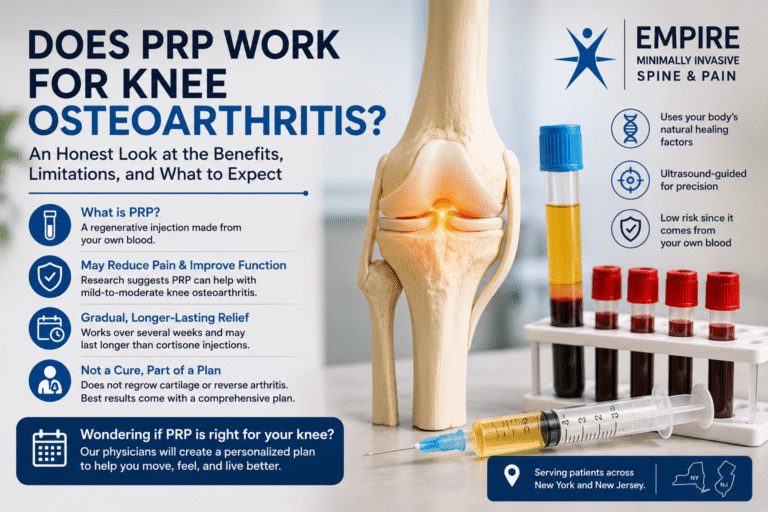
Anti-inflammatory medicine helps many people. When pain persists, options include a corticosteroid joint injection to calm inflammation, viscosupplementation (gel injections) to lubricate the joint, and whether PRP works for knee osteoarthritis in appropriate cases. Which fits depends on your knee and your goals.
When is surgery considered?
Surgery becomes an option when arthritis is advanced and pain limits daily life despite months of non-surgical care. For some patients, an arthroscopic procedure addresses a specific mechanical problem; for advanced, widespread cartilage loss, knee surgery including joint replacement is highly effective at relieving pain and restoring function. The right choice depends on the severity and pattern of arthritis, your age, and your goals. The American Academy of Orthopaedic Surgeons’ patient site, OrthoInfo, is a reliable place to read more.
When should you see a doctor?
See a knee pain doctor if knee pain and stiffness have lasted more than a few weeks, are limiting your activity, or are disturbing your sleep. Starting the right combination of weight management, exercise, and treatment early can slow the impact of arthritis and keep you moving.
Seek prompt care if your knee has:
- Sudden severe pain, an inability to bear weight, or a locked knee
- Significant swelling that comes on quickly, or an obvious deformity after an injury
- Fever, warmth, and redness over the joint
These can signal an injury, gout, or infection rather than gradual arthritis.
Knee pain slowing you down?
Empire Minimally Invasive Spine and Pain can confirm whether it’s osteoarthritis and build a plan that starts with the least invasive options — from injections to surgery when it’s truly needed. Serving Long Island and New Jersey.
Request a consultation
Or call our Plainview orthopedic office at 516-400-3333.
Frequently asked questions
What does knee osteoarthritis feel like?
It usually feels like an ache that’s worse with activity and better with rest, along with stiffness after sitting or in the morning. Many people also notice swelling, warmth, and a grinding or catching sensation when they bend the knee.
Can knee osteoarthritis be reversed or cured?
There’s no cure that regrows lost cartilage, but the symptoms can be managed very effectively. Weight management, exercise, and injections help most people stay active and comfortable for a long time, and surgery is a reliable option if arthritis becomes advanced.
What is the best treatment for knee arthritis?
There’s no single best treatment — care is matched to your knee. Most people start with weight management, low-impact exercise, physical therapy, and anti-inflammatory medicine, adding injections if needed, and consider surgery only when those no longer control the pain.
Should I keep exercising with knee osteoarthritis?
Yes — the right exercise is one of the most effective treatments. Low-impact activity like walking, cycling, and swimming keeps the joint moving and strengthens supporting muscles. It’s high-impact, twisting, or painful activity you want to ease off, ideally with guidance from a therapist.
Do I need a knee replacement?
Not usually. Replacement is considered only for advanced arthritis that limits daily life despite non-surgical care. When it is needed, modern knee replacement is very effective at relieving pain and restoring function.
This article is for general education and is not a substitute for medical advice. Talk with a qualified clinician about your specific symptoms.
What Our Patients Say

Dr. Jeffrey Guttman
Articles: 15
Our Plainview office has moved
Find us at our new location:
520 Old Country Rd
Plainview, NY 11803
Same doctors, same phone numbers.
Most Major Plans,
No-Fault & Personal Injury.
We accept most major insurance plans across our New York and New Jersey offices. Select your state to see accepted plans.
Accepted at our New York Locations
Workers' Compensation
No-Fault (NY & NJ)
Lien Cases
Medicare
Empire BCBS
BCBS / Anthem
Cigna
Aetna
Empire NYSHIP
Oxford (PPO)
United Health Care
GHI / Emblem Health
Humana (PPO)
Magnacare (PPO)
Northwell Direct
1199 SEIU
Self Pay
Accepted at our New Jersey Locations
No-Fault (NJ)
Lien Cases
Horizon BCBS
Empire NYSHIP
BCBS / Anthem (PPO)
Cigna
Aetna (PPO)
GHI / Emblem (PPO)
Port Authority UHC
Verizon Plan
Carpenter & Trade Unions
Self Pay
Medicare, Medicaid and Workers' Compensation are not accepted at our New Jersey locations. Not sure about your plan? Call us and we'll verify before your visit.
Not sure about your plan?
Call Us — 516-229-1443
Verify Your Coverage for FREE
Enter your information and our team will confirm your benefits before your visit.
✓ HIPAA Compliant
✓ No Obligation
✓ Same-Day Response
Your information is encrypted and secure. By submitting, you consent to receive communications regarding your appointment. You may opt out at any time.
Meet Our Pain Management & Orthopedic Specialists
Board-certified physicians dedicated to accurate diagnosis and minimally invasive care.

Pain Management
John Akhnoukh, M.D.
Board Certified Anesthesiologist & Interventional Pain Management Physician
Visit Profile



Pain Management
James Yu, D.O.
Board Certified Anesthesiologist & Interventional Pain Management Physician
Visit Profile

Pain Management
Benjamin Souferi, D.O.
Fellowship-Trained Interventional Pain Medicine Physician (Cleveland Clinic)
Visit ProfilePain Conditions Affecting Daily Life
Improve your quality of life with our comprehensive approach to pain management
We are dedicated to finding individualized treatment options tailored to fit your needs. Our team is dedicated to helping you lead a productive and active life, free from pain and disruption.
Our Locations
Pain management and orthopedic care across New York and New Jersey.