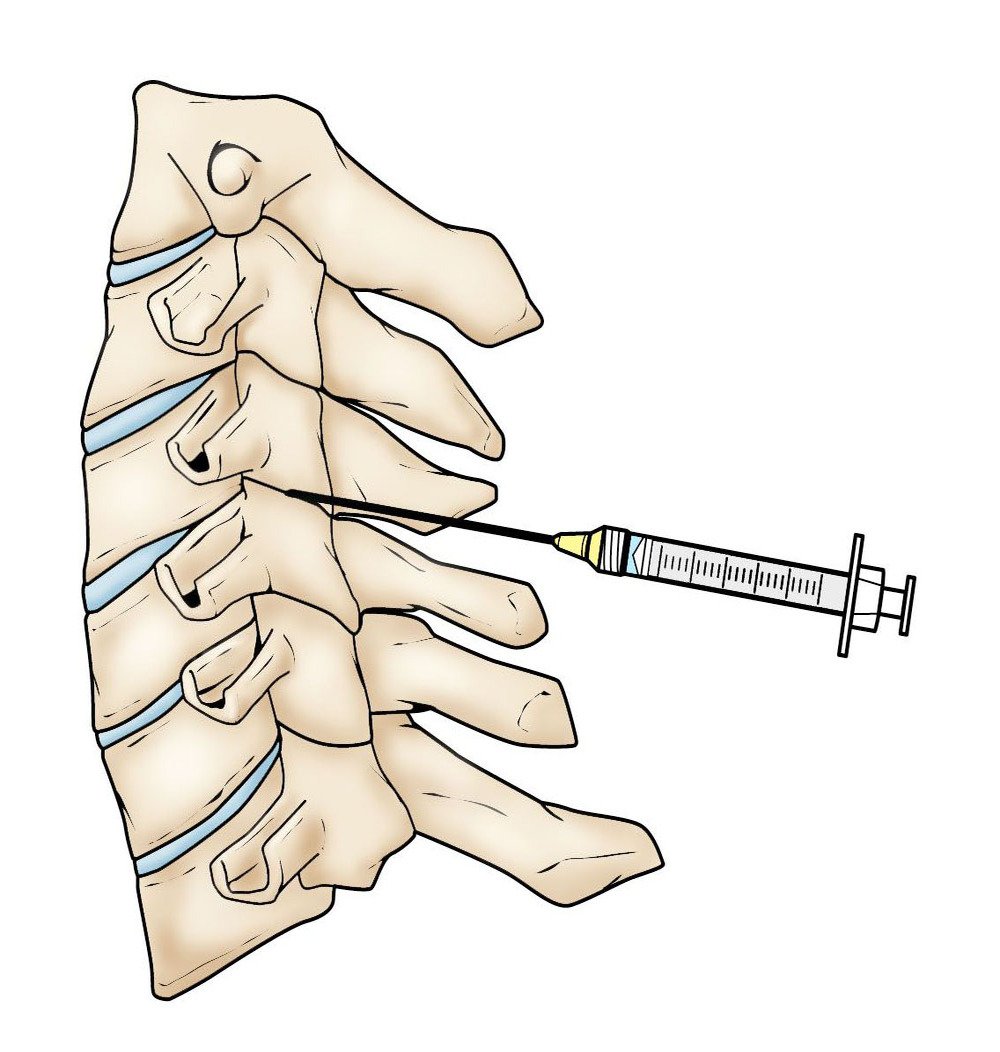
Regenerative disc injections into spine for pain are a medical treatment that involves injecting a substance into a damaged intervertebral disc in the spine to stimulate the body’s natural healing process. Intervertebral discs are the cushions that separate the vertebrae in the spine and allow for movement. When a disc becomes damaged, it can cause pain and other symptoms. Several substances can be used for regenerative disc injections, including platelet-rich plasma (PRP), bone marrow aspirate concentrate (BMAC), and synthetic biomaterials. These substances contain various growth factors and other substances that can stimulate the production of new cells and promote the healing of damaged tissue.
Procedure Information on Regenerative disc injections into spine for pain:
For chronic low back pain that traces to a worn or degenerating disc, a regenerative disc injection uses your own platelet-rich plasma (PRP) to target the source rather than just mask the pain. Our physicians perform these injections across Long Island and northern New Jersey — with offices in Plainview, New Hyde Park, and Ronkonkoma, NY, and Clifton, Montville, and Plainfield, NJ.
The short version
- The injection places concentrated growth factors from your own blood (PRP) into or around a degenerated spinal disc.
- It’s aimed at chronic discogenic low back pain that hasn’t settled after months of conservative care.
- It’s an outpatient, image-guided procedure done under local anesthesia, usually in about 30 minutes to an hour.
- Research is promising but still early — results vary, and we’ll be honest about what the evidence does and doesn’t show.
What a regenerative disc injection treats
The discs between your vertebrae act as cushions that let your spine bend and absorb load. When a disc degenerates, it can become a source of ongoing low back pain — what’s often called discogenic pain. A regenerative disc injection delivers platelet-rich plasma, concentrated from a small sample of your own blood, to the affected disc to support healing and calm inflammation in that area.
This approach is generally considered for people with chronic low back pain of disc origin that has lasted at least a few months and hasn’t responded to conservative treatment like physical therapy and medication. It’s not a first step, and it’s not the right answer for every kind of back pain.
What the research shows — honestly
Published reviews of intradiscal PRP for degenerative disc disease report encouraging results: patients in these studies had chronic discogenic low back pain for at least three to six months and had failed conservative care before treatment. A systematic review in the journal Cureus found intradiscal PRP produced statistically significant pain improvement with low complication and re-injection rates, while noting the overall level of evidence is still limited.
Other research has found the effect of an intradiscal PRP injection is broadly similar to a steroid injection for discogenic pain. In plain terms: the early evidence is genuinely promising, but this is still a developing treatment, not a guaranteed fix. Anyone who tells you it definitely regrows your disc is getting ahead of the science.
Straight talk: Regenerative disc injections don’t work for everyone, and they don’t reverse advanced disc damage. We treat this as one considered option within a full plan, and we’ll tell you honestly if we think another approach fits your situation better.
Are you a candidate?
This injection may be worth discussing when:
- Your pain is mainly in the low back and linked to a degenerating disc on imaging
- It’s lasted several months despite physical therapy, medication, and activity changes
- You’d like to explore options that support healing before considering spine surgery
- You understand the treatment is promising but still evolving
What to expect
The procedure is done in-office on an outpatient basis and usually takes about 30 minutes to an hour. We draw a small blood sample, concentrate the platelets in a centrifuge, and use live imaging guidance to place the PRP precisely at the target disc under local anesthesia. There’s no hospital stay.
Most patients return to normal activity within a few days. As with other regenerative treatments, any benefit builds gradually over weeks to months rather than immediately, since it depends on your body’s own healing response. Your physician will review the specific risks — which for disc injections include soreness and, less commonly, the usual risks of a needle procedure — before you decide.
How it compares to other disc-pain options
| Regenerative disc (PRP) injection | Epidural steroid injection | |
|---|---|---|
| Main goal | Support healing at a degenerated disc | Reduce inflammation around an irritated nerve |
| Best for | Chronic discogenic low back pain | Radiating nerve pain (sciatica) |
| Onset | Builds over weeks to months | Days to two weeks |
| Made from | Your own blood | Steroid medication |
If your pain shoots down a leg rather than staying in the back, an epidural steroid injection may be the more appropriate first step. And if you’re exploring regenerative options for joints or tendons rather than the spine, our PRP therapy page covers that in detail.
Why patients across Long Island and North Jersey choose Empire
We’re a local pain and orthopedic practice, so your evaluation, injection, and follow-up all happen close to home with the same team — no hospital-system runaround.
- New York: Plainview, New Hyde Park, and Ronkonkoma — across Nassau and Suffolk
- New Jersey: Clifton, Montville, and Plainfield — serving Passaic, Morris, and Union County communities
- Interventional pain management and orthopedics under one roof
- Image-guided technique for precise, targeted placement
Insurance
Coverage varies by plan and by location, and we accept many major insurance plans across our New York and New Jersey offices. Many insurers consider regenerative injections elective, so the simplest way to know exactly what applies to you is to call — our team will verify your benefits and go over any costs before your visit, so there are no surprises. Whether you’re on Long Island or in North Jersey, reach out and we’ll walk you through your options.
Frequently asked questions
Do regenerative disc injections really work?
Early research is promising — studies show meaningful pain improvement for some patients with chronic discogenic low back pain — but the evidence is still limited and results vary. It’s a reasonable option to discuss, not a guaranteed cure.
Is the procedure painful?
The area is numbed with local anesthesia first. You may feel pressure during the injection and some soreness at the site for a few days afterward, which typically settles on its own.
How long until I notice a difference?
Because it works through your body’s healing response, any benefit builds gradually over weeks to months rather than right away.
How is this different from an epidural steroid injection?
A steroid injection reduces inflammation, mainly for radiating nerve pain like sciatica. A regenerative disc injection aims to support healing at a degenerated disc for chronic back pain. They suit different problems.
Is it covered by insurance?
Often it’s treated as elective, but coverage varies by plan and condition. Our team will verify your specific benefits and explain any cost before you schedule.
What if it doesn’t help?
It doesn’t work for everyone. If it doesn’t give you enough relief, we’ll talk through other options rather than simply repeating it — this is one step in a plan, not the whole plan.
Chronic back pain from a worn disc?
Our physicians see patients across Long Island, NY and northern New Jersey. We’ll review your imaging and history and give you an honest read on whether a regenerative disc injection is worth considering for you.
New York: 516-229-1443 | New Jersey: 732-630-7246
Our Back Pain Treatment Options May Include:
Epidural Steroid Injections
Radiofrequency Ablation (RFA)
Spinal Cord Stimulator Implant
Kyphoplasty / Vertebroplasty
Basivertebral Nerve Ablation
PRP Therapy
Regenerative Disc Injections
MM
Medically reviewed by Dr. Monika Misak, M.D. — Board-certified in Pain Medicine & Emergency Medicine
Last reviewed July 2026 · Empire Minimally Invasive Spine & Pain
What Our Patients Say
Our Plainview office has moved
Find us at our new location:
520 Old Country Rd
Plainview, NY 11803
Same doctors, same phone numbers.
Most Major Plans,
No-Fault & Personal Injury.
We accept most major insurance plans across our New York and New Jersey offices. Select your state to see accepted plans.
Accepted at our New York Locations
Workers' Compensation
No-Fault (NY & NJ)
Lien Cases
Medicare
Empire BCBS
BCBS / Anthem
Cigna
Aetna
Empire NYSHIP
Oxford (PPO)
United Health Care
GHI / Emblem Health
Humana (PPO)
Magnacare (PPO)
Northwell Direct
1199 SEIU
Self Pay
Accepted at our New Jersey Locations
No-Fault (NJ)
Lien Cases
Horizon BCBS
Empire NYSHIP
BCBS / Anthem (PPO)
Cigna
Aetna (PPO)
GHI / Emblem (PPO)
Port Authority UHC
Verizon Plan
Carpenter & Trade Unions
Self Pay
Medicare, Medicaid and Workers' Compensation are not accepted at our New Jersey locations. Not sure about your plan? Call us and we'll verify before your visit.
Not sure about your plan?
Call Us — 516-229-1443
Verify Your Coverage for FREE
Enter your information and our team will confirm your benefits before your visit.
✓ HIPAA Compliant
✓ No Obligation
✓ Same-Day Response
Your information is encrypted and secure. By submitting, you consent to receive communications regarding your appointment. You may opt out at any time.
Meet Our Pain Management & Orthopedic Specialists
Board-certified physicians dedicated to accurate diagnosis and minimally invasive care.

Pain Management
John Akhnoukh, M.D.
Board Certified Anesthesiologist & Interventional Pain Management Physician
Visit Profile



Pain Management
James Yu, D.O.
Board Certified Anesthesiologist & Interventional Pain Management Physician
Visit Profile
Pain Management
Benjamin Souferi, D.O.
Fellowship-Trained Interventional Pain Medicine Physician (Cleveland Clinic)
Visit ProfilePain Conditions Affecting Daily Life
Improve your quality of life with our comprehensive approach to pain management
We are dedicated to finding individualized treatment options tailored to fit your needs. Our team is dedicated to helping you lead a productive and active life, free from pain and disruption.
Our Locations
Pain management and orthopedic care across New York and New Jersey.