Herniated Disc vs. Bulging Disc: What’s the Difference?
In this article
If an MRI report mentions a “bulging” or “herniated” disc, it’s natural to wonder how different the two really are — and which one is more serious. Both involve a spinal disc pushing out of its normal space, but they differ in how the disc is affected and how likely each is to press on a nerve. This guide breaks down the difference in plain language, what symptoms to expect, and how each is treated.
Key takeaways
- A bulging disc protrudes outward while its tough outer layer stays intact.
- A herniated disc has a crack in that outer layer, letting the softer inner material push out.
- A herniated disc is more likely to press on a nerve and cause pain.
- Both can exist with no symptoms at all and are often found by chance on an MRI.
- Most cases are treated without surgery, starting with conservative care.
The quick answer
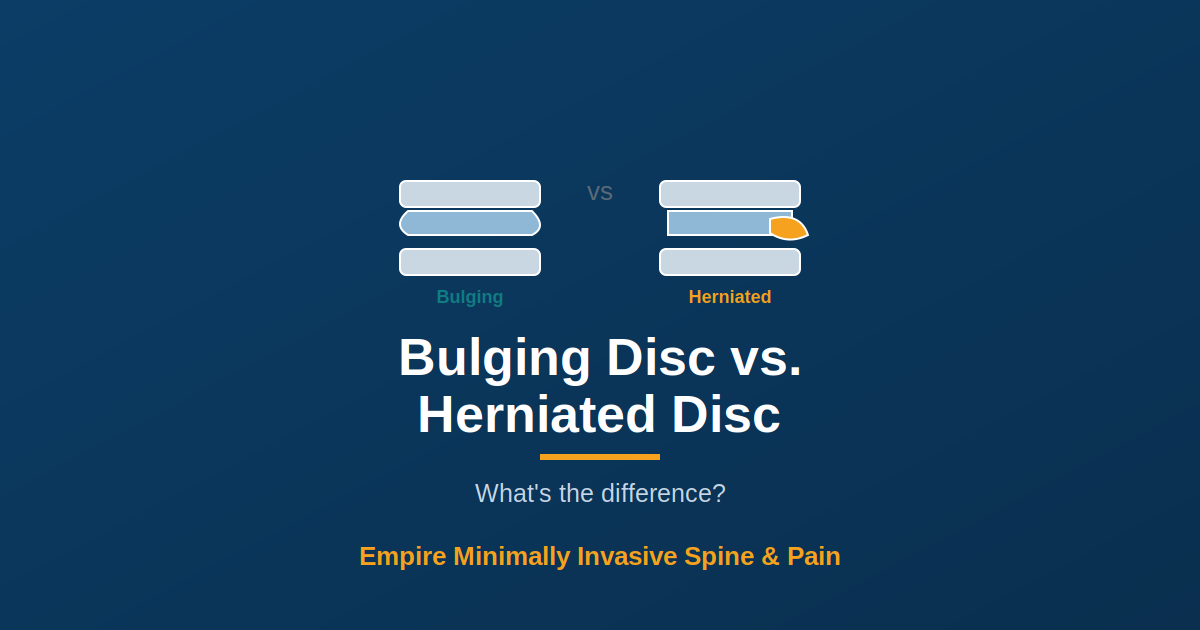
A bulging disc and a herniated disc both describe a spinal disc that has pushed beyond its normal border, but the difference is in the disc’s outer wall. In a bulging disc, the tough outer layer stays intact and the disc simply extends outward. In a herniated disc, that outer layer cracks and some of the soft inner material pushes through — which is more likely to irritate a nearby nerve.
Mayo Clinic explains that a herniated disk “results when a crack in the tough outer layer of cartilage allows some of the softer inner cartilage to stick out,” while a bulging disk keeps its outer layer intact (Mayo Clinic).
What is a bulging disc?
A bulging disc is a spinal disc that extends beyond its normal boundary while its tough outer layer stays intact. Imagine a disc that has flattened slightly with age and spread outward around much of its edge. Because the outer wall holds, a bulging disc often causes no symptoms and may be discovered only when an MRI is done for another reason.
Mayo Clinic describes a bulging disk as one where the outer layer protrudes outward, typically affecting “at least a quarter to a half of the disk’s circumference” while staying intact (Mayo Clinic).
What is a herniated disc?
A herniated disc is one where the tough outer layer develops a crack, letting some of the soft inner cartilage push out. Only the small area around the crack is affected, but that escaping material can press on or inflame a nearby nerve root. That’s why a herniated disc is more often linked to back pain that radiates into an arm or leg.
Per Mayo Clinic, a herniated disk “results when a crack in the tough outer layer of cartilage allows some of the softer inner cartilage to stick out,” affecting only the small cracked area rather than the whole disc (Mayo Clinic).
Bulging vs. herniated disc: the key differences
The main difference is whether the disc’s outer wall is intact. A bulging disc pushes out with its wall whole; a herniated disc has cracked, letting inner material escape and making nerve irritation more likely. Here’s a side-by-side comparison.
| Bulging disc | Herniated disc | |
|---|---|---|
| Outer wall | Intact | Cracked |
| Area affected | Broad (quarter to half of the disc) | Small, focused at the crack |
| Nerve pressure | Less likely | More likely |
| Symptoms | Often none | More likely to cause pain |
Which is worse, a bulging or herniated disc?
A herniated disc is generally more likely to cause pain than a bulging disc, because it protrudes farther and is more likely to compress a nerve root. That said, “worse” depends on symptoms, not the label alone — a large bulging disc in a tight space can hurt, while a small herniation may cause nothing at all. What matters is whether the disc is actually pressing on a nerve.
Mayo Clinic notes that “compared with a bulging disk, a herniated disk is more likely to cause pain because it protrudes farther and is more likely to compress nerve roots” (Mayo Clinic).
What are the symptoms of each?
Both conditions can be completely silent, which surprises many patients. When symptoms do occur, they depend on whether the disc is pressing on a nerve. A disc pressing on a nerve in the lower back can send pain, numbness, or tingling into the buttock and leg; in the neck, symptoms can travel into the shoulder and arm.
An important caveat from Mayo Clinic: “You can have a bulging disk or herniated disk without any symptoms,” and many people only learn they have disc changes after an MRI done for another reason (Mayo Clinic).
How are bulging and herniated discs treated?
Both bulging and herniated discs are treated the same basic way — starting with conservative care and escalating only if symptoms don’t improve. At Empire Minimally Invasive Spine and Pain, we follow a step-and-ladder approach that begins with the least invasive option and reserves surgery as a last resort.
Conservative care
Most people improve with time, activity changes, physical therapy, and anti-inflammatory measures. A disc that isn’t pressing hard on a nerve often settles without any procedure.
Minimally invasive procedures
When a disc is irritating a nerve and pain persists, image-guided injections can reduce inflammation around the nerve root and improve day-to-day function.
Minimally invasive surgery
If symptoms are severe or don’t respond, a small-incision procedure such as endoscopic discectomy can remove the disc fragment pressing on the nerve while sparing surrounding muscle and tissue. Because the goal is to relieve nerve pressure with the smallest effective intervention, many patients never need traditional open surgery.
Worried about your MRI results?
Empire’s spine specialists can explain what your bulging or herniated disc actually means for you — and map out the least invasive path to relief. Serving Long Island and New Jersey.
Request a consultation Or call our New York office at 516-229-1443.Frequently asked questions
Is a bulging disc less serious than a herniated disc?
Often, yes. A bulging disc keeps its outer wall intact and is less likely to press on a nerve, so it more often causes no symptoms. But severity depends on whether the disc is compressing a nerve, not on the label alone.
Can a bulging disc turn into a herniated disc?
It can. A bulging disc that is under ongoing stress may eventually develop a crack in its outer layer, which would make it a herniated disc. Not every bulging disc progresses, though — many stay stable for years.
Can a herniated or bulging disc heal without surgery?
Yes. Most disc problems improve with conservative care over time, and surgery is reserved for cases with severe or persistent nerve symptoms. Even when a procedure is needed, minimally invasive options are usually tried before open surgery.
Do I need surgery for a herniated disc?
Usually not. Most herniated discs are managed without surgery. A specialist may consider a minimally invasive procedure only if pain, numbness, or weakness is severe or doesn’t respond to conservative care and injections.
How do I know if my disc is pressing on a nerve?
Pain, numbness, tingling, or weakness that travels down an arm or leg — rather than staying in the back or neck — suggests a nerve is involved. A physical exam and an MRI help confirm which nerve and disc are responsible.
This article is for general education and is not a substitute for medical advice. Talk with a qualified clinician about your specific symptoms.
What Our Patients Say

Dr. Andrew J. Appel
Articles: 4

Our Plainview office has moved
Find us at our new location:
520 Old Country Rd
Plainview, NY 11803
Same doctors, same phone numbers.
Most Major Plans,
No-Fault & Personal Injury.
We accept most major insurance plans across our New York and New Jersey offices. Select your state to see accepted plans.
Accepted at our New York Locations
Workers' Compensation
No-Fault (NY & NJ)
Lien Cases
Medicare
Empire BCBS
BCBS / Anthem
Cigna
Aetna
Empire NYSHIP
Oxford (PPO)
United Health Care
GHI / Emblem Health
Humana (PPO)
Magnacare (PPO)
Northwell Direct
1199 SEIU
Self Pay
Accepted at our New Jersey Locations
No-Fault (NJ)
Lien Cases
Horizon BCBS
Empire NYSHIP
BCBS / Anthem (PPO)
Cigna
Aetna (PPO)
GHI / Emblem (PPO)
Port Authority UHC
Verizon Plan
Carpenter & Trade Unions
Self Pay
Medicare, Medicaid and Workers' Compensation are not accepted at our New Jersey locations. Not sure about your plan? Call us and we'll verify before your visit.
Not sure about your plan?
Call Us — 516-229-1443
Verify Your Coverage for FREE
Enter your information and our team will confirm your benefits before your visit.
✓ HIPAA Compliant
✓ No Obligation
✓ Same-Day Response
Your information is encrypted and secure. By submitting, you consent to receive communications regarding your appointment. You may opt out at any time.
Meet Our Pain Management & Orthopedic Specialists
Board-certified physicians dedicated to accurate diagnosis and minimally invasive care.

Pain Management
John Akhnoukh, M.D.
Board Certified Anesthesiologist & Interventional Pain Management Physician
Visit Profile



Pain Management
James Yu, D.O.
Board Certified Anesthesiologist & Interventional Pain Management Physician
Visit Profile

Pain Management
Benjamin Souferi, D.O.
Fellowship-Trained Interventional Pain Medicine Physician (Cleveland Clinic)
Visit ProfilePain Conditions Affecting Daily Life
Improve your quality of life with our comprehensive approach to pain management
We are dedicated to finding individualized treatment options tailored to fit your needs. Our team is dedicated to helping you lead a productive and active life, free from pain and disruption.
Our Locations
Pain management and orthopedic care across New York and New Jersey.