Spinal Stenosis Exercises to Avoid (and What to Do Instead)
In this article
Do your buttocks and legs feel heavy, achy or tingly when you stand in line or walk through a store? Does sitting down make it fade? You may be dealing with lumbar spinal stenosis. Staying active is one of the best things you can do for it. But some very common exercises can flare symptoms, and a few popular stretches push your spine in exactly the wrong direction.
This guide explains which exercises to avoid with spinal stenosis, why they cause trouble, and what to do instead.
Key takeaways
- Arching your lower back backward narrows the spinal canal. Bending slightly forward opens it.
- Backbends, prone press-ups, “superman” lifts and downhill walking are the most common flare triggers.
- Forward-leaning activity, like a stationary bike or walking with rest breaks, is usually easier to tolerate.
- Don’t stop moving. A guided exercise program is a first-line treatment.
- New leg weakness or any bladder or bowel change needs urgent care.
Why do some exercises make spinal stenosis worse?
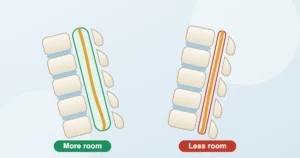
Spinal stenosis means the space around the nerves in your lower back has narrowed. It’s usually caused by wear and tear: bulging discs, thick ligaments and arthritis in the small spine joints. That space gets smaller when you arch your back. It gets bigger when you bend forward. So any exercise that keeps your lower back arched, especially while lifting, can squeeze the nerves and cause leg pain.
That’s why many people with stenosis feel better pushing a shopping cart or walking uphill, and worse walking downhill. The MSD Manual’s clinical guide puts it simply: the canal in the lower back is larger when you bend forward and smaller when you arch back (MSD Manual Professional Edition, reviewed 2024).
Which exercises should you avoid with spinal stenosis?
The exercises to avoid with spinal stenosis are the ones that arch your lower back, add weight while it’s arched, or keep you standing until your legs start to hurt. Everyone is different, so treat this as a list of common triggers, not a ban. If a move brings on leg pain, numbness or heaviness, stop. Switch to a position where you lean slightly forward.
1. Backbends and back-extension stretches
Cobra and upward-facing dog in yoga, prone press-ups (lying face down and pushing your chest up), and standing backbends all arch the lower spine. These moves are often suggested for disc problems. That’s exactly why people with stenosis get into trouble with them. The right stretch for one back problem can be the wrong one for another.
2. “Superman” lifts and back-extension machines
Lying face down and lifting your arms and legs arches your back and adds muscle force on top. So does the back-extension machine (Roman chair) at the gym. If you want a stronger back, core work done with your spine straight or bent slightly forward is usually a better fit.
3. Overhead lifting that arches your back
Overhead presses, heavy lifts over your head, and reaching for high shelves while leaning back all pull your lower back into an arch. Lighter weights, seated versions, or keeping your ribs down can help. A physical therapist can show you how.
4. Running, jumping and downhill walking
Running, jogging and walking downhill often bring on stenosis symptoms, while walking uphill is usually easier (MSD Manual). Downhill walking and upright running keep your back more arched. Jumping adds repeated jarring on top of that.
5. Long stretches of standing still
Standing for a long time is a classic trigger. Cleveland Clinic notes that stenosis pain tends to grow with long periods of standing or walking, and with walking downhill. It eases when you lean forward, walk uphill or sit (Cleveland Clinic). Standing workouts are fine for many people. Just build in sitting breaks before the legs start to ache, not after.
A quick rule of thumb
If a move makes your legs feel worse and sitting or bending forward makes that feeling fade, the move is probably narrowing your spinal canal. Change the position before you drop the exercise altogether.
What exercises help spinal stenosis instead?
The exercises that usually help spinal stenosis are done with your back straight or bent slightly forward. Think cycling, gentle forward-bending stretches, core work, and walking with breaks. They build strength and stamina without closing down the space around the nerves. A physical therapist can match the plan to your symptoms.
- Stationary or recumbent bike. You’re seated and leaning slightly forward, the same position that relieves symptoms for many people. It’s often the easiest way to get real cardio in.
- Knee-to-chest stretch. Lying on your back and gently pulling one or both knees toward your chest bends the lower spine forward.
- Pelvic tilts. Flattening your lower back against the floor while lying on your back trains the core in a flexed, protected position.
- Seated forward bends. Sitting and slowly leaning forward toward your knees can ease symptoms after standing.
- Core strengthening in neutral. Moves like modified planks and dead bugs build support around the spine without arching it.
- Water walking or pool exercise. Water takes weight off the spine and lets many people stay active longer. Ask your therapist which strokes and positions suit your back.
Cleveland Clinic says physical therapy for stenosis builds strength, balance, flexibility and spine stability. It can also teach you ways of walking that open up the spinal canal (Cleveland Clinic).
Is walking good for spinal stenosis?
Yes, walking is usually good for spinal stenosis, as long as you walk in a way your back can handle. Long, upright walks can bring on leg symptoms. Short walks with planned rest breaks often work better. So does walking uphill instead of down, or leaning slightly on a cart, walker or walking poles. Build distance slowly. Don’t push through leg pain.
If you can only walk a block or two before your legs force you to stop, that’s worth an evaluation. How far you can walk is one of the clearest ways to tell whether stenosis is stable, better or worse.
Does exercise actually help spinal stenosis?
For many people, yes. A 2021 guideline for doctors in The Journal of Pain looked at stenosis that causes leg symptoms. It suggests patients may start with non-drug care: education, lifestyle changes, home exercise, hands-on therapy and rehab. The panel called this a conditional recommendation, based on moderate-quality evidence (Bussières et al., The Journal of Pain, 2021).
A randomized trial in the Annals of Internal Medicine compared surgery with a physical therapy program. All the patients were already candidates for surgery. Overall, surgery and the PT program had similar results (Delitto et al., Annals of Internal Medicine, 2015). That doesn’t mean exercise works for everyone. Some patients in the therapy group still went on to have surgery. It does mean a structured exercise program deserves a real try before surgery is on the table.
When should you see a spine specialist?
See a spine specialist if leg pain or numbness keeps cutting down how far you can walk. The same goes if symptoms get worse after a few weeks of home exercise, or if you’re not sure which moves are safe. An exam and imaging can confirm whether stenosis is the cause and where the narrowing is. That changes which exercises make sense.
Get urgent care right away if you have:
- New or worsening weakness in a leg or foot
- Numbness in the groin, inner thighs or “saddle” area
- New trouble controlling your bladder or bowels
Rarely, severe nerve compression in the lower back causes a condition called cauda equina syndrome, which needs emergency treatment (MSD Manual).
How Empire treats spinal stenosis
At Empire Minimally Invasive Spine and Pain, we treat stenosis step by step. We start with the least invasive option that can help. That’s usually a guided exercise and physical therapy plan like the one above. We only move up when that isn’t enough. Next steps can include image-guided injections. For the right patients, they can also include minimally invasive procedures like the MILD procedure for lumbar spinal stenosis or an interspinous spacer implant. Open surgery is a last resort, not a first offer.
Stenosis in the center of the lower spine is also a research interest for Dr. John Akhnoukh. His ongoing work looks at ways to improve lumbar epidural injections for patients with this condition. For a fuller overview of causes and treatment options, read our guide to spinal stenosis symptoms and treatment.
Talk to a spine specialist about your stenosis
Our physicians can confirm what’s causing your leg symptoms and build a plan that keeps you moving, starting with the least invasive option.
Long Island (Plainview, New Hyde Park, Ronkonkoma): 516-229-1443. Our New York offices accept Medicare.
New Jersey (spinal stenosis treatment in Clifton, NJ): 732-630-7246. Our New Jersey offices accept most commercial PPO plans and no-fault (personal injury) claims, but not Medicare or workers’ comp.
Frequently asked questions
What exercises should I avoid with spinal stenosis?
The most common ones are backbends like cobra and prone press-ups, “superman” lifts and back-extension machines. Overhead lifting that arches your back, running and long downhill walks are also common triggers. They all narrow the space around the nerves. Stop any move that brings on leg pain, numbness or heaviness.
Is a stationary bike good for spinal stenosis?
For many people, yes. Sitting on a stationary or recumbent bike keeps your lower back slightly bent forward, the position that tends to relieve stenosis symptoms. It’s often easier to tolerate than walking or running for the same amount of exercise.
Can exercise make spinal stenosis worse?
The wrong exercises can flare symptoms, especially ones that arch your lower back or keep you standing upright for long periods. The right program, done in neutral or forward-leaning positions, usually helps. A physical therapist can tell the difference for your specific case.
Should I stop exercising if I have spinal stenosis?
No. Staying active is part of treatment. A 2021 clinical guideline suggests starting with education, home exercise and rehabilitation for many patients. Change the type of exercise rather than stopping, and get checked if your walking distance keeps shrinking.
Are the exercises to avoid different for neck (cervical) stenosis?
Yes. Cervical stenosis affects the neck and can involve the spinal cord itself, so the safe and unsafe movements aren’t the same as for the lower back. Get a specific plan from a spine specialist before starting neck exercises, especially if you have hand clumsiness, balance changes or arm numbness.
This article is for general education and isn’t a substitute for medical advice. Talk with a qualified clinician about your specific symptoms before starting a new exercise program.
What Our Patients Say

Dr. John Akhnoukh
Articles: 14
Our Plainview office has moved
Find us at our new location:
520 Old Country Rd
Plainview, NY 11803
Same doctors, same phone numbers.
Most Major Plans,
No-Fault & Personal Injury.
We accept most major insurance plans across our New York and New Jersey offices. Select your state to see accepted plans.
Accepted at our New York Locations
Workers' Compensation
No-Fault (NY & NJ)
Lien Cases
Medicare
Empire BCBS
BCBS / Anthem
Cigna
Aetna
Empire NYSHIP
Oxford (PPO)
United Health Care
GHI / Emblem Health
Humana (PPO)
Magnacare (PPO)
Northwell Direct
1199 SEIU
Self Pay
Accepted at our New Jersey Locations
No-Fault (NJ)
Lien Cases
Horizon BCBS
Empire NYSHIP
BCBS / Anthem (PPO)
Cigna
Aetna (PPO)
GHI / Emblem (PPO)
Port Authority UHC
Verizon Plan
Carpenter & Trade Unions
Self Pay
Medicare, Medicaid and Workers' Compensation are not accepted at our New Jersey locations. Not sure about your plan? Call us and we'll verify before your visit.
Not sure about your plan?
Call Us — 516-229-1443
Verify Your Coverage for FREE
Enter your information and our team will confirm your benefits before your visit.
✓ HIPAA Compliant
✓ No Obligation
✓ Same-Day Response
Your information is encrypted and secure. By submitting, you consent to receive communications regarding your appointment. You may opt out at any time.
Meet Our Pain Management & Orthopedic Specialists
Board-certified physicians dedicated to accurate diagnosis and minimally invasive care.

Pain Management
John Akhnoukh, M.D.
Board Certified Anesthesiologist & Interventional Pain Management Physician
Visit Profile



Pain Management
James Yu, D.O.
Board Certified Anesthesiologist & Interventional Pain Management Physician
Visit Profile

Pain Management
Benjamin Souferi, D.O.
Fellowship-Trained Interventional Pain Medicine Physician (Cleveland Clinic)
Visit ProfilePain Conditions Affecting Daily Life
Improve your quality of life with our comprehensive approach to pain management
We are dedicated to finding individualized treatment options tailored to fit your needs. Our team is dedicated to helping you lead a productive and active life, free from pain and disruption.
Our Locations
Pain management and orthopedic care across New York and New Jersey.