
Torn Meniscus: Exercises to Avoid and Recovery
With a torn meniscus, the wrong exercises can grind or pinch the torn cartilage and set your recovery back. The moves to avoid are deep squats, lunges, and anything that twists or pivots the knee, plus high-impact activity like running and jumping. The good news: you can still stay strong. Gentle moves like quad sets, straight-leg raises, and heel slides build the muscles around the knee without stressing the tear. Many meniscus tears settle within four to six weeks with rest and physical therapy.
Key takeaways
- Avoid deep squats, lunges, twisting/pivoting, and high-impact moves — they stress a torn meniscus.
- Safe alternatives (quad sets, straight-leg raises, heel slides, mini-squats) keep the knee strong.
- Mild discomfort during gentle exercise is common; sharp pain means stop.
- Less severe tears often improve in 4–6 weeks with rest and physical therapy.
- Locking, giving way, or a knee you can’t straighten are signs to get evaluated.
Why some exercises make a meniscus tear worse
The meniscus is a C-shaped pad of cartilage that cushions your knee. When it tears, deep bending and twisting squeeze the torn edge between the bones, which causes pain, catching, and swelling. The goal early on is to strengthen the muscles that support the knee — mainly the quads and hamstrings — without forcing the joint into the positions that irritate the tear.
Exercises to avoid with a torn meniscus
While the tear is healing, skip the moves that load a deeply bent or twisting knee:
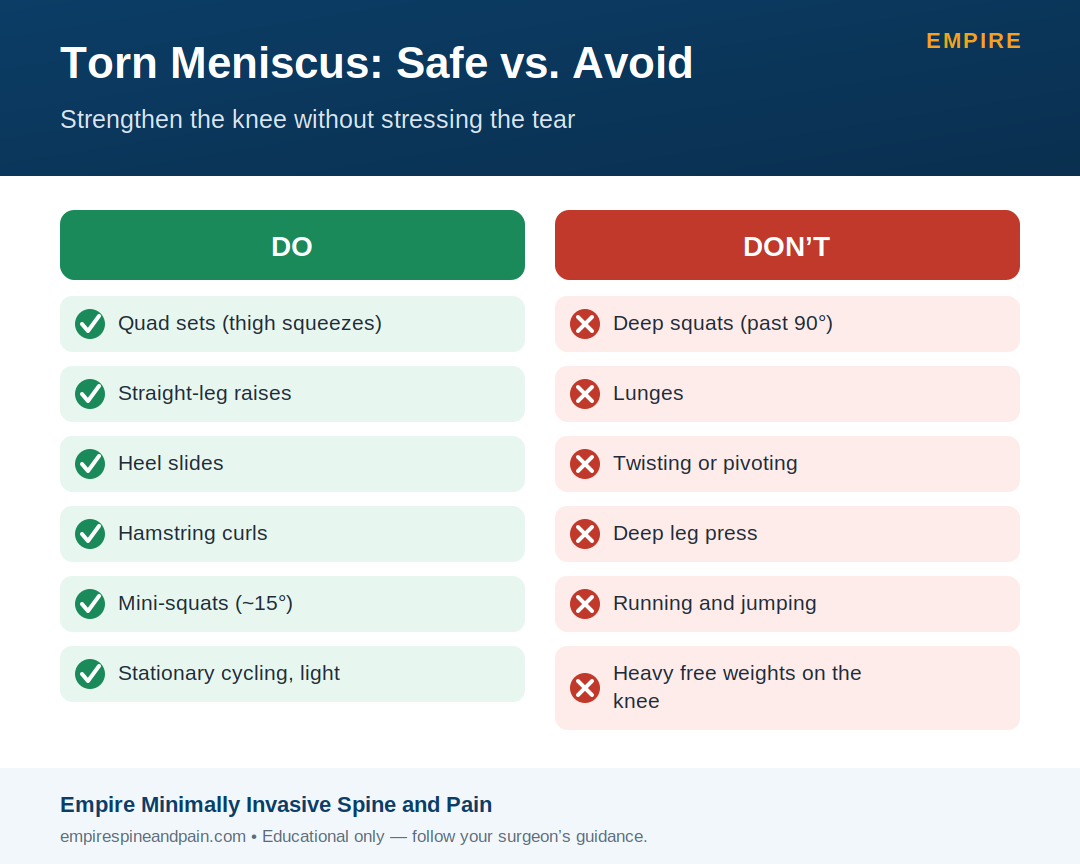
- Deep squats — bending past about 90 degrees pinches the meniscus.
- Lunges (especially deep or walking lunges).
- Twisting or pivoting — sports like basketball, tennis, and soccer, or any move that rotates the knee.
- Deep leg press and full-arc leg extensions through a painful range.
- High-impact activity — running, jumping, and plyometrics.
- Adding heavy free weights to any of the above.
Safe exercises to do instead
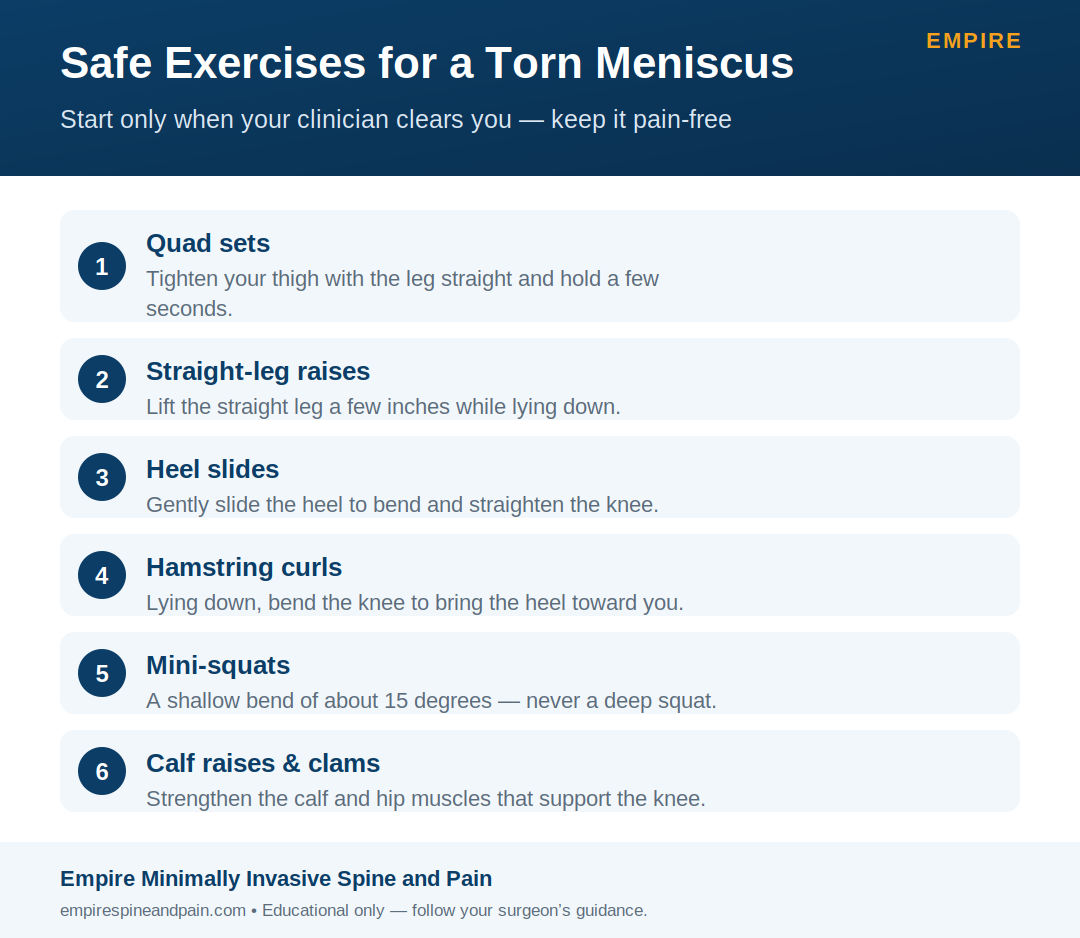
These build strength and mobility while protecting the tear. Start only after your doctor or physical therapist clears you. A little discomfort is normal — but if a movement causes pain, stop.
- Quad sets — tighten your thigh with the leg straight; hold a few seconds.
- Straight-leg raises — lift the straight leg a few inches while lying down.
- Heel slides — gently slide the heel to bend and straighten the knee.
- Hamstring curls — lying down, bend the knee to bring the heel toward you.
- Mini-squats — a shallow bend of about 15 degrees, not a deep squat.
- Standing calf raises and clams — for the calf and hip muscles that support the knee.
A simple rehab progression
Recovery moves through phases. Let comfort and your therapist guide how fast you progress.
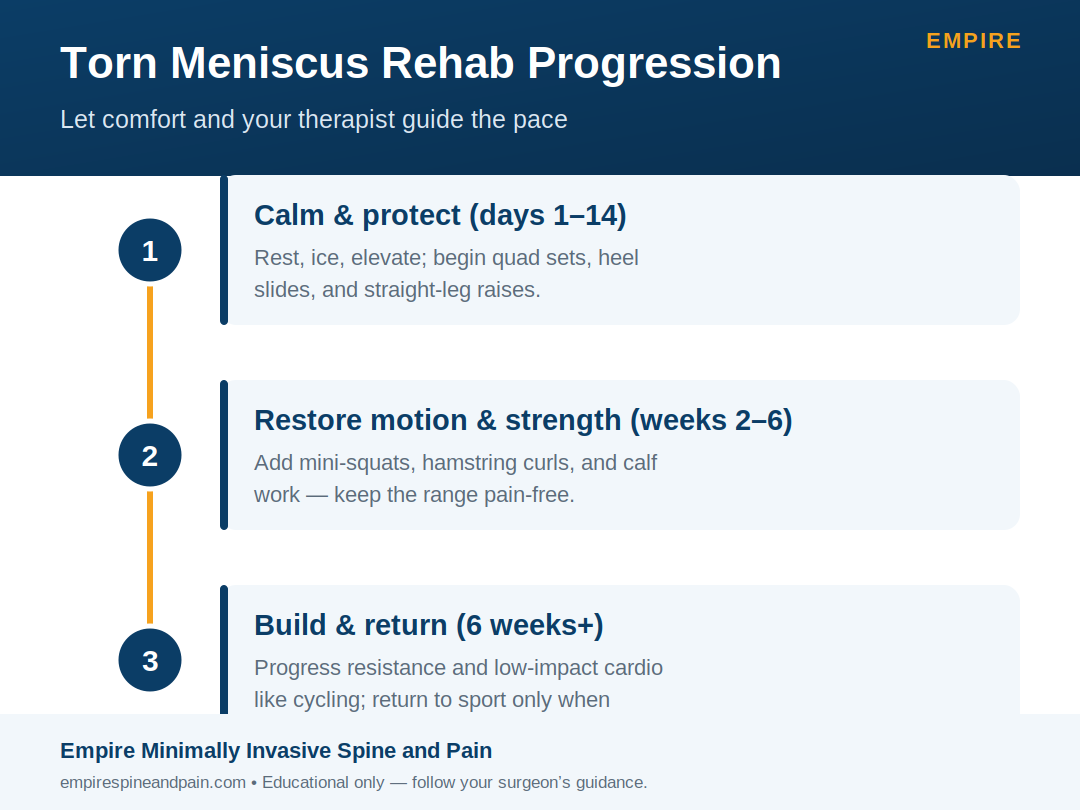
- Phase 1 — Calm and protect (about days 1–14): reduce swelling with rest, ice, and elevation; begin gentle quad sets, heel slides, and straight-leg raises.
- Phase 2 — Restore motion and basic strength (weeks 2–6): add mini-squats, hamstring curls, and calf work; keep range pain-free.
- Phase 3 — Build strength and return to activity (6 weeks+): progress resistance and low-impact conditioning like stationary cycling; return to sport only when cleared.
How long does a torn meniscus take to heal?
It depends on the tear. Less severe tears often improve within four to six weeks with rest and physical therapy. Larger tears, or those that lock the knee, may need a procedure — and recovery after surgery can take longer. Steady, pain-guided progress is the pattern to expect.
Is walking or cycling okay?
Usually, yes. Walking on level ground and stationary cycling with light resistance are among the safest ways to keep the knee moving, as long as they don’t cause sharp pain. They avoid the deep bending and twisting that aggravate a tear while keeping the joint mobile.
When exercises aren’t enough
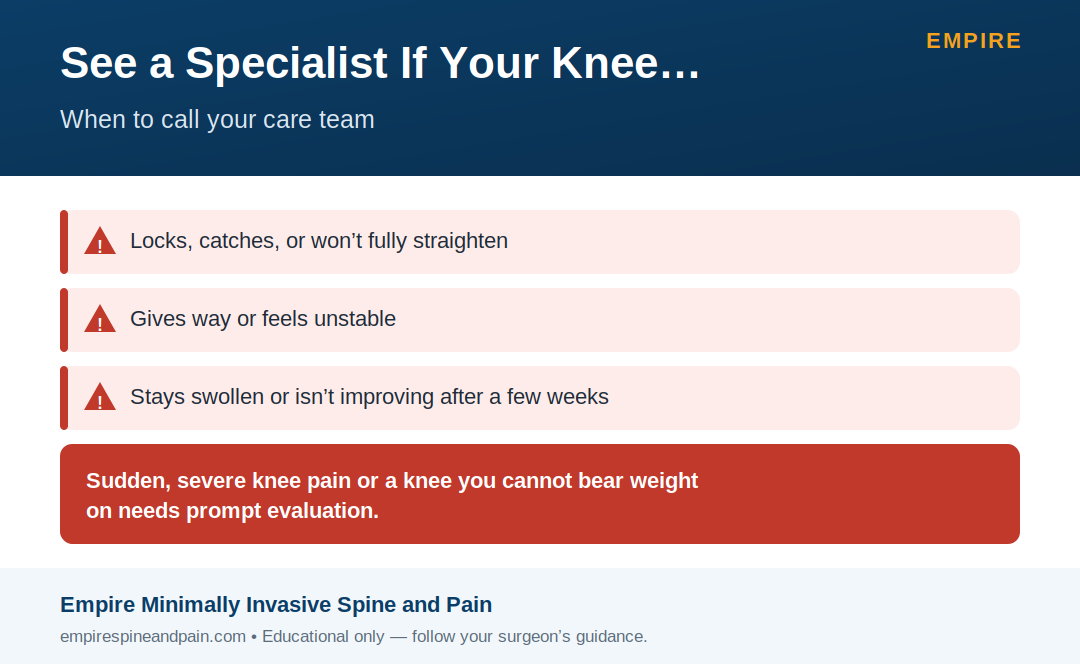
See a knee pain doctor if your knee locks or catches, gives way, can’t fully straighten, stays swollen, or if pain isn’t improving after a few weeks of careful rehab. If conservative care doesn’t settle the tear, a minimally invasive knee arthroscopy performed by an experienced knee surgeon can trim or repair the meniscus through tiny incisions. Not sure whether you need it? Our guide on whether a torn meniscus needs surgery walks through the decision, and our torn meniscus and knee pain resources cover the full picture.
Frequently asked questions
What exercises should I avoid with a torn meniscus?
Avoid deep squats, lunges, twisting or pivoting movements, deep leg press through a painful range, and high-impact activities like running and jumping. Adding heavy weights to these makes them riskier.
Can I walk with a torn meniscus?
Usually yes, on level ground and within comfort. Walking keeps the knee mobile without the deep bending or twisting that aggravates a tear. Stop if you feel sharp pain, locking, or the knee giving way.
Is cycling good for a torn meniscus?
Stationary cycling with light resistance is generally a safe, low-impact way to keep the knee moving and build strength, as long as it stays pain-free.
Will exercise heal a torn meniscus?
Exercise strengthens the muscles that support and protect the knee, which helps many tears settle. It won’t repair a large mechanical tear, but for less severe tears, rest plus physical therapy often improves symptoms in 4–6 weeks.
How long should I rest a torn meniscus before exercising?
Begin gentle movement early — often within the first days — to prevent stiffness, but only after your doctor or therapist confirms it’s safe, and keep it pain-free.
This article is for general education and is not a substitute for personal medical advice. Get exercises cleared by your own clinician. Sources: Medical News Today (meniscus tear exercises) and general orthopedic rehabilitation guidance.
What Our Patients Say

Dr. Jeffrey Guttman
Articles: 15
Our Plainview office has moved
Find us at our new location:
520 Old Country Rd
Plainview, NY 11803
Same doctors, same phone numbers.
Most Major Plans,
No-Fault & Personal Injury.
We accept most major insurance plans across our New York and New Jersey offices. Select your state to see accepted plans.
Accepted at our New York Locations
Workers' Compensation
No-Fault (NY & NJ)
Lien Cases
Medicare
Empire BCBS
BCBS / Anthem
Cigna
Aetna
Empire NYSHIP
Oxford (PPO)
United Health Care
GHI / Emblem Health
Humana (PPO)
Magnacare (PPO)
Northwell Direct
1199 SEIU
Self Pay
Accepted at our New Jersey Locations
No-Fault (NJ)
Lien Cases
Horizon BCBS
Empire NYSHIP
BCBS / Anthem (PPO)
Cigna
Aetna (PPO)
GHI / Emblem (PPO)
Port Authority UHC
Verizon Plan
Carpenter & Trade Unions
Self Pay
Medicare, Medicaid and Workers' Compensation are not accepted at our New Jersey locations. Not sure about your plan? Call us and we'll verify before your visit.
Not sure about your plan?
Call Us — 516-229-1443
Verify Your Coverage for FREE
Enter your information and our team will confirm your benefits before your visit.
✓ HIPAA Compliant
✓ No Obligation
✓ Same-Day Response
Your information is encrypted and secure. By submitting, you consent to receive communications regarding your appointment. You may opt out at any time.
Meet Our Pain Management & Orthopedic Specialists
Board-certified physicians dedicated to accurate diagnosis and minimally invasive care.

Pain Management
John Akhnoukh, M.D.
Board Certified Anesthesiologist & Interventional Pain Management Physician
Visit Profile



Pain Management
James Yu, D.O.
Board Certified Anesthesiologist & Interventional Pain Management Physician
Visit Profile

Pain Management
Benjamin Souferi, D.O.
Fellowship-Trained Interventional Pain Medicine Physician (Cleveland Clinic)
Visit ProfilePain Conditions Affecting Daily Life
Improve your quality of life with our comprehensive approach to pain management
We are dedicated to finding individualized treatment options tailored to fit your needs. Our team is dedicated to helping you lead a productive and active life, free from pain and disruption.
Our Locations
Pain management and orthopedic care across New York and New Jersey.