Can You Heal a Torn Rotator Cuff Without Surgery?
Medically reviewed by Salvatore Corso, MD — Orthopedic Surgeon, Sports Medicine
The MRI says “rotator cuff tear,” and the word that sticks is tear. Torn things get repaired. So surgery must be coming.
Not for most people, as it turns out. A tear in the rotator cuff is one of the most common findings in the shoulder, and a large share of the people who have one get their shoulder back without an operating room — not because they toughed it out, but because the research supports treating it that way first.
Here’s what the evidence actually says, and where surgery still earns its place.
Key Takeaways
- A torn tendon doesn’t reattach to the bone on its own — but your shoulder can still stop hurting and start working again.
- In a 452-patient study, about 75% of people with atraumatic full-thickness tears had not chosen surgery after two years of physical therapy.
- Tear size didn’t predict who ended up in surgery. What the patient expected did.
- Sudden tears from a fall, and tears in people who work overhead, are the cases where early repair is more often the right call.
What this article covers
- What a torn rotator cuff actually means
- Can a torn rotator cuff heal on its own?
- How well does physical therapy actually work?
- Who ends up needing surgery anyway?
- When is surgery the better choice?
- How we approach it at Empire
- When should you see a specialist?
- Frequently asked questions
What does a torn rotator cuff actually mean?
The rotator cuff is four muscles whose tendons wrap over the top of the arm bone like a cuff on a sleeve. They hold the ball of the shoulder centered in its socket and let you lift and rotate your arm. A tear means one of those tendons has pulled away from the bone, partly or completely.
Two kinds of tears show up in the clinic. A partial tear frays the tendon without detaching it. A full-thickness tear means the tendon has come off its attachment — there’s a hole in the cuff. Most tears involve the supraspinatus, the tendon that sits highest and does the most work overhead.
The other split matters more for your decision: how the tear happened. Some tears arrive in a moment — a fall onto an outstretched arm, a heavy lift that goes wrong. Most don’t. Most are the slow product of years of use, which is why they turn up so often in people who never had a single injury they can point to. Nearly two million Americans see a doctor about rotator cuff problems each year (American Academy of Orthopaedic Surgeons, 2024).
Can a torn rotator cuff heal on its own?
The tendon itself won’t reattach. Once it has pulled off the bone, it doesn’t grow back on its own, and no exercise program stitches it back down. On that narrow question, the honest answer is no.
But that’s rarely the question people are actually asking. What they want to know is whether the pain goes away and whether the arm works again — and there, the answer changes completely. Plenty of people with a tear that is still visible on an MRI have a shoulder that doesn’t hurt and does everything they need. The surrounding muscles take over the work. The inflammation settles. The tear stays; the problem doesn’t.
Worth sitting with: “healed” and “better” aren’t the same thing in the shoulder. A repair fixes the anatomy. Physical therapy fixes the function. Which one you need depends on your shoulder and your life — not on the word in the MRI report.
How well does physical therapy actually work?
Better than most people expect. The strongest evidence comes from the Multicenter Orthopaedic Outcomes Network (MOON) Shoulder Group, which followed 452 patients who had symptomatic, full-thickness tears that came on without a specific injury. Everyone started the same structured physical therapy program. About 75% had not chosen surgery two years later (Kuhn et al., Journal of Shoulder and Elbow Surgery, 2013).
Then they kept following them. At ten years, more than 70% still had not had surgery, and their reported pain and function hadn’t drifted backward in the meantime. That work earned the group the American Academy of Orthopaedic Surgeons’ 2024 Kappa Delta Award, and it changed how a lot of surgeons open this conversation.
MOON Shoulder Group cohort, 452 patients with atraumatic full-thickness tears 0%
50%
100%~75%
At 2 years
70%+
At 10 years
Source: Kuhn et al., J Shoulder Elbow Surg (2013); MOON 10-year follow-up, AAOS (2024)
One detail is easy to skim past: the people who did opt for surgery mostly decided early, between six and twelve weeks. Very few changed their minds in the years that followed. A course of therapy tends to answer the question fairly quickly.
Who ends up needing surgery anyway?
Here’s the finding that surprises people, including some clinicians. When the MOON researchers looked at what predicted whether a patient ended up in surgery, the size of the tear didn’t. Neither did how far the tendon had pulled back, how high the patient rated their pain, or how weak the shoulder tested.
What predicted it was what the patient expected physical therapy to do for them.
That isn’t a claim that the tear doesn’t matter, and it isn’t a suggestion that surgery is a state of mind. It’s a finding about a real pattern: two people can walk in with almost identical MRIs and take completely different paths, and the MRI won’t tell you which is which. This is why a good consultation spends more time on what you need your shoulder to do than on the size of the hole in the tendon.
When is surgery the better choice?
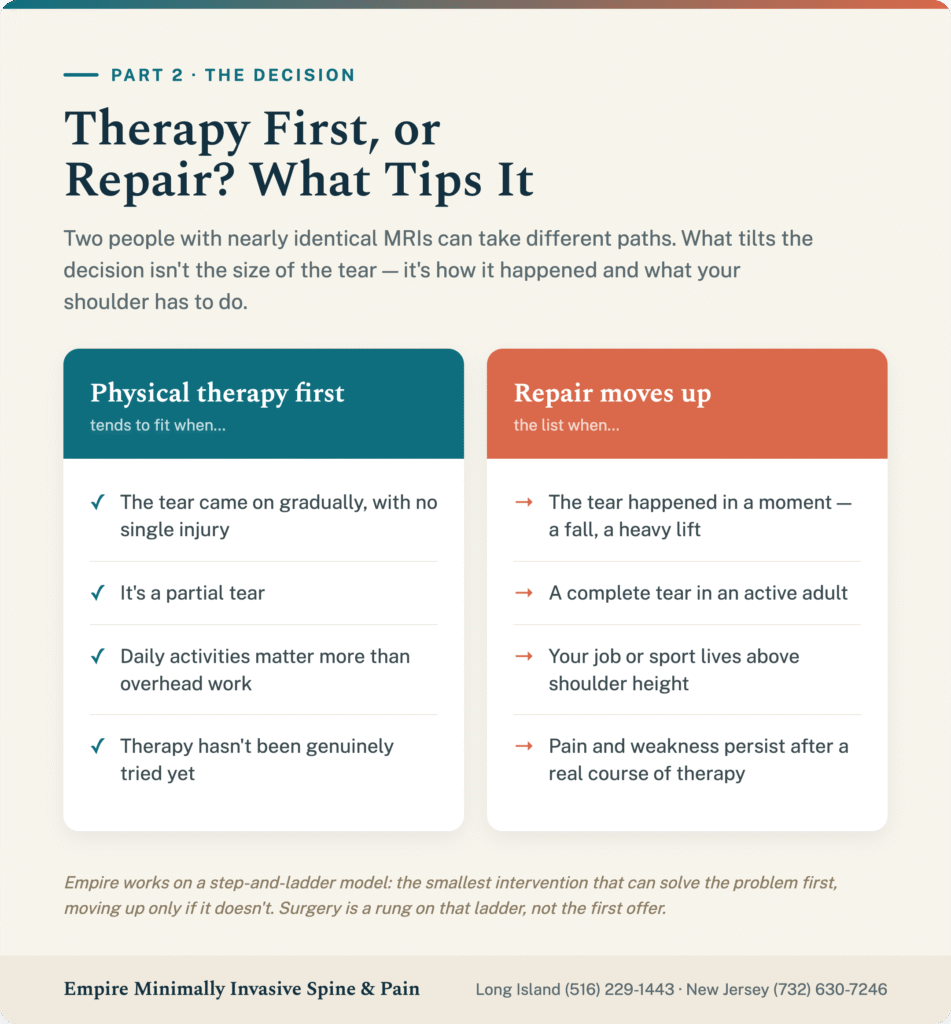
Sometimes it clearly is. Repair moves up the list when the tear came from a distinct injury rather than years of wear, when you’re younger and more active, when your work or sport puts your arm over your head, or when a real course of therapy has come and gone and the pain and weakness are still there.
| Physical therapy first tends to fit | Repair moves up the list |
|---|---|
| The tear came on gradually, with no single injury | The tear happened in a moment — a fall, a heavy lift |
| A partial tear | A complete tear in an active adult |
| Daily activities matter more than overhead work | Your job or sport lives above shoulder height |
| Therapy hasn’t been genuinely tried yet | Pain and weakness persist after a real course of therapy |
When repair is the answer, it’s usually done arthroscopically — through small incisions with a camera, rather than opening the shoulder. You can read what that involves on our rotator cuff repair page. The American Academy of Orthopaedic Surgeons’ patient guide is also a solid, plain-language second read if you want a source with no stake in your decision.
How we approach it at Empire
Our practice works on a step-and-ladder model: start with the smallest intervention that can solve the problem, and move up only if it doesn’t. For most rotator cuff tears that means a real course of therapy, sometimes with an injection to quiet the shoulder down enough to do the work. Surgery is a rung on that ladder, not the first offer.
It’s the same logic we apply when an MRI turns up a meniscus tear in the knee — the imaging finding and the thing that’s actually hurting you aren’t always the same object.
The part that isn’t negotiable is honesty about which rung you’re on. If your tear is the kind the evidence says does better with early repair, saying so is the job. Delay isn’t a virtue when it costs you a better outcome.
When should you see a specialist?
Book an appointment if shoulder pain has hung around more than a few weeks, if you can’t sleep on that side, if lifting your arm has become a decision rather than a reflex, or if the shoulder went weak suddenly after a fall. That last one deserves a prompt look rather than a wait-and-see.
Bring the question you actually care about. Not “how big is the tear” — the research says that’s not the number that decides this. Ask what your shoulder needs to do, and what it’ll take to get there.
Frequently asked questions
How long before I know if physical therapy is working?
Sooner than most people assume. In the MOON cohort, patients reported measurable improvement by six and twelve weeks, and those who went on to surgery mostly made that call in the same window. A few months of honest effort usually answers the question.
Will the tear get bigger if I wait?
It can, and that’s a fair thing to weigh with your surgeon. What the ten-year MOON data showed is that people who improved with therapy generally stayed improved, without a wave of later surgeries. Waiting isn’t automatically a gamble, but it’s a decision to make with imaging and a specialist, not alone.
Does a cortisone injection fix a rotator cuff tear?
No. It can reduce inflammation and pain enough to let you do the therapy that actually rebuilds function, which is a real role. It isn’t a repair, and it isn’t a plan on its own.
Can I still exercise with a rotator cuff tear?
Usually, with guidance. The point of therapy is loading the shoulder in ways that help and avoiding the ones that don’t — which is exactly the part that’s hard to figure out from a video. Get the program from someone who has examined your shoulder.
Get a straight answer about your shoulder
Our orthopedic team treats rotator cuff injuries across Long Island and northern New Jersey — starting with the least invasive option that can actually solve it.
Schedule a consultation → | New York: 516-229-1443 | New Jersey: 732-630-7246
What Our Patients Say

Dr. Salvatore Corso
Articles: 9
Our Plainview office has moved
Find us at our new location:
520 Old Country Rd
Plainview, NY 11803
Same doctors, same phone numbers.
Most Major Plans,
No-Fault & Personal Injury.
We accept most major insurance plans across our New York and New Jersey offices. Select your state to see accepted plans.
Accepted at our New York Locations
Workers' Compensation
No-Fault (NY & NJ)
Lien Cases
Medicare
Empire BCBS
BCBS / Anthem
Cigna
Aetna
Empire NYSHIP
Oxford (PPO)
United Health Care
GHI / Emblem Health
Humana (PPO)
Magnacare (PPO)
Northwell Direct
1199 SEIU
Self Pay
Accepted at our New Jersey Locations
No-Fault (NJ)
Lien Cases
Horizon BCBS
Empire NYSHIP
BCBS / Anthem (PPO)
Cigna
Aetna (PPO)
GHI / Emblem (PPO)
Port Authority UHC
Verizon Plan
Carpenter & Trade Unions
Self Pay
Medicare, Medicaid and Workers' Compensation are not accepted at our New Jersey locations. Not sure about your plan? Call us and we'll verify before your visit.
Not sure about your plan?
Call Us — 516-229-1443
Verify Your Coverage for FREE
Enter your information and our team will confirm your benefits before your visit.
✓ HIPAA Compliant
✓ No Obligation
✓ Same-Day Response
Your information is encrypted and secure. By submitting, you consent to receive communications regarding your appointment. You may opt out at any time.
Meet Our Pain Management & Orthopedic Specialists
Board-certified physicians dedicated to accurate diagnosis and minimally invasive care.
Pain Management
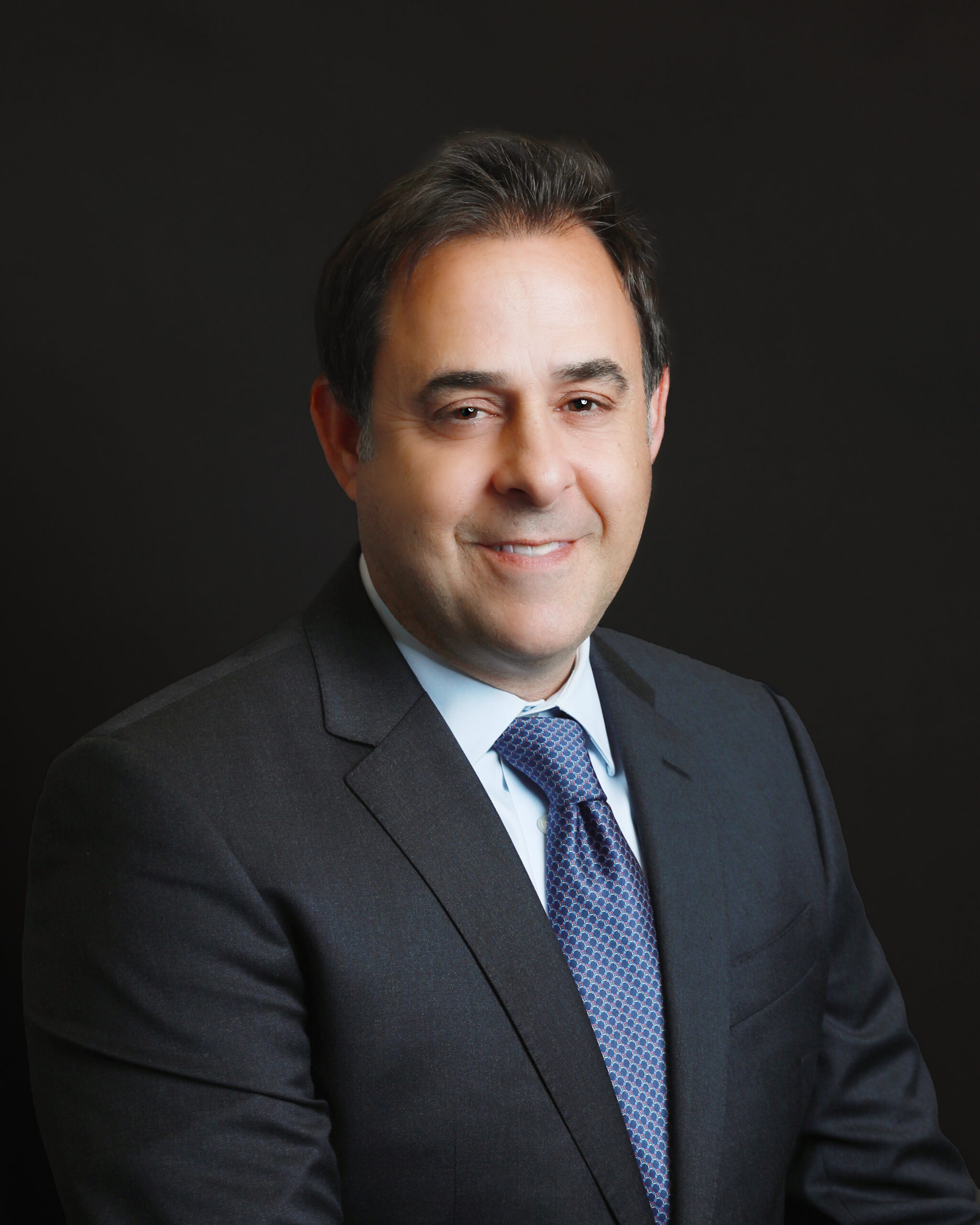
John Akhnoukh, M.D.
Board Certified Anesthesiologist & Interventional Pain Management Physician
Visit Profile

Pain Management
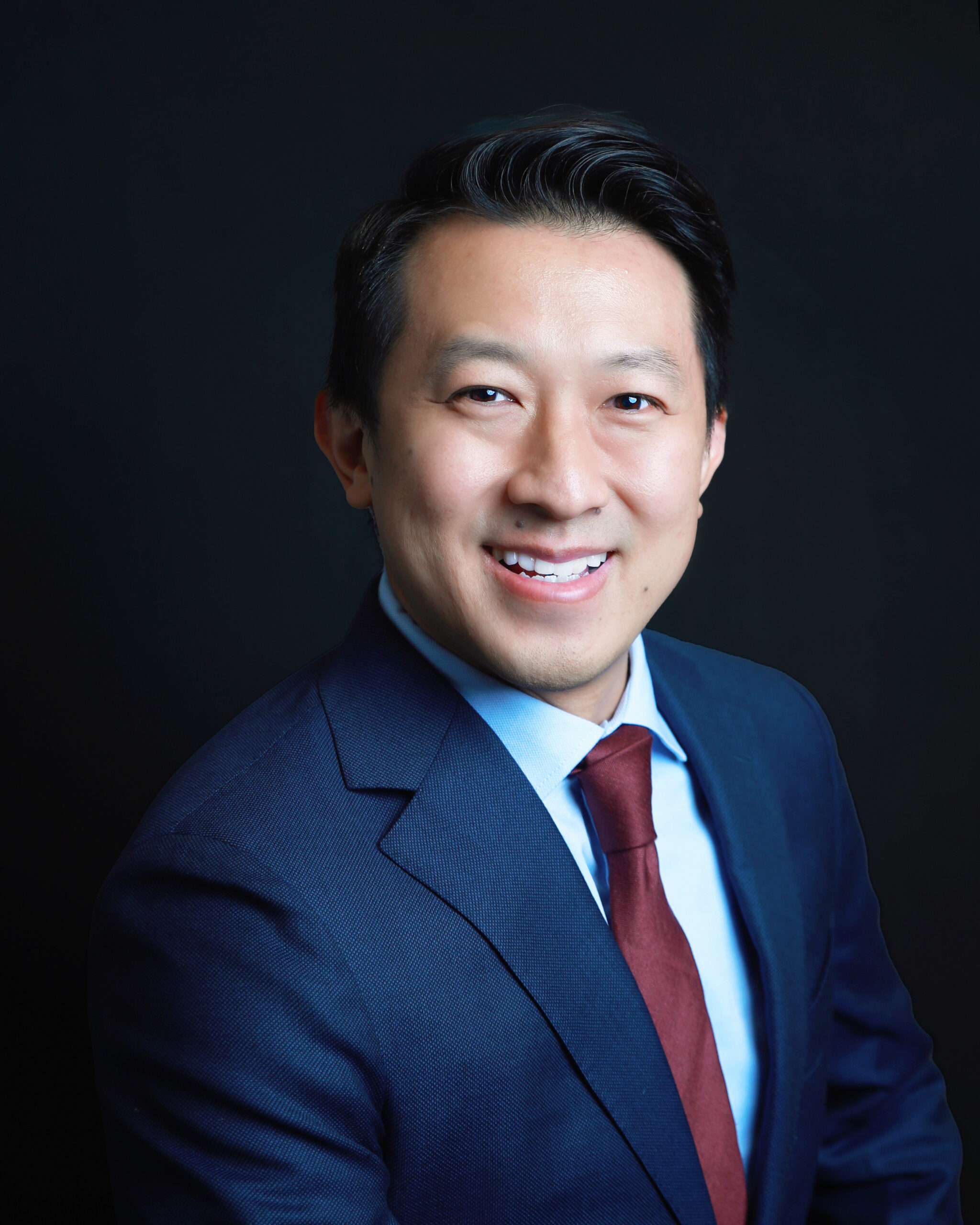
James Yu, D.O.
Board Certified Anesthesiologist & Interventional Pain Management Physician
Visit Profile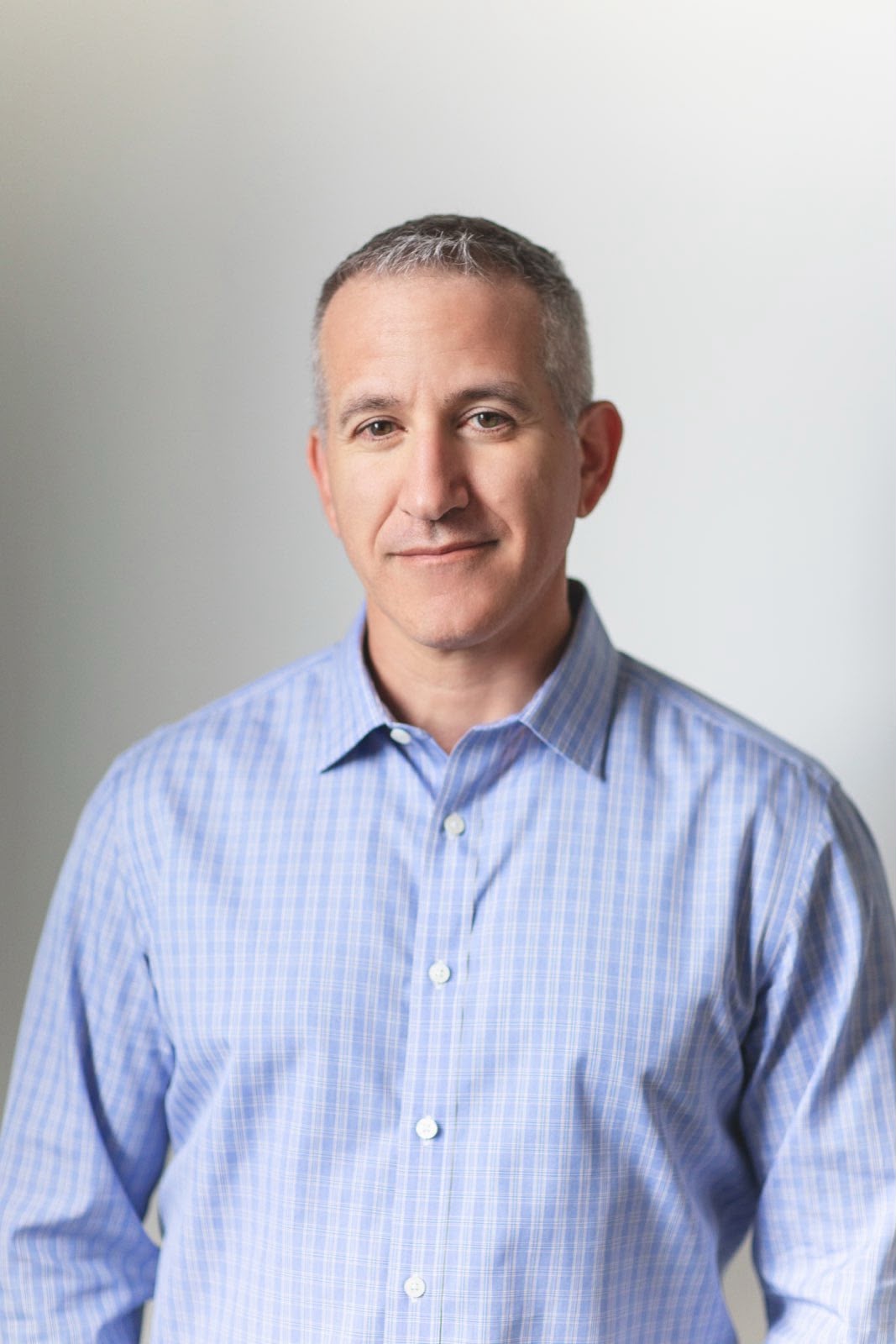

Pain Management
Benjamin Souferi, D.O.
Fellowship-Trained Interventional Pain Medicine Physician (Cleveland Clinic)
Visit ProfilePain Conditions Affecting Daily Life
Improve your quality of life with our comprehensive approach to pain management
We are dedicated to finding individualized treatment options tailored to fit your needs. Our team is dedicated to helping you lead a productive and active life, free from pain and disruption.
Our Locations
Pain management and orthopedic care across New York and New Jersey.