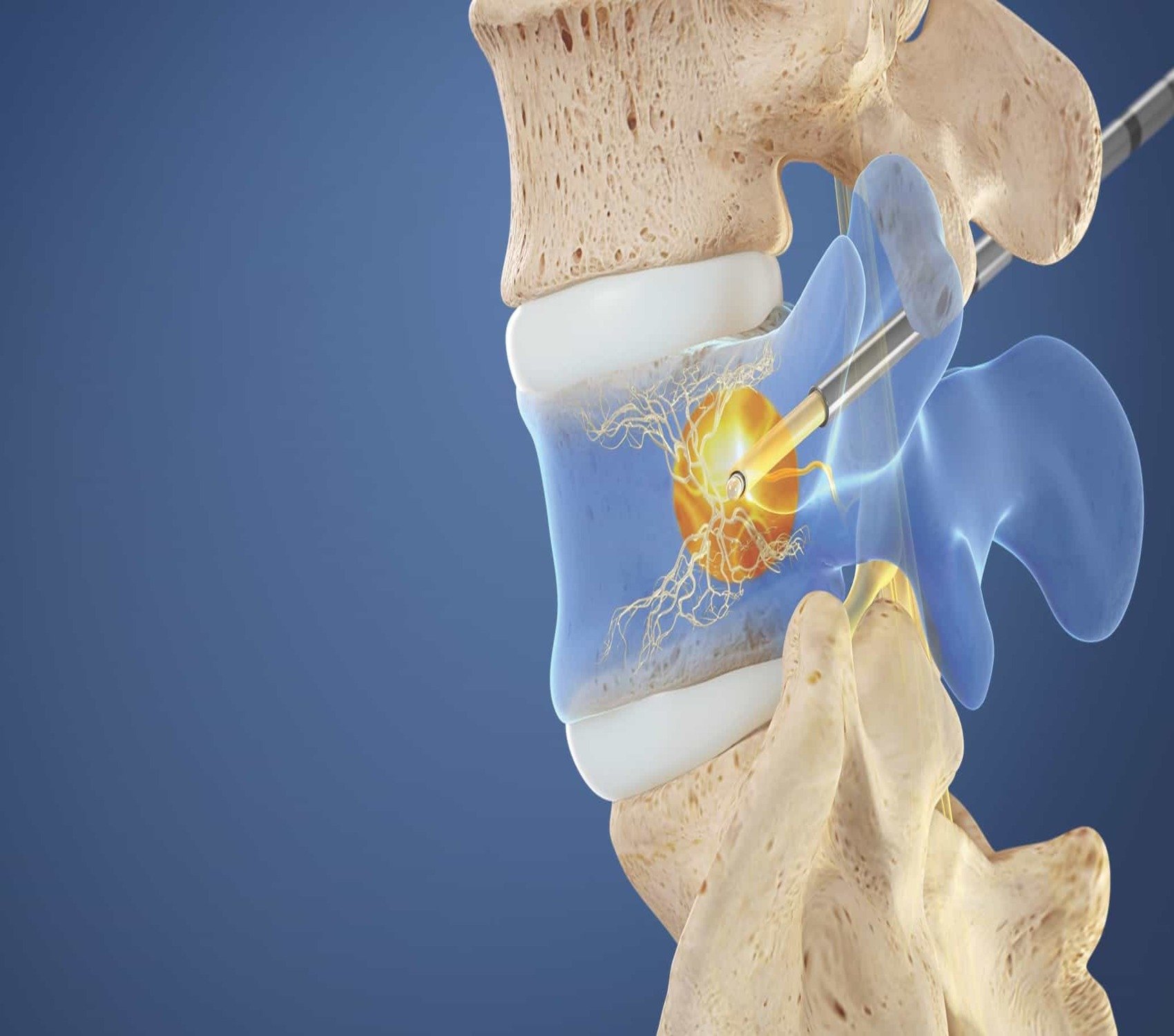
Basivertebral nerve ablation (BVNA) is a minimally invasive procedure used to treat chronic vertebrogenic low back pain, which is pain originating from the vertebral endplates—the thin layers of bone between the intervertebral discs and vertebrae. This type of pain is commonly associated with degeneration of spinal discs and Modic changes visible on MRI scans. The basivertebral nerve transmits pain signals from these endplates to the brain. In patients with vertebrogenic pain, this nerve becomes a source of chronic discomfort. During the procedure, a specialized needle is guided into the vertebral body using fluoroscopy (real-time X-ray imaging). A small probe is then inserted to deliver radiofrequency (RF) energy, which heats and ablates (destroys) the basivertebral nerve. This interrupts the transmission of pain signals from the degenerated endplates. Basivertebral nerve ablation is typically performed in an outpatient setting under local anesthesia with light sedation. The procedure takes about 1 hour, and most patients go home the same day.
If you have chronic low back pain that sits deep in the middle of your back, worsens when you bend or sit, and hasn’t responded to therapy or injections, it may be coming from inside the vertebrae themselves — and basivertebral nerve ablation may help. Our pain physicians offer this treatment across Long Island and northern New Jersey, with offices in Plainview, New Hyde Park, and Ronkonkoma, NY, and Clifton, Montville, and Plainfield, NJ.
The short version
- Basivertebral nerve ablation (often done with the Intracept system) treats a specific kind of chronic low back pain called vertebrogenic pain.
- It uses radiofrequency energy to quiet the basivertebral nerve inside the vertebra, where this pain originates.
- It’s an outpatient procedure, usually about an hour, with most people back to normal activity within one to two weeks.
- It targets a different pain source than standard radiofrequency ablation — which is why a careful diagnosis comes first.
What basivertebral nerve ablation treats
Some chronic low back pain doesn’t come from a disc, a facet joint, or a pinched nerve — it comes from the vertebral body itself. When the endplates (the surfaces at the top and bottom of each vertebra) become damaged, they can generate a deep, aching, hard-to-pin-down back pain. Doctors call this vertebrogenic pain, and it’s carried by a nerve that runs inside the bone called the basivertebral nerve.
According to Hospital for Special Surgery, basivertebral nerve ablation is used to treat vertebrogenic pain that originates from damaged vertebral endplates. The procedure uses radiofrequency energy to interrupt that nerve so it can no longer send the pain signal — without removing bone or disturbing the structure of your spine.
This is not the same as standard RFA: Ordinary radiofrequency ablation targets the medial branch nerves of arthritic facet joints. Basivertebral nerve ablation targets a nerve inside the vertebra for a different pain source. The two treat different problems, which is exactly why an accurate diagnosis matters before either one.
Are you a candidate?
Basivertebral nerve ablation tends to fit a specific profile. As described in NIH’s StatPearls reference, it’s a minimally invasive option for carefully selected patients with vertebrogenic pain. It may be worth discussing when:
- You’ve had chronic low back pain for at least six months
- Conservative care — physical therapy, medication, and often injections — hasn’t given you lasting relief
- Your pain is felt deep and centrally in the low back, and worsens with bending forward or prolonged sitting
- MRI shows changes at the vertebral endplates (sometimes called Modic changes) consistent with this pain source
It isn’t right for everyone. It’s generally not recommended for people with certain implanted electronic devices such as a pacemaker, during pregnancy, or where other conditions make it unsuitable — all things your physician will review with you.
What to expect
The procedure is done in-office on an outpatient basis under light sedation and local anesthesia, using live X-ray guidance to reach the basivertebral nerve precisely. It usually takes about an hour, leaves no implant behind, and requires no stitches. You go home the same day with a driver.
Most people begin returning to normal activity within one to two weeks. It’s sensible to avoid heavy lifting and vigorous exercise for roughly the first two weeks, while walking is usually encouraged. Your physician will give you specific aftercare guidance at your follow-up.
How it compares to other back-pain procedures
| Basivertebral nerve ablation | Standard radiofrequency ablation | |
|---|---|---|
| Pain source treated | Vertebrogenic pain (vertebral endplates) | Facet joint pain (arthritic joints) |
| Nerve targeted | Basivertebral nerve, inside the vertebra | Medial branch nerves, outside the joint |
| Repeated over time? | Typically intended as a one-time treatment per level | Often repeated as nerves regrow |
| Diagnosis before | MRI endplate changes + exam | Positive diagnostic medial branch block |
Why patients across Long Island and North Jersey choose Empire
We’re a local pain and orthopedic practice, not a national hospital system — so your diagnosis, procedure, and follow-up all happen close to home with the same team.
- New York: Plainview, New Hyde Park, and Ronkonkoma — across Nassau and Suffolk
- New Jersey: Clifton, Montville, and Plainfield — serving Passaic, Morris, and Union County communities
- Interventional pain management and orthopedics under one roof
- Image-guided technique for precise, targeted treatment
Insurance
Coverage varies by plan and by location, and we accept many major insurance plans across our New York and New Jersey offices. The simplest way to know exactly what your plan covers is to call — our team will verify your benefits before your visit, so there are no surprises. Whether you’re on Long Island or in North Jersey, reach out and we’ll walk you through your options.
Frequently asked questions
How long does it take to recover from basivertebral nerve ablation?
Most people return to normal activity within one to two weeks. It’s wise to avoid heavy lifting and strenuous exercise for about the first two weeks, while gentle walking is usually encouraged.
Is the procedure painful?
You’re given local anesthesia and light sedation, so it’s generally well tolerated. Some soreness at the treatment area for a week or two afterward is normal and usually settles with rest and ice.
What are the risks or downsides?
Risks are low but can include temporary soreness, bruising, numbness, infection, or nerve irritation at the treatment site. Your physician will review these with you before you decide.
How is this different from radiofrequency ablation?
Standard RFA treats arthritic facet joint pain by targeting the medial branch nerves. Basivertebral nerve ablation treats vertebrogenic pain by targeting a nerve inside the vertebra. They address different pain sources, so the right one depends on your diagnosis.
Who is not a candidate?
It’s generally not recommended for people with certain implanted electronic devices like a pacemaker, during pregnancy, or where other health conditions make it unsuitable. An evaluation is the only way to know for sure.
Is it a permanent fix?
It’s typically intended as a one-time treatment for the treated level, and many patients experience lasting relief. As with any procedure, results vary from person to person, and no honest practice can promise a specific outcome.
Deep, stubborn low back pain that nothing has fixed?
Our pain physicians see patients across Long Island, NY and northern New Jersey. We’ll work out where your pain is truly coming from and tell you honestly whether basivertebral nerve ablation is worth considering.
New York: 516-229-1443 | New Jersey: 732-630-7246
JA
Medically reviewed by Dr. John Akhnoukh, M.D. — Board-certified in Anesthesiology & Interventional Pain Management
Last reviewed July 2026 · Empire Minimally Invasive Spine & Pain
What Our Patients Say
Our Plainview office has moved
Find us at our new location:
520 Old Country Rd
Plainview, NY 11803
Same doctors, same phone numbers.
Most Major Plans,
No-Fault & Personal Injury.
We accept most major insurance plans across our New York and New Jersey offices. Select your state to see accepted plans.
Accepted at our New York Locations
Workers' Compensation
No-Fault (NY & NJ)
Lien Cases
Medicare
Empire BCBS
BCBS / Anthem
Cigna
Aetna
Empire NYSHIP
Oxford (PPO)
United Health Care
GHI / Emblem Health
Humana (PPO)
Magnacare (PPO)
Northwell Direct
1199 SEIU
Self Pay
Accepted at our New Jersey Locations
No-Fault (NJ)
Lien Cases
Horizon BCBS
Empire NYSHIP
BCBS / Anthem (PPO)
Cigna
Aetna (PPO)
GHI / Emblem (PPO)
Port Authority UHC
Verizon Plan
Carpenter & Trade Unions
Self Pay
Medicare, Medicaid and Workers' Compensation are not accepted at our New Jersey locations. Not sure about your plan? Call us and we'll verify before your visit.
Not sure about your plan?
Call Us — 516-229-1443
Verify Your Coverage for FREE
Enter your information and our team will confirm your benefits before your visit.
✓ HIPAA Compliant
✓ No Obligation
✓ Same-Day Response
Your information is encrypted and secure. By submitting, you consent to receive communications regarding your appointment. You may opt out at any time.
Meet Our Pain Management & Orthopedic Specialists
Board-certified physicians dedicated to accurate diagnosis and minimally invasive care.

Pain Management
John Akhnoukh, M.D.
Board Certified Anesthesiologist & Interventional Pain Management Physician
Visit Profile



Pain Management
James Yu, D.O.
Board Certified Anesthesiologist & Interventional Pain Management Physician
Visit Profile

Pain Management
Benjamin Souferi, D.O.
Fellowship-Trained Interventional Pain Medicine Physician (Cleveland Clinic)
Visit ProfilePain Conditions Affecting Daily Life
Improve your quality of life with our comprehensive approach to pain management
We are dedicated to finding individualized treatment options tailored to fit your needs. Our team is dedicated to helping you lead a productive and active life, free from pain and disruption.
Our Locations
Pain management and orthopedic care across New York and New Jersey.