
Epidural Steroid Injection Cost, Coverage, and Safety: An Honest Guide
If you’ve been told an epidural steroid injection might help your back or neck pain, two questions usually come next: what will it cost, and is it safe? Both deserve a straight answer. The honest truth is that the price depends heavily on where the shot is done and what your insurance looks like, and the safety picture is mostly reassuring with a few rare risks worth knowing about. This guide walks through cost, insurance and Medicare coverage, and a balanced look at the risks — no sales pitch, just what you’d want a friend in medicine to tell you.
Key takeaways
- There’s no single price — where the injection is done (a doctor’s office vs. a hospital) is often the biggest cost factor.
- Most commercial plans and Medicare cover ESIs when they’re medically necessary; you’ll usually still owe a deductible and coinsurance.
- Medicare coverage policies generally allow up to four injections per spine region per year.
- Serious complications are rare; most side effects are mild and temporary.
What this guide covers
- How much does an epidural steroid injection cost?
- Does insurance cover epidural steroid injections?
- Does Medicare cover ESIs — and how many per year?
- The truth about epidural steroid injections: how safe are they?
- How long does relief last, and where ESIs fit in your care
- Frequently asked questions
How much does an epidural steroid injection cost?
There isn’t one price for an epidural steroid injection, and any site that quotes you a single number is guessing. The cost depends on where it’s done, whether image guidance is used, your region, and your insurance. The setting matters most: Medicare notes that you may pay more for the same outpatient care in a hospital than in a doctor’s office (Medicare.gov, 2026). Same needle, same medication — different bill.
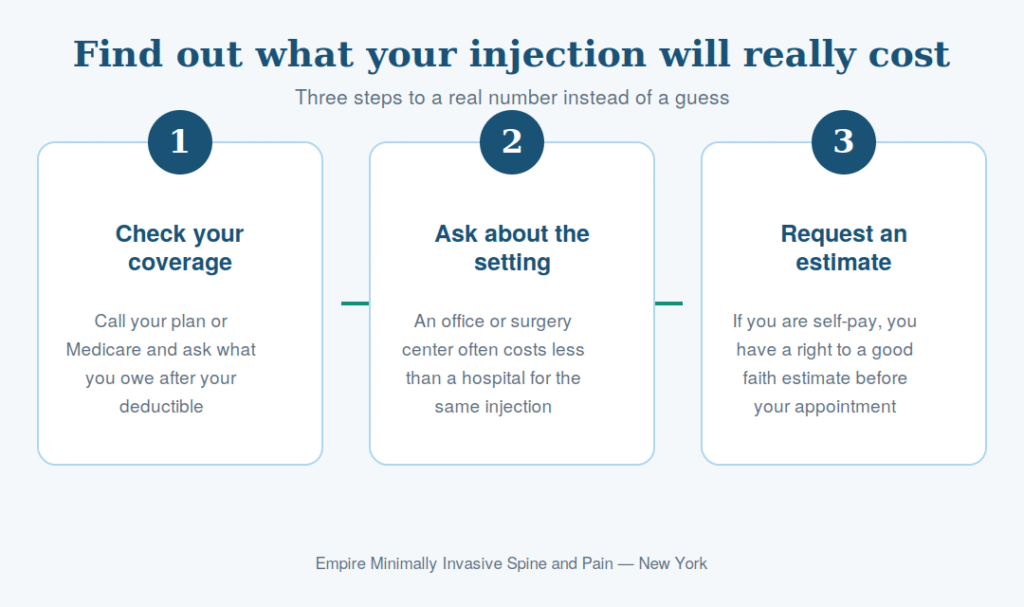
So how do you get a real number instead of a guess? Ask before the procedure. If you have insurance, call the member line and ask what you’ll owe after your deductible and coinsurance for the specific billing codes. If you’re paying yourself, you have a legal right to a written estimate (more on that just below).
Three things that move the price the most
1. Place of service. A hospital outpatient department usually bills more than an office or surgery center for the same injection.
2. Imaging guidance. Most ESIs are done under X-ray (fluoroscopy) or ultrasound for accuracy, which adds to the cost but improves precision.
3. Your coverage. With insurance, your share is a deductible plus coinsurance. Without it, you pay the full self-pay rate.
How much is an epidural injection without insurance?
Without insurance, you pay the facility’s full self-pay rate — but you don’t have to walk in blind. Under the federal No Surprises Act, uninsured and self-pay patients are entitled to a good faith estimate of expected costs before care. If your final bill comes in at least $400 above that estimate, you may be able to dispute it (CMS). Ask for that estimate in writing, and ask whether an office or surgery center setting would cost less than a hospital.
Does insurance cover epidural steroid injections?
Yes — most commercial health plans cover epidural steroid injections when they’re medically necessary for conditions like a herniated disc, spinal stenosis, or sciatica. “Covered” doesn’t mean free, though. You’ll typically owe your plan’s deductible and then coinsurance, and many plans require prior authorization or proof that you’ve already tried conservative care such as physical therapy or medication.
Most insurers treat an epidural steroid injection as a covered, medically necessary treatment once conservative care hasn’t resolved the pain — but coverage rules, prior-authorization requirements, and your out-of-pocket share vary by plan. Confirm the details with your insurer before scheduling.
A practical tip: ask your plan whether the injection is covered at the specific location where it’ll be performed. Because the setting drives the price, an in-network office or ambulatory surgery center can mean a smaller bill than a hospital outpatient department for the exact same procedure.
Does Medicare cover epidural steroid injections — and how many per year?
Medicare Part B does cover epidural steroid injections when they’re medically necessary. After you meet the Part B deductible, you generally pay 20% of the Medicare-approved amount for the outpatient service (Medicare.gov, 2026). A Medigap or Medicare Advantage plan may change what that 20% looks like for you.
How many will Medicare pay for? Medicare’s coverage policies generally limit epidural steroid injections to a maximum of four sessions per spine region in a rolling 12-month period, and a repeat injection is expected to be backed by documentation that the earlier one gave you meaningful, lasting relief (CMS Local Coverage Determination L39242). That’s a coverage cap, not a target — in day-to-day practice, many physicians limit patients to two or three injections a year to protect the surrounding bone and muscle (Cleveland Clinic).
Medicare coverage policies generally allow up to four epidural steroid injections per spine region over a rolling 12 months, and cover a repeat only when the prior injection is documented to have helped (CMS LCD L39242). Many clinicians choose to stay at two to three per year in practice.
The truth about epidural steroid injections: how safe are they?
For most people, an epidural steroid injection is a low-risk outpatient procedure — but “low-risk” isn’t “no-risk,” and you deserve the full picture. The common side effects are mild and temporary. The serious ones are rare but real, which is exactly why this is a conversation to have with your doctor rather than a decision to make from a search result.
Here’s the balance the evidence actually supports. In 2014, the U.S. Food and Drug Administration warned that rare but serious neurologic problems — including loss of vision, stroke, paralysis, and, in very rare cases, death — have been reported after epidural corticosteroid injections, and it noted these steroids aren’t FDA-approved specifically for injection into the spine’s epidural space (FDA Drug Safety Communication, 2014). In response, a group of pain and spine medical societies published a joint review concluding that epidural steroid injections are safe and effective when performed properly (Pain Medicine, 2015). Both things are true at once: the serious risks are genuine, and they’re uncommon when the injection is done carefully by an experienced physician.
The FDA has reported rare but serious neurologic risks from epidural corticosteroid injections — including vision loss, stroke, and paralysis — and notes the use is off-label (FDA, 2014). Pain and spine societies have countered that, done properly, the injections are safe and effective (Pain Medicine, 2015).
What does that look like in practical terms? Most people notice nothing worse than a sore back for a day or two. The table below separates the everyday, temporary effects from the rare complications so you can see them side by side.
| Common & temporary | Rare but serious |
|---|---|
| A short flare of pain before the steroid kicks in; soreness or bruising at the injection site; a brief rise in blood sugar (if you have diabetes) or in blood pressure and eye pressure (if you have glaucoma) | A “spinal” headache from a fluid leak (affects fewer than 1% of people); infection; bleeding near the spine; nerve injury; and the very rare neurologic events the FDA flagged |
Sources: Cleveland Clinic; FDA, 2014.
When to seek emergency care
Get emergency medical help right away if, after an epidural injection, you have sudden vision changes, severe headache, weakness or numbness in your arms or legs, loss of bladder or bowel control, dizziness, or seizures. These reactions are rare, but they need immediate attention (FDA, 2014).
How long does relief last, and where ESIs fit in your care
An epidural steroid injection usually starts working within two to seven days, and relief tends to last weeks to months — occasionally up to a year, though that’s less common (Cleveland Clinic). It won’t permanently solve what’s causing the pain, and it doesn’t help everyone, but for many people it calms things down enough to move, sleep, and get through physical therapy. If you want the day-by-day picture, we cover how long an epidural injection takes to work for sciatica in a separate article.
At Empire Minimally Invasive Spine and Pain, an injection is one rung on a ladder, not the whole staircase. We start with the least invasive option that can solve the problem — rest, physical therapy, and medication first, then targeted injections like an epidural steroid injection if pain persists, and only considering surgery when less invasive steps haven’t worked. If your pain is coming from arthritic joints in the spine rather than an irritated nerve, a different tool may fit better; we compare epidural steroid injection versus radiofrequency ablation to help sort that out.
Relief from an epidural steroid injection usually begins within two to seven days and lasts weeks to months, rarely up to a year (Cleveland Clinic). It’s best used as a step that buys time for rehab and daily function, not as a stand-alone solution.
Frequently asked questions
Are epidural injections covered by workers’ comp or after a car accident in New York?
Often, yes. If your back or neck injury came from a work accident or a car crash in New York, the injection is usually billed to your workers’ compensation or no-fault (auto) claim rather than your health insurance, as long as the treatment is documented as related to the injury. The rules and paperwork differ from standard health coverage, so it helps to work with a practice that handles these claims regularly.
How much will I actually pay if I have insurance?
Your out-of-pocket cost is usually your remaining deductible plus your coinsurance for the procedure. With Medicare Part B, that’s typically 20% of the approved amount after the deductible (Medicare.gov). The most reliable way to get your number is to call your plan with the procedure codes before the appointment.
Is the injection painful?
Most people feel a pinch and some pressure rather than sharp pain. The skin is numbed first, and the injection itself usually takes only a few minutes. A day or two of soreness at the site afterward is normal and typically eases on its own.
Can the shot make my pain worse?
A short-lived increase in pain in the first day or two — sometimes called a steroid flare — can happen before the medication starts to work (Cleveland Clinic). It usually settles quickly. Pain that’s severe or comes with the warning signs listed above is not typical and should be checked right away.
How soon can I go back to work?
Many people return to light activity the next day, though your doctor may ask you to take it easy for 24 hours. If your job is physically demanding, ask for specific guidance based on your spine condition and which level was injected.
What if I can’t afford it?
Ask for a good faith estimate up front, and ask whether having the injection in an office or surgery center rather than a hospital would lower the cost — the setting is often the biggest single factor. Some practices also offer payment plans, so it’s worth asking directly.
Talk to a New York pain specialist about your options
If back, neck, or nerve pain isn’t improving, our back pain doctors and sciatica doctors on Long Island can review your diagnosis, explain what an injection would likely cost with your coverage, and lay out the less invasive options first. We see patients across Long Island and the New York metro area, including Plainview, New Hyde Park, and Ronkonkoma. In New Jersey, see our specialists for sciatica treatment in NJ at our Clifton office (732-630-7246); please note our New Jersey offices don’t accept Medicare. Call 516-229-1443 or learn more about epidural steroid injections to get started.
About the author
This article was written for patients of Empire Minimally Invasive Spine and Pain and is bylined by Dr. Monika Misak, an interventional pain specialist on Empire’s pain management team. Empire is a combined pain management and orthopedic practice serving New York and New Jersey, focused on treating spine and joint pain with the least invasive approach that works.
This article is for general education and isn’t a substitute for personal medical advice. Talk with a qualified clinician about your specific condition and treatment options.
Sources
- Cleveland Clinic — Epidural Steroid Injection (ESI)
- U.S. FDA — Drug Safety Communication on epidural corticosteroid injections (2014)
- Pain Medicine — Epidural Steroid Injections Are Safe and Effective: Multisociety Letter (2015)
- CMS — Local Coverage Determination L39242, Epidural Steroid Injections for Pain Management
- Medicare.gov — Outpatient hospital services
- CMS — No Surprises Act (good faith estimates)
What Our Patients Say

Dr. Monika Misak
Articles: 9

Medicare, Workers Comp,
No Fault & Others.
We accept most major insurance plans across our New York and New Jersey offices. Select your state to see accepted plans.
Accepted at our New York Locations
Workers' Compensation
No-Fault (NY & NJ)
Lien Cases
Medicare
Empire BCBS
BCBS / Anthem
Cigna
Aetna
Empire NYSHIP
Oxford (PPO)
United Health Care
GHI / Emblem Health
Humana (PPO)
Magnacare (PPO)
Northwell Direct
1199 SEIU
Self Pay
Accepted at our New Jersey Locations
Workers' Compensation
No-Fault (NJ)
Lien Cases
Horizon BCBS
Empire NYSHIP
BCBS / Anthem (PPO)
Cigna
Aetna (PPO)
GHI / Emblem (PPO)
Port Authority UHC
Verizon Plan
Carpenter & Trade Unions
Self Pay
Medicare and Medicaid are not accepted at our New Jersey locations. Not sure about your plan? Call us and we'll verify before your visit.
Not sure about your plan?
Call Us — 516-229-1443
Verify Your Coverage for FREE
Enter your information and our team will confirm your benefits before your visit.
✓ HIPAA Compliant
✓ No Obligation
✓ Same-Day Response
Your information is encrypted and secure. By submitting, you consent to receive communications regarding your appointment. You may opt out at any time.
Meet Our Pain Management & Orthopedic Specialists
Board-certified physicians dedicated to accurate diagnosis and minimally invasive care.

Pain Management
John Akhnoukh, M.D.
Board Certified Anesthesiologist & Interventional Pain Management Physician
Visit Profile



Pain Management
James Yu, D.O.
Board Certified Anesthesiologist & Interventional Pain Management Physician
Visit Profile

Pain Management
Benjamin Souferi, D.O.
Fellowship-Trained Interventional Pain Medicine Physician (Cleveland Clinic)
Visit ProfilePain Conditions Affecting Daily Life
Improve your quality of life with our comprehensive approach to pain management
We are dedicated to finding individualized treatment options tailored to fit your needs. Our team is dedicated to helping you lead a productive and active life, free from pain and disruption.
Our Locations
Pain management and orthopedic care across New York and New Jersey.