Microdiscectomy Recovery Time: A Week-by-Week Timeline
Most people recover from a microdiscectomy faster than they expect. It is usually an outpatient surgery, so you go home the same day and walk that afternoon. Desk or light work often returns in about two to four weeks, most everyday activities by around six weeks, and heavy labor or sports closer to twelve weeks. The sharp leg pain (sciatica) that led to surgery is often much better within days. This guide walks you through recovery week by week — what is normal, what to avoid, and when to call your surgeon.
Comparing options? An endoscopic discectomy treats the same kind of herniated disc through an even smaller opening. See endoscopic discectomy vs. microdiscectomy for how the two procedures and their recoveries compare.
Key takeaways
- Microdiscectomy is usually outpatient — most people go home the same day and walk right away.
- Leg pain often eases quickly; incision soreness, stiffness, and tiredness fade over the first few weeks.
- Typical return: desk work 2–4 weeks, routine activity ~6 weeks, heavy work and sports ~12 weeks.
- The main early rule is to limit bending, lifting, and twisting for the first 3–6 weeks.
- Numbness or tingling can linger while the nerve heals; that is often normal and improves over weeks to months.
- Call your surgeon right away for fever, wound drainage, new weakness, or loss of bladder or bowel control.
How long does microdiscectomy recovery take?
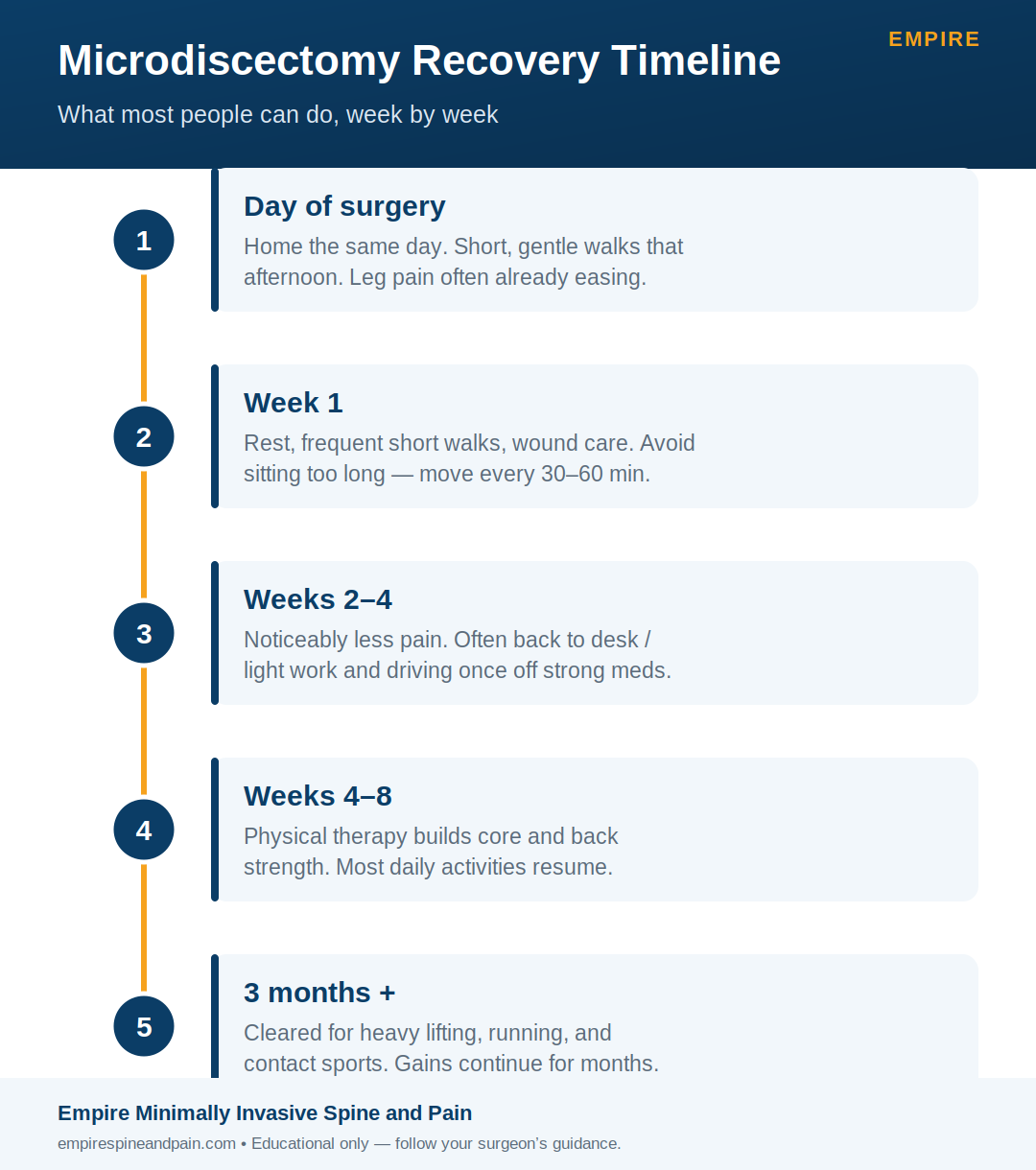
Recovery is a series of milestones, not a single date. According to Cleveland Clinic, recovery from a discectomy generally takes one to four weeks for the surgical area to settle, with light activity around two weeks, routine activity by about six weeks, and strenuous work or contact sports closer to twelve weeks. Here is the timeline at a glance:
The first week
A microdiscectomy is typically done as an outpatient procedure, so you will likely go home the same day. You will be encouraged to walk short distances that first afternoon — gentle walking is one of the best things you can do for healing and circulation. Expect some soreness at the small incision on your lower back, which is normal.
During week one, most of your energy goes into rest, short walks, and letting the incision heal. Prolonged sitting is often the least comfortable position early on, because sitting puts more stress on the lower back, so stand up and move every 30 to 60 minutes. Take pain medicine as directed, and do not bend at the waist, lift more than a few pounds, or twist your spine.
Weeks 2 to 4
This is often the turning point. Spine-Health notes that about two weeks after a lumbar microdiscectomy, most patients begin to feel significantly less pain and have more energy. Walking gets easier, and you can add gentle stretching if your surgeon approves.
Many people with desk or light-duty jobs return to work in this window, often starting with half-days and taking frequent breaks to stand and move. Driving usually becomes possible once you are off opioid pain medication and can move freely in an emergency — often around the two-week mark. Jobs that involve standing, lifting, or physical labor typically need more time.
Weeks 4 to 8
By four to eight weeks, most people are back to the majority of daily activities. This is usually when physical therapy ramps up to rebuild core and back strength, improve flexibility, and teach safe movement. Some surgeons start gentle therapy earlier; others wait until about six weeks. Cleveland Clinic notes that surgeons often advise limiting heavy bending, lifting, and twisting for three to six weeks to lower the risk of the disc herniating again. Think of this as the “protect and rebuild” phase.
Three months and beyond
Around the three-month mark, many people are cleared for heavier work, running, and contact sports, once strength and healing allow. If you have a physically demanding job, your return-to-work date is often in this later window and may be guided by physical therapy progress. Improvement can continue gradually for several months as strength returns and any remaining nerve irritation settles.
Nerve healing: numbness, tingling, and buttock or leg symptoms
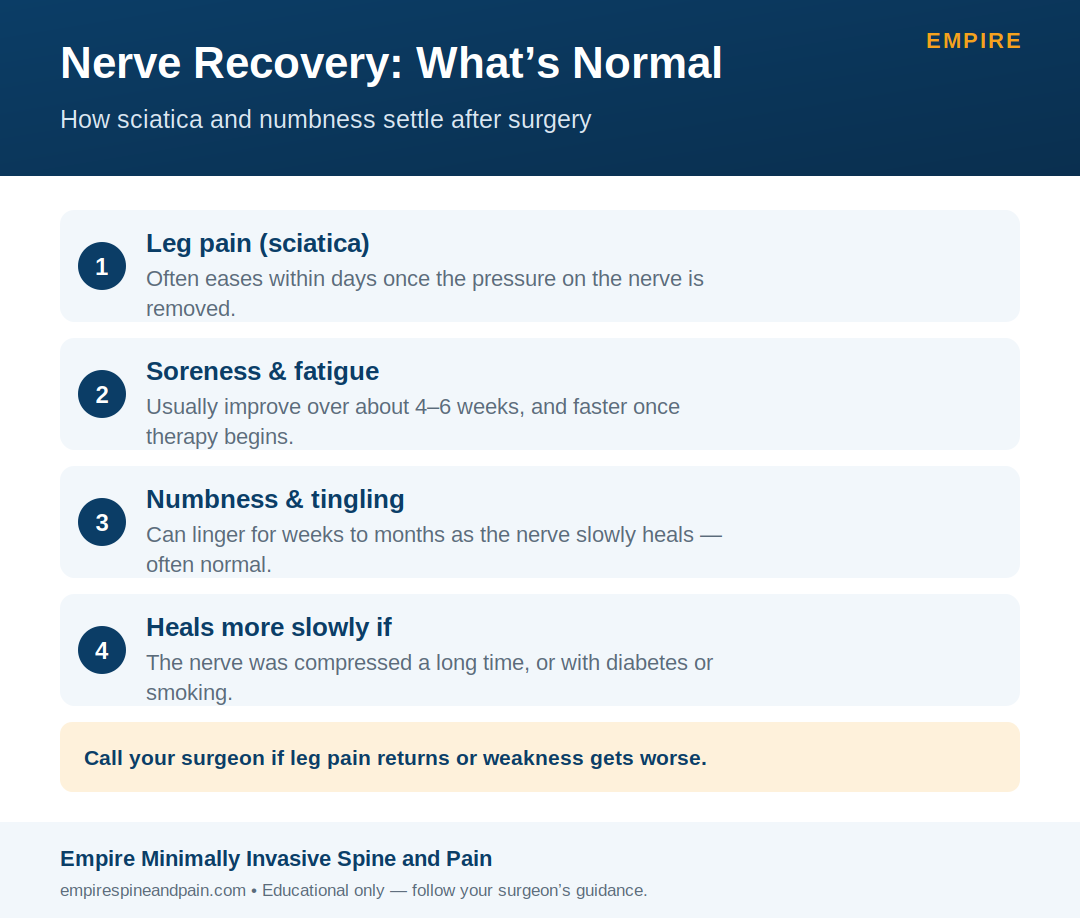
Removing the disc fragment takes pressure off the nerve, but the nerve itself heals on its own timeline. It is common to still feel some numbness, tingling, or aching in the buttock, thigh, or leg for a while after surgery. According to Barricaid, general post-surgery discomfort often eases within about four to six weeks, especially once physical therapy begins, while nerve-based sensations can linger longer because the nerve may keep sending signals as it recovers.
How fast the nerve heals depends on things like how long it was compressed before surgery, how much pressure the disc created, your overall health, and conditions that affect circulation such as diabetes. Slow, steady improvement is the pattern to expect. Tell your surgeon if leg pain suddenly returns or weakness gets worse — those are worth checking.
Activity restrictions: bending, lifting, twisting, driving, sports
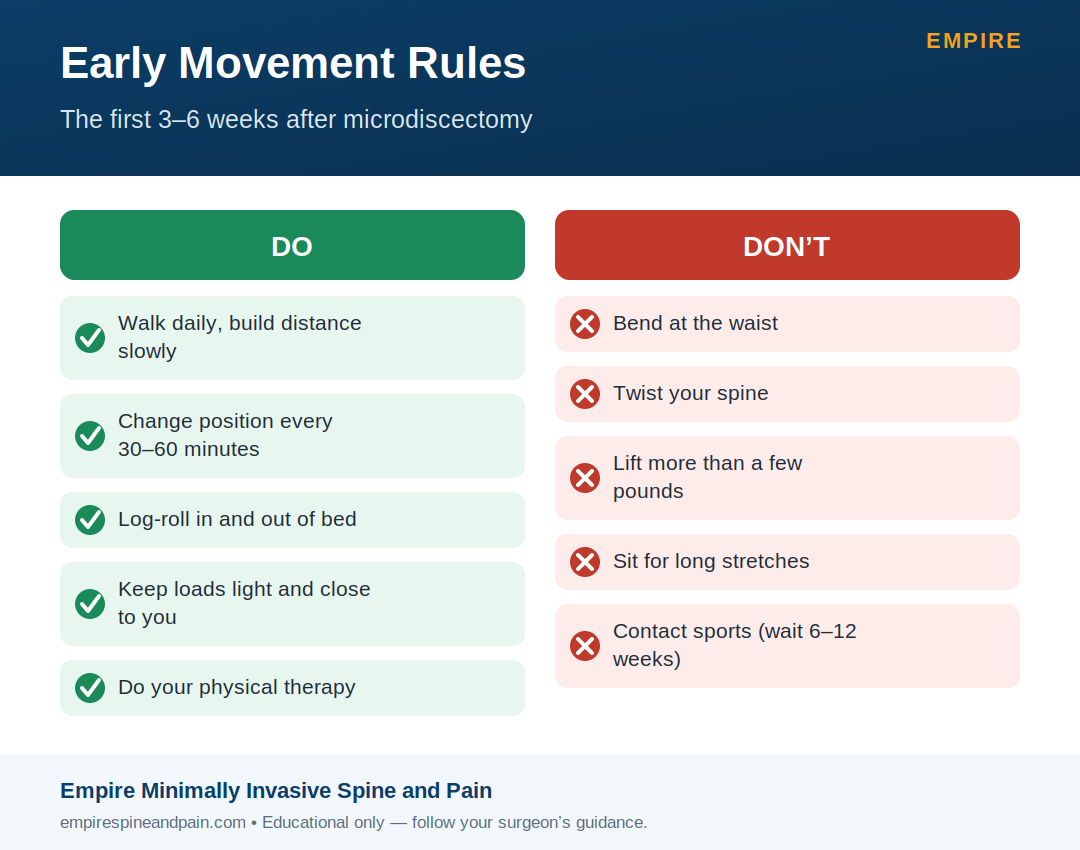
The single most important early rule is often summed up as “BLT” — avoid bending, lifting, and twisting beyond what your surgeon allows for the first several weeks. Keep lifting very light early on (many surgeons limit it to a few pounds), and raise limits only as your team clears you. Driving usually waits until you are off opioid medication. Contact sports and high-impact activity are typically off-limits for at least six weeks, and often until around twelve weeks.
Incision care and showering
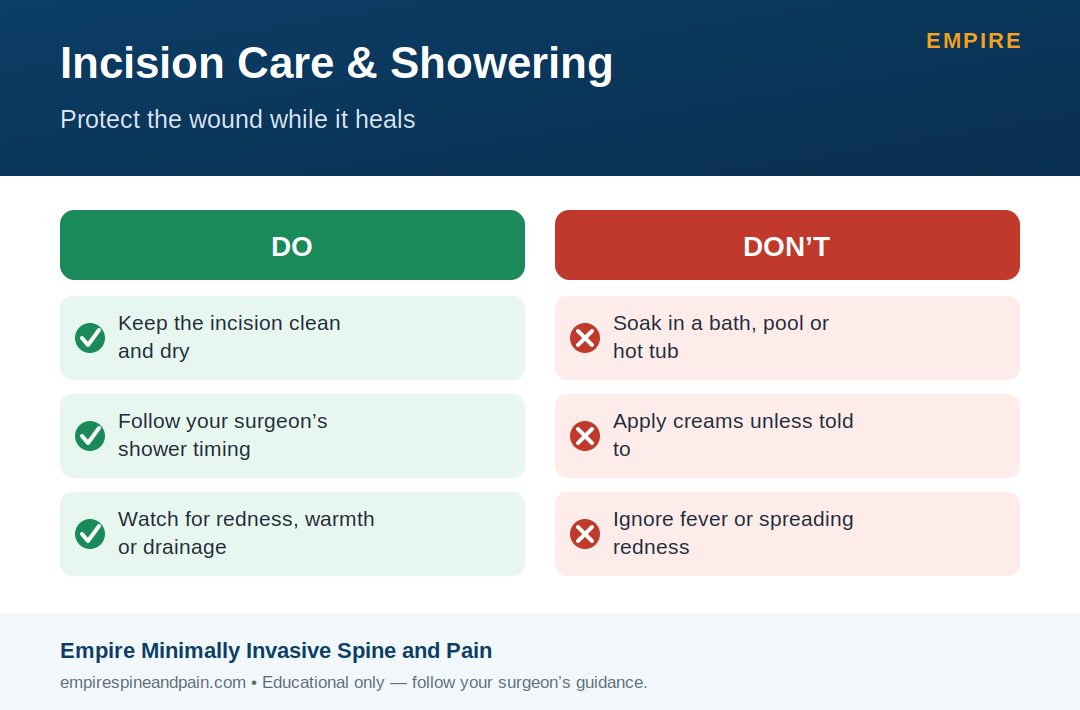
Keep the incision clean and dry, and follow your surgeon’s specific instructions on when you can shower and whether the area can get wet. Do not soak the incision in a bath, pool, or hot tub until you are cleared, since that raises infection risk. Watch the wound for increasing redness, swelling, warmth, or drainage, and report those promptly.
Everyday movement: sitting, sleeping, and using the toilet
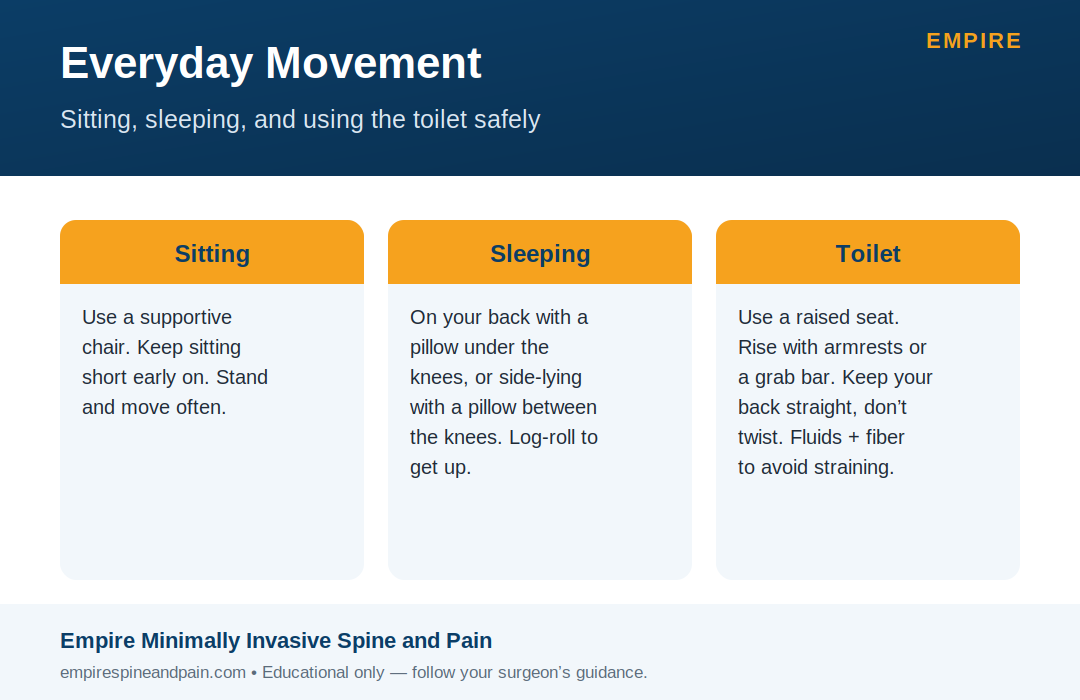
Good body mechanics protect the healing disc during ordinary tasks:
- Sitting: use a supportive chair, keep sitting sessions short early on, and stand up to move every 30–60 minutes.
- Sleeping: many people are comfortable on their back with a pillow under the knees, or on their side with a pillow between the knees to keep the spine aligned. Log-roll (move your whole body as one unit) when getting in and out of bed.
- Using the toilet: a raised toilet seat or a taller toilet makes it easier to sit and stand without deep bending; lower yourself and rise using armrests or a grab bar, keep your back straight, and avoid twisting to reach. Prevent straining by staying hydrated and getting enough fiber — ask your care team about a stool softener, since pain medicine can cause constipation.
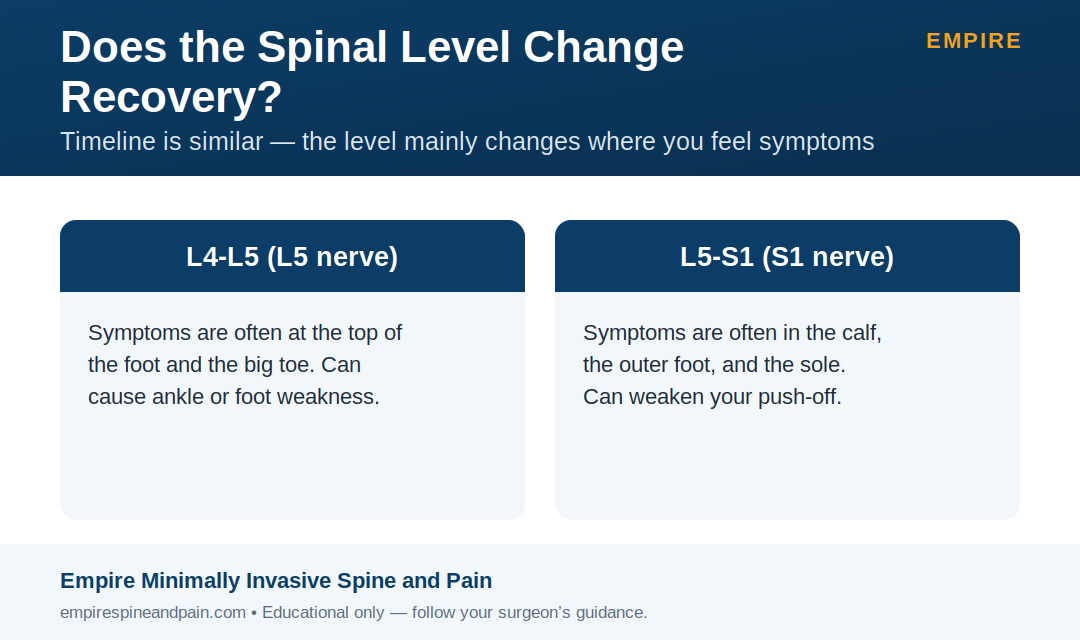
Does the spinal level change recovery? (L4-L5 vs L5-S1)
Most microdiscectomies are done at the two lowest levels of the spine, L4-L5 and L5-S1. The overall recovery timeline is broadly similar between them. What differs is mainly where you feel symptoms, because each level involves a different nerve: an L4-L5 herniation often affects the L5 nerve (symptoms toward the top of the foot and big toe, sometimes ankle weakness), while an L5-S1 herniation often affects the S1 nerve (symptoms in the calf, outer foot, and sole). Your surgeon can explain what to expect for your specific level and which residual sensations are normal as that nerve recovers.
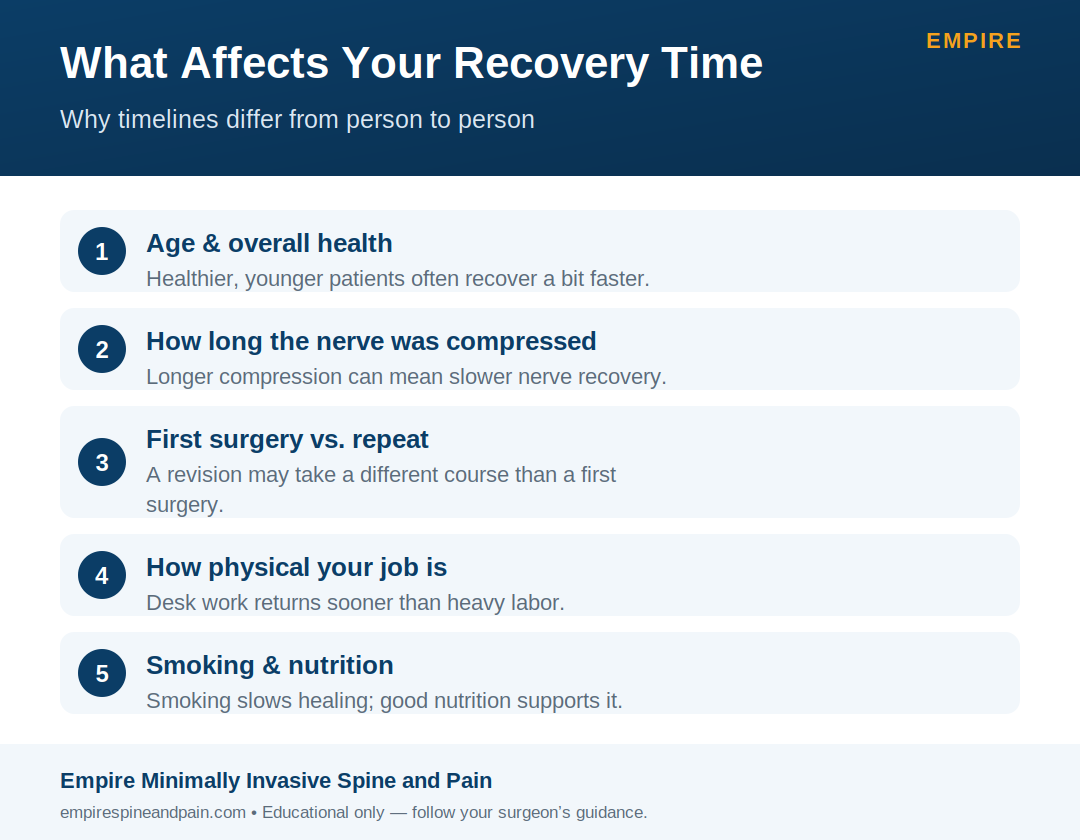
Factors that affect your recovery time
No two recoveries are identical. Common factors include your age and overall health, how long the nerve was compressed before surgery, whether it was a first surgery or a repeat, how physically demanding your job is, and lifestyle factors like smoking (which slows healing) and nutrition. Following your restrictions and doing your physical therapy are two of the biggest things within your control.
The role of physical therapy
Physical therapy is often the difference between a good recovery and a great one. A therapist helps you rebuild the core and back muscles that support your spine, restore flexibility, and learn movement habits that lower the chance of reinjury. Most programs start with walking and gentle motion, then progress to strengthening as you heal.
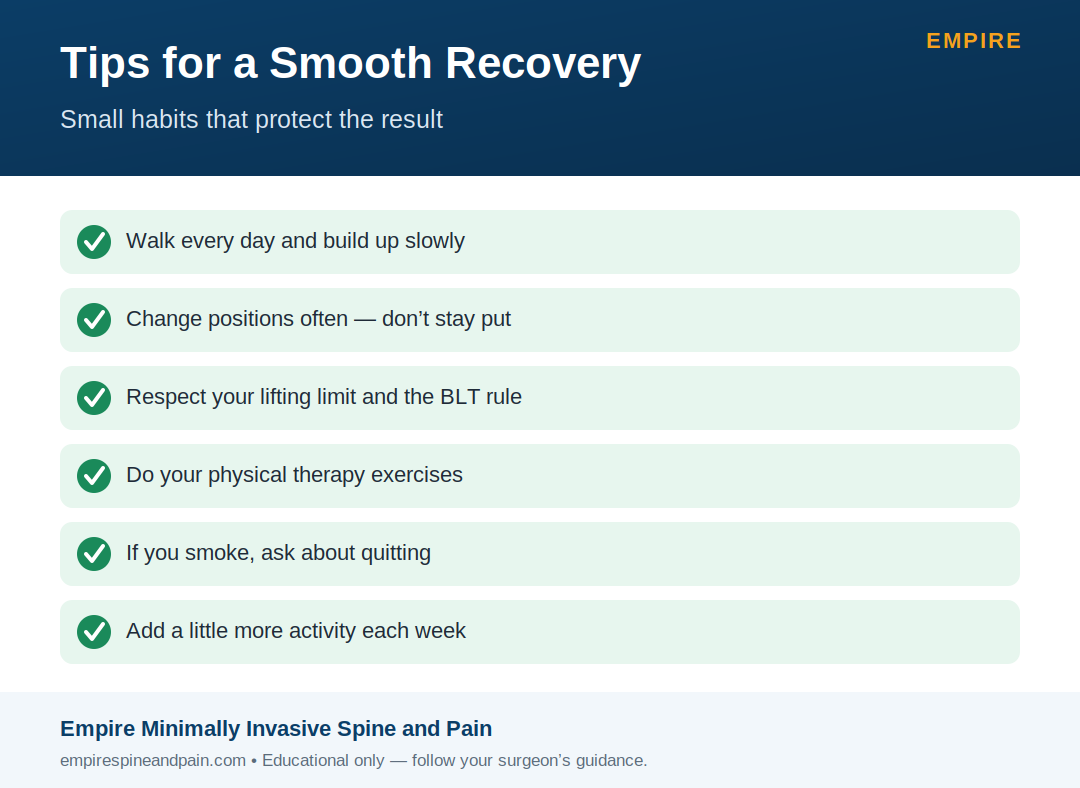
Tips for a smooth recovery
- Walk every day and build distance slowly — it is the safest early exercise.
- Change positions often; do not sit or stand in one spot too long.
- Respect the BLT rule and any weight limit you were given.
- Do your physical therapy exercises consistently.
- If you smoke, ask about quitting — it meaningfully helps healing.
- Ease back in: do a little more each week rather than jumping ahead.
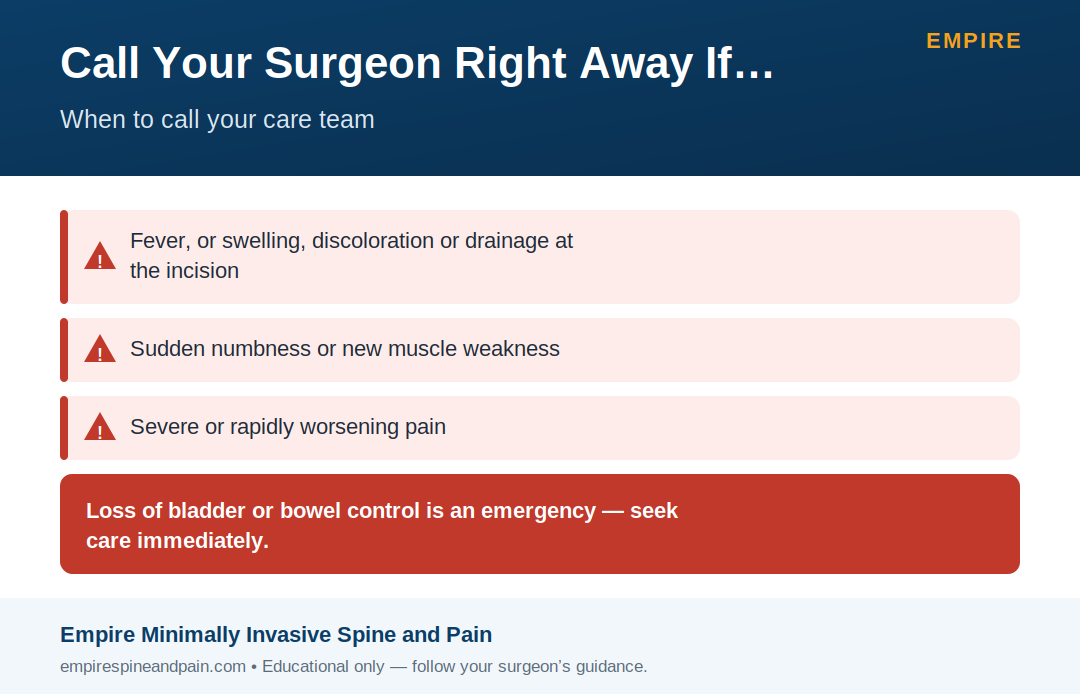
Warning signs: when to call your doctor
Some incision soreness, stiffness, tiredness, and improving numbness are expected. But Cleveland Clinic advises contacting your doctor right away if you notice signs of a problem, including fever, swelling, skin discoloration, or drainage at the incision (possible infection), sudden numbness or new muscle weakness, severe or worsening pain, or any loss of bladder or bowel control. Loss of bladder or bowel control is an emergency — seek care immediately.
Is there a less invasive option?
A traditional microdiscectomy already uses a small incision and a microscope. It is one option for a herniated disc that keeps pressing on a nerve after non-surgical care has not helped. For some patients, an even less invasive approach — endoscopic discectomy — uses a tiny tube-and-camera system that can mean less tissue disruption and, for the right candidate, a smoother early recovery. At Empire Minimally Invasive Spine and Pain we follow a step-and-ladder approach: we start with the least invasive option that can solve the problem and only move up if needed. You can learn more on our endoscopic spine surgery page or see how we approach minimally invasive spine surgery overall. If you are still weighing your options, connect with a back pain doctor or sciatica doctor near you, and our back pain resources cover the non-surgical steps that usually come first.
Frequently asked questions
How long after a microdiscectomy will I feel better?
Many people notice their leg pain (sciatica) ease within days, because the pressure on the nerve is relieved during surgery. General soreness and fatigue usually improve over the first two to six weeks, and any lingering numbness or tingling can take longer as the nerve heals.
How do you sit on the toilet after a microdiscectomy?
Use a raised toilet seat or a taller toilet so you do not have to bend deeply. Lower yourself and rise with the help of armrests or a grab bar, keep your back straight, and avoid twisting. Prevent straining by staying hydrated and eating enough fiber, and ask your care team about a stool softener, since pain medicine can cause constipation.
Will my back ever be the same after a microdiscectomy?
Most people return to their normal activities and feel much better after surgery. The disc is not made brand-new, but symptoms typically resolve, and strengthening your core and using good body mechanics protect the result. A small percentage of discs re-herniate (Cleveland Clinic cites about 5% to 15%), which is one reason physical therapy and safe movement matter.
Is a microdiscectomy a big surgery?
It is one of the more minimally invasive spine surgeries. It uses a small incision, is usually done as an outpatient procedure, and most people go home the same day. It is still surgery, though, so the recovery restrictions are important to follow.
When can I return to work and drive?
Desk or light-duty work often resumes in about two to four weeks, frequently starting with half-days. Physically demanding jobs usually require longer, often closer to six to twelve weeks. Driving is typically fine once you are off opioid pain medication and can move comfortably in an emergency, often around two weeks.
Will I ever be normal after a microdiscectomy?
Most people return to a normal, active life after a microdiscectomy. The surgery relieves the nerve pressure that causes sciatica, and once healing and strengthening are done, many patients get back to work, exercise, and everyday routines. Recovery is gradual, and a small number of people have lingering symptoms, but the aim is a full return to the things you did before.
Is a microdiscectomy worth it?
For the right patient, a microdiscectomy is often worth it. It is usually considered only after conservative care — rest, medication, physical therapy, and sometimes injections — has not eased sciatica from a herniated disc. When leg pain is severe and clearly tied to nerve compression, surgery can bring meaningful relief. The decision depends on your symptoms, imaging, and how much daily life is affected, so talk it through with a spine specialist.
How long should I take off work after a microdiscectomy?
Time off work depends mostly on your job. Many people with desk or light-duty roles return in about two to four weeks, often starting with half-days. Jobs that involve standing, lifting, or physical labor usually need longer — commonly six to twelve weeks. If your injury is work-related, your surgeon can document your restrictions for a workers’ compensation claim and help plan a safe, staged return to duty.
How painful is recovery from a microdiscectomy?
Most people find recovery more manageable than they feared. The sharp leg pain from the herniated disc often eases within days, because surgery relieves the pinched nerve. What remains is usually soreness at the small incision and some back stiffness, which fade over the first few weeks. Pain medicine helps early on, and gentle walking eases stiffness. Tell your surgeon if pain suddenly worsens instead of improving.
Considering a microdiscectomy — or still living with sciatica?
The team at Empire Minimally Invasive Spine and Pain can review your imaging, explain your options, and start with the least invasive treatment that fits your case. Consultations are available at our New York and New Jersey offices.
New York: 516-229-1443 • New Jersey: 732-630-7246
This article is for general education and is not a substitute for personal medical advice. Recovery plans vary — always follow the instructions of your own surgeon. Sources: Cleveland Clinic (Diskectomy), Spine-Health (Lumbar Microdiscectomy Recovery), and Barricaid (sciatic nerve recovery after microdiscectomy).
What Our Patients Say

Dr. John Akhnoukh
Articles: 14

Our Plainview office has moved
Find us at our new location:
520 Old Country Rd
Plainview, NY 11803
Same doctors, same phone numbers.
Most Major Plans,
No-Fault & Personal Injury.
We accept most major insurance plans across our New York and New Jersey offices. Select your state to see accepted plans.
Accepted at our New York Locations
Workers' Compensation
No-Fault (NY & NJ)
Lien Cases
Medicare
Empire BCBS
BCBS / Anthem
Cigna
Aetna
Empire NYSHIP
Oxford (PPO)
United Health Care
GHI / Emblem Health
Humana (PPO)
Magnacare (PPO)
Northwell Direct
1199 SEIU
Self Pay
Accepted at our New Jersey Locations
No-Fault (NJ)
Lien Cases
Horizon BCBS
Empire NYSHIP
BCBS / Anthem (PPO)
Cigna
Aetna (PPO)
GHI / Emblem (PPO)
Port Authority UHC
Verizon Plan
Carpenter & Trade Unions
Self Pay
Medicare, Medicaid and Workers' Compensation are not accepted at our New Jersey locations. Not sure about your plan? Call us and we'll verify before your visit.
Not sure about your plan?
Call Us — 516-229-1443
Verify Your Coverage for FREE
Enter your information and our team will confirm your benefits before your visit.
✓ HIPAA Compliant
✓ No Obligation
✓ Same-Day Response
Your information is encrypted and secure. By submitting, you consent to receive communications regarding your appointment. You may opt out at any time.
Meet Our Pain Management & Orthopedic Specialists
Board-certified physicians dedicated to accurate diagnosis and minimally invasive care.

Pain Management
John Akhnoukh, M.D.
Board Certified Anesthesiologist & Interventional Pain Management Physician
Visit Profile



Pain Management
James Yu, D.O.
Board Certified Anesthesiologist & Interventional Pain Management Physician
Visit Profile

Pain Management
Benjamin Souferi, D.O.
Fellowship-Trained Interventional Pain Medicine Physician (Cleveland Clinic)
Visit ProfilePain Conditions Affecting Daily Life
Improve your quality of life with our comprehensive approach to pain management
We are dedicated to finding individualized treatment options tailored to fit your needs. Our team is dedicated to helping you lead a productive and active life, free from pain and disruption.
Our Locations
Pain management and orthopedic care across New York and New Jersey.