Degenerative Disc Disease: Causes, Symptoms, and Treatment
In this article
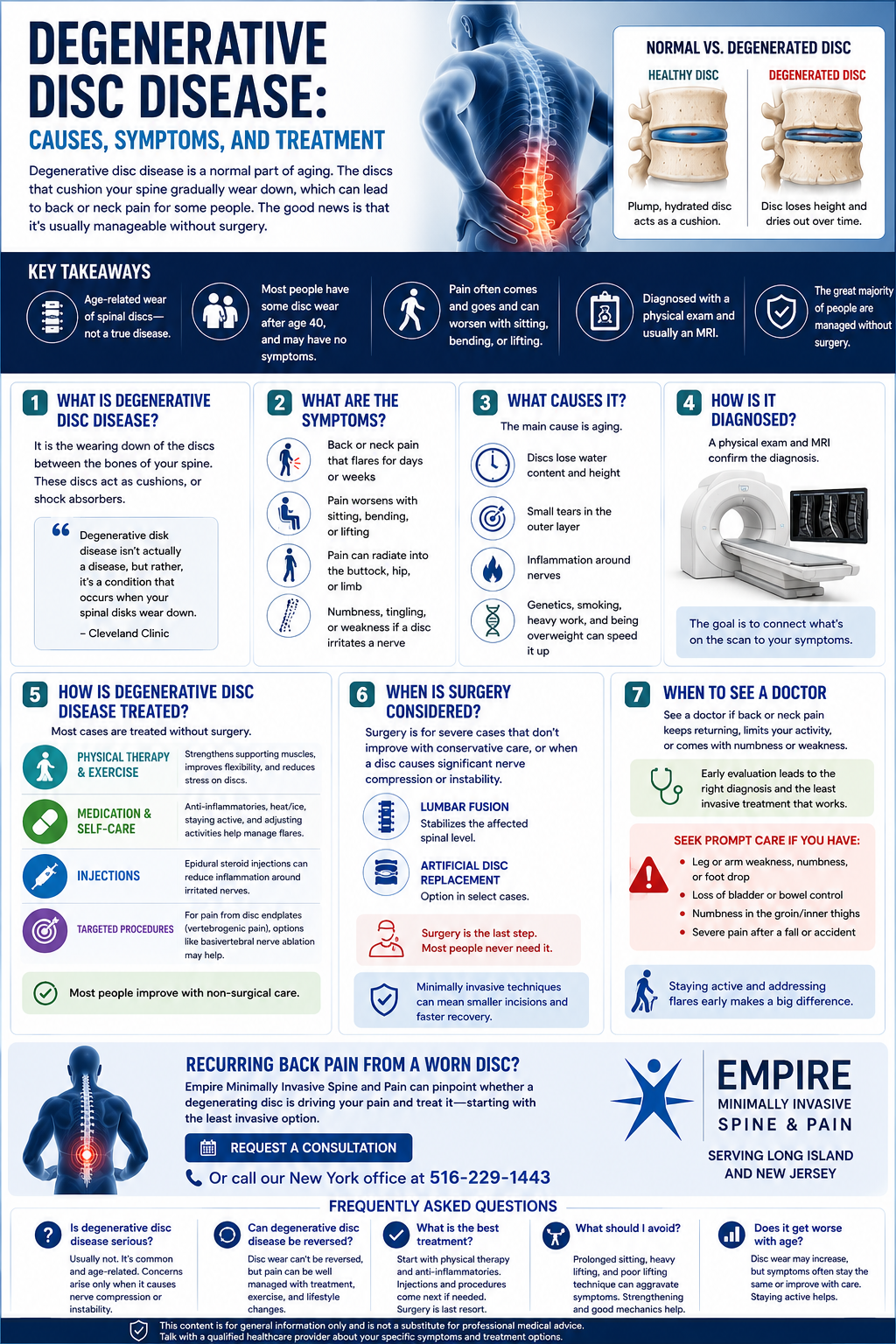
Degenerative disc disease has an alarming name for what is, in most cases, a normal part of getting older. The discs that cushion your spine gradually wear down with age, and for some people that causes back or neck pain. The good news is that it’s usually manageable without surgery. This guide explains what degenerative disc disease really is, how it’s diagnosed, and the treatments that help.
Key takeaways
- Degenerative disc disease is age-related wear of the spinal discs — not really a “disease.”
- Most people have some disc wear after about age 40, and many have no symptoms at all.
- When it does hurt, the pain often flares and settles, and can feel worse with sitting, bending, or lifting.
- It’s diagnosed with an exam and usually an MRI.
- The great majority of people are managed without surgery.
What is degenerative disc disease?
Degenerative disc disease is the wearing down of the discs that sit between the bones of your spine. These discs act as cushions, or shock absorbers. As we age, they lose water content, get thinner, and become less able to absorb stress — and that wear can sometimes cause pain. Despite the name, it isn’t a disease you “catch,” and it isn’t always progressive.
As Cleveland Clinic puts it: “Degenerative disk disease isn’t actually a disease, but rather, it’s a condition that occurs when your spinal disks wear down” (Cleveland Clinic).
What are the symptoms of degenerative disc disease?
Many people with disc wear have no symptoms. When degenerative disc disease does cause pain, it’s usually in the lower back or neck, and it tends to come and go in flare-ups rather than staying constant. A few patterns are common:
- Back or neck pain that flares for days or weeks, then settles
- Pain that worsens with sitting, bending, or lifting, and eases when you walk or change positions
- Pain that can radiate into the buttock, hip, or limb
- Occasional numbness or tingling if a worn disc irritates a nearby nerve
What causes degenerative disc disease?
The main cause of degenerative disc disease is simply aging. Over the years, discs dry out and lose height, and small tears can form in the tough outer layer. Those changes can trigger inflammation near the nerves and lead to pain. Genetics, smoking, heavy physical work, and being overweight can all speed the process along.
How is degenerative disc disease diagnosed?
Degenerative disc disease is diagnosed with a physical exam and, usually, an MRI. Your physician will check your strength, reflexes, and sensation and ask how your pain behaves. An MRI shows the condition of the discs and whether a worn disc is affecting a nearby nerve. Because disc wear is so common, the goal is to connect what’s on the scan to your actual symptoms — which is exactly how care is approached at Empire Minimally Invasive Spine and Pain.
How is degenerative disc disease treated?
Degenerative disc disease is treated conservatively in the great majority of cases, and that’s where Empire begins — a step-and-ladder approach that saves the most invasive options for last.
Physical therapy and exercise
Strengthening the muscles that support the spine and improving flexibility takes load off the worn discs. This is first-line and helps most people.
Cleveland Clinic lists physical therapy — “strengthening and stretching exercises with a trained physical therapist” — among the first-line treatments, alongside anti-inflammatory measures (Cleveland Clinic).
Medication and self-care
Anti-inflammatory medication, heat and ice, staying active, and adjusting the activities that flare your pain all help manage symptoms during a flare-up.
Injections and targeted procedures
If pain persists, an epidural steroid injection can calm inflammation around an irritated nerve. When the pain is coming from the worn disc endplates themselves (vertebrogenic pain), a targeted option like basivertebral nerve ablation may help — you can read how that works in our guide to the Intracept procedure.
When is surgery considered?
Surgery for degenerative disc disease is reserved for severe cases that don’t improve with conservative care, or when a worn disc is causing significant nerve compression or instability. Options include a lumbar fusion to stabilize the affected level, or in select cases artificial disc replacement. For most people, it never comes to this. If you’re weighing disc problems and their treatments, our comparison of a herniated disc vs. a bulging disc is a helpful companion read.
When should you see a doctor?
See a doctor if back or neck pain keeps returning, limits your activity, or comes with numbness, tingling, or weakness in a limb. A specialist can confirm whether disc wear is the source and start the least invasive treatment that works, rather than leaving you to manage recurring flares on your own. For self-care approaches in the meantime, see our guide on healing a bulging disc naturally.
Seek prompt care if you have:
- Leg or arm weakness, numbness, or foot drop
- Loss of bladder or bowel control
- Severe pain after a fall or accident
Recurring back pain from a worn disc?
Empire Minimally Invasive Spine and Pain can pinpoint whether a degenerating disc is driving your pain and treat it — starting with the least invasive option. Serving Long Island and New Jersey.
Request a consultation Or call our New York office at 516-229-1443.Frequently asked questions
Is degenerative disc disease serious?
Usually not. It’s a common, age-related change, and many people have it without symptoms. It becomes a bigger concern only when a worn disc compresses a nerve or causes instability — and even then, most cases are managed without surgery.
Can degenerative disc disease be reversed?
The disc wear itself can’t be reversed, but the pain it causes can be controlled well. Strengthening the supporting muscles, staying active, and treating flares keeps most people comfortable for the long term.
What is the best treatment for degenerative disc disease?
Care is matched to your case, but it almost always starts with physical therapy and anti-inflammatory measures. Injections and targeted procedures come next if needed, and surgery is reserved for severe cases that don’t respond.
What should I avoid with degenerative disc disease?
Prolonged sitting, repeated heavy lifting, and poor lifting mechanics tend to aggravate it. A physical therapist can show you safer movement patterns and exercises that strengthen your spine without overloading the worn disc.
Does degenerative disc disease get worse with age?
Disc wear tends to increase gradually with age, but symptoms don’t always track with it — many people find their pain stays stable or improves with treatment. Staying active and addressing flares early makes a real difference.
This article is for general education and is not a substitute for medical advice. Talk with a qualified clinician about your specific symptoms.
What Our Patients Say

Dr. Andrew J. Appel
Articles: 4

Our Plainview office has moved
Find us at our new location:
520 Old Country Rd
Plainview, NY 11803
Same doctors, same phone numbers.
Most Major Plans,
No-Fault & Personal Injury.
We accept most major insurance plans across our New York and New Jersey offices. Select your state to see accepted plans.
Accepted at our New York Locations
Workers' Compensation
No-Fault (NY & NJ)
Lien Cases
Medicare
Empire BCBS
BCBS / Anthem
Cigna
Aetna
Empire NYSHIP
Oxford (PPO)
United Health Care
GHI / Emblem Health
Humana (PPO)
Magnacare (PPO)
Northwell Direct
1199 SEIU
Self Pay
Accepted at our New Jersey Locations
No-Fault (NJ)
Lien Cases
Horizon BCBS
Empire NYSHIP
BCBS / Anthem (PPO)
Cigna
Aetna (PPO)
GHI / Emblem (PPO)
Port Authority UHC
Verizon Plan
Carpenter & Trade Unions
Self Pay
Medicare, Medicaid and Workers' Compensation are not accepted at our New Jersey locations. Not sure about your plan? Call us and we'll verify before your visit.
Not sure about your plan?
Call Us — 516-229-1443
Verify Your Coverage for FREE
Enter your information and our team will confirm your benefits before your visit.
✓ HIPAA Compliant
✓ No Obligation
✓ Same-Day Response
Your information is encrypted and secure. By submitting, you consent to receive communications regarding your appointment. You may opt out at any time.
Meet Our Pain Management & Orthopedic Specialists
Board-certified physicians dedicated to accurate diagnosis and minimally invasive care.

Pain Management
John Akhnoukh, M.D.
Board Certified Anesthesiologist & Interventional Pain Management Physician
Visit Profile



Pain Management
James Yu, D.O.
Board Certified Anesthesiologist & Interventional Pain Management Physician
Visit Profile

Pain Management
Benjamin Souferi, D.O.
Fellowship-Trained Interventional Pain Medicine Physician (Cleveland Clinic)
Visit ProfilePain Conditions Affecting Daily Life
Improve your quality of life with our comprehensive approach to pain management
We are dedicated to finding individualized treatment options tailored to fit your needs. Our team is dedicated to helping you lead a productive and active life, free from pain and disruption.
Our Locations
Pain management and orthopedic care across New York and New Jersey.