What Happens at Your First Pain Management Appointment?
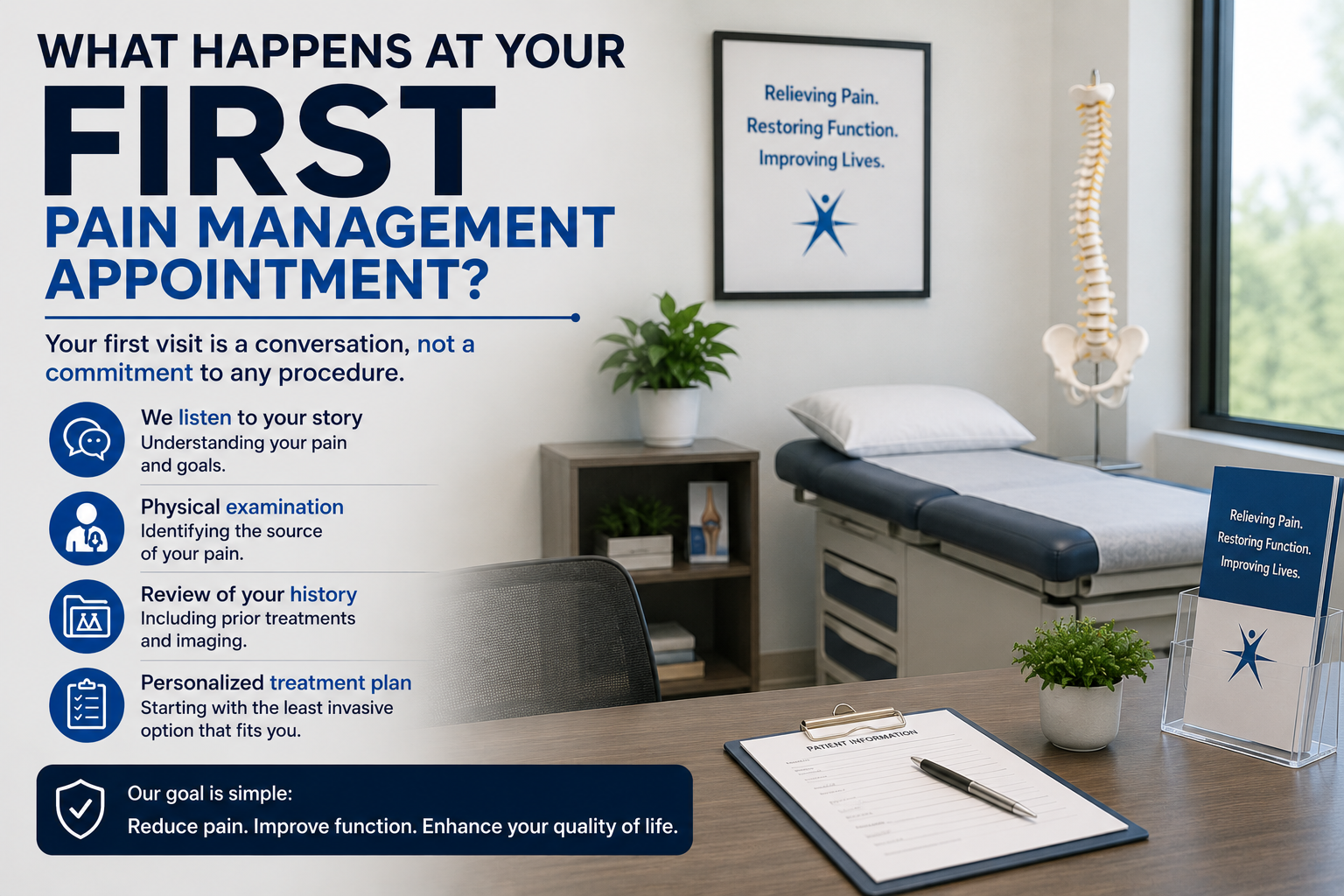
Booked your first pain management appointment and wondering what actually happens? The short version: a first visit is a conversation and a diagnosis, not a commitment to any procedure. Your doctor listens to your story, examines you, reviews any imaging, and explains your options. At Empire Minimally Invasive Spine and Pain, that plan starts with the least invasive option that fits your problem — not surgery or long-term pain pills.
Key takeaways
- Your first visit is mostly talking, a physical exam, and a review of your history — not a procedure.
- You often don’t need a referral, though some insurance plans require one.
- Bring your ID, insurance card, a medication list, and any imaging or records you have.
- You leave with a diagnosis (or a plan to get one) and a treatment plan built around the least invasive option first.
- For Workers’ Comp or auto-injury cases, we handle the paperwork with you.
Do I need a referral to see a pain management doctor?
Often, no. Many people can book a pain management appointment on their own without a referral from another doctor. The catch is your insurance. Some plans, especially HMOs, ask for a referral from your primary care doctor before they’ll cover the visit. A quick call to your plan clears this up before you come in.
There’s a second kind of referral worth knowing about. In many practices, if you turn out to need a surgeon, that’s a separate step and a separate wait. Empire works differently: our pain management and orthopedic teams sit under one roof, so if your care needs to move from injections to a surgical opinion, you don’t start over somewhere new.
If your pain started with a work injury or a car accident, a pain management doctor can usually see you directly, and our team sorts out the Workers’ Comp or No-Fault authorization so coverage isn’t a guessing game.
Check-in and paperwork
Your visit starts at the front desk with check-in and forms. You’ll confirm your contact details, insurance, and pharmacy, and fill out a health history and a form about your pain — where it is, how long it’s lasted, and what makes it better or worse. Getting there about 15 minutes early gives you time to do this without feeling rushed.
The pain questionnaire matters more than it looks. The questions about when your pain flares and what you’ve already tried are what your doctor reads first, so answering honestly saves time in the room.
Workers’ Comp or auto injury? Bring your claim or case number if you have it. For Workers’ Compensation and No-Fault (auto) cases, Empire handles the required paperwork and documents each visit for your claim, so the medical side and the insurance side stay lined up from day one.
Initial vital signs
Next, a medical assistant usually takes your vital signs — blood pressure, heart rate, temperature, and often height and weight. It’s quick and routine. These numbers give your care team a baseline and flag anything that should be watched before certain treatments or medications are considered.
If pain has been keeping you from sleeping or moving, mention it here. Small details like poor sleep or a recent weight change help your doctor see the fuller picture, not just the sore spot.
What happens during the consultation?
This is the heart of the visit. You sit down with the specialist and tell your story: where it hurts, when it started, what it stops you from doing, and everything you’ve already tried. The doctor asks follow-up questions, reviews your history and any imaging, and starts to narrow down what’s causing the pain. Expect to spend real time talking here.
A good consultation goes both ways. If you’ve worried that a specialist will rush you or push straight to a procedure, this is where that fear gets answered. The goal of a first visit is to understand the problem, not to sell a fix on the spot.
A first pain management visit centers on listening and diagnosis. At Empire Minimally Invasive Spine and Pain, board-certified interventional pain physicians use your history, exam, and imaging to find the source of the pain, then explain the options — starting with the least invasive one. Nothing is decided for you in that room without your say.
What does the physical examination involve?
After talking, the doctor examines you. For back, neck, or joint pain, that usually means checking how well you move, your strength, your reflexes, and where it hurts when pressed. You may be asked to bend, walk, or lift a leg while lying down. The exam is hands-on but shouldn’t be harsh — tell the doctor when something hurts.
The exam connects your story to what the body is actually doing — it helps a doctor tell, for example, whether leg pain is coming from the back or the hip. If more detail is needed, imaging like an X-ray or MRI may be ordered, or existing scans reviewed. Curious how nerve-related leg pain is evaluated? Our sciatica doctor page goes deeper.
Will I be drug tested at my first appointment?
Sometimes, and it’s a fair thing to ask about. Urine drug testing is a routine safety step some pain clinics use, especially when the plan might include medications that carry risk. It isn’t a moral test and it isn’t there to catch you out. It helps the doctor prescribe safely and see the full list of what’s already in your system.
The honest move is to be upfront. Tell your doctor what you take — prescriptions, over-the-counter medicines, supplements, and yes, cannabis, even where it’s legal. A doctor can only build a safe plan around what they actually know about.
Drug screening in pain care is about safe prescribing, not judgment. Careful prescribing guidance, such as the CDC’s Clinical Practice Guideline for Prescribing Opioids for Pain (CDC, 2022), encourages doctors to prescribe cautiously and monitor safety. An open conversation about what you use is always the better path than worry.
How is your treatment plan decided?
Near the end of the visit, your doctor explains what they think is going on and lays out a plan. That plan is built to match the diagnosis, your health, and your goals. For most pain problems, it starts with the least invasive option that can work — not a jump to surgery or a long-term prescription.
Empire follows a step-up approach. For many people that means physical therapy, activity changes, and targeted, image-guided injections — such as epidural steroid or facet joint injections — come first. Minimally invasive procedures are next if needed, and major surgery is a last resort, considered only when gentler options haven’t resolved the problem.
A pain management treatment plan is a ladder, not a single step. Empire Minimally Invasive Spine and Pain starts with conservative care and targeted injections, moves to minimally invasive procedures only if needed, and treats surgery as a last resort. You may not start any treatment on day one — first visits often end with a diagnosis, a plan, and next steps to schedule.
Will you get an injection or a prescription on the first day? Sometimes, but often not. Many first visits end with a plan and a follow-up rather than a same-day procedure. To understand medication options in general, the NIH’s MedlinePlus has a plain-language overview of pain relievers and how they’re used.
What should I bring to my first appointment?
Bring a short, simple kit so nothing holds up your visit. The basics are a photo ID, your insurance card, a list of your medications with doses, and any imaging or records tied to your pain. If a work injury or car accident is involved, add your claim or case number and any attorney or adjuster contact.
Here’s a quick checklist:
- Photo ID and insurance card (plus a referral if your plan needs one)
- A list of current medications, doses, and any allergies
- Recent imaging (X-ray, MRI, CT) on disc or through a patient portal, and any related reports
- Names of other doctors involved in your care
- For Workers’ Comp or No-Fault cases: your claim/case number and adjuster or attorney details
- Two or three questions you want answered
Wear comfortable clothes you can move in. The doctor may need to see how your back, neck, or joint moves during the exam.
When should you see a pain management doctor?
It’s reasonable to see a pain management doctor when pain has lasted more than a few weeks, keeps coming back, or gets in the way of work, sleep, or daily life — especially if rest, over-the-counter medicine, or physical therapy haven’t helped enough. You don’t have to wait until pain is unbearable to get evaluated.
Some symptoms need urgent care, not a routine appointment. Sudden loss of bladder or bowel control, new leg weakness, or numbness in the groin can point to a serious problem — go to an emergency room rather than waiting for a scheduled visit.
Frequently asked questions
How long does a first pain management appointment take?
Plan for about an hour. A first visit runs longer than a follow-up because it includes paperwork, a full history, an exam, and time to go over your plan. Arriving early to finish forms helps keep things on schedule.
Does insurance cover a pain management visit?
Most insurance plans cover a medically needed pain management evaluation, though coverage details vary by plan and some require a referral. Empire accepts most major insurance and also treats Workers’ Comp and No-Fault (auto) cases. If you’re unsure, our team can check your coverage before your visit.
Will I get pain medication at my first visit?
Maybe, but it depends on your diagnosis and history. A first visit is often about finding the cause and setting a plan, not writing a prescription. When medication is part of the plan, your doctor weighs the benefits and risks with you rather than defaulting to long-term pain pills.
What if I’m nervous about being judged for my pain?
That worry is common, and a good pain doctor expects it. Your job is to describe your pain and your history honestly; their job is to take it seriously and help. Being open about what you’ve tried and what you take leads to a safer, better plan — not judgment.
Do I have to decide on treatment the same day?
No. Showing up doesn’t sign you up for a procedure. You can take the diagnosis and plan home, ask questions, and decide on next steps at your own pace. Care moves forward when you’re ready.
Ready to get answers about your pain?
Empire Minimally Invasive Spine and Pain offers same-week evaluations at our New York and New Jersey offices. Talk with a board-certified specialist who starts with the least invasive option — not surgery first.
Call New York: 516-229-1443 | New Jersey: 732-630-7246
Book your appointment online or find the office nearest you.
About the author
Dr. John Akhnoukh is a board-certified Anesthesiologist and board-certified Interventional Pain Management physician at Empire Minimally Invasive Spine and Pain. He completed a pain medicine fellowship across New York-Presbyterian Hospital, Memorial Sloan Kettering, and the Hospital for Special Surgery, and focuses on image-guided, minimally invasive treatments that aim to reduce pain while avoiding unnecessary surgery.
This article is for general education and isn’t a substitute for medical advice. Individual results vary. Talk with a qualified physician about your specific condition.
What Our Patients Say

Dr. John Akhnoukh
Articles: 14

Our Plainview office has moved
Find us at our new location:
520 Old Country Rd
Plainview, NY 11803
Same doctors, same phone numbers.
Most Major Plans,
No-Fault & Personal Injury.
We accept most major insurance plans across our New York and New Jersey offices. Select your state to see accepted plans.
Accepted at our New York Locations
Workers' Compensation
No-Fault (NY & NJ)
Lien Cases
Medicare
Empire BCBS
BCBS / Anthem
Cigna
Aetna
Empire NYSHIP
Oxford (PPO)
United Health Care
GHI / Emblem Health
Humana (PPO)
Magnacare (PPO)
Northwell Direct
1199 SEIU
Self Pay
Accepted at our New Jersey Locations
No-Fault (NJ)
Lien Cases
Horizon BCBS
Empire NYSHIP
BCBS / Anthem (PPO)
Cigna
Aetna (PPO)
GHI / Emblem (PPO)
Port Authority UHC
Verizon Plan
Carpenter & Trade Unions
Self Pay
Medicare, Medicaid and Workers' Compensation are not accepted at our New Jersey locations. Not sure about your plan? Call us and we'll verify before your visit.
Not sure about your plan?
Call Us — 516-229-1443
Verify Your Coverage for FREE
Enter your information and our team will confirm your benefits before your visit.
✓ HIPAA Compliant
✓ No Obligation
✓ Same-Day Response
Your information is encrypted and secure. By submitting, you consent to receive communications regarding your appointment. You may opt out at any time.
Meet Our Pain Management & Orthopedic Specialists
Board-certified physicians dedicated to accurate diagnosis and minimally invasive care.

Pain Management
John Akhnoukh, M.D.
Board Certified Anesthesiologist & Interventional Pain Management Physician
Visit Profile



Pain Management
James Yu, D.O.
Board Certified Anesthesiologist & Interventional Pain Management Physician
Visit Profile

Pain Management
Benjamin Souferi, D.O.
Fellowship-Trained Interventional Pain Medicine Physician (Cleveland Clinic)
Visit ProfilePain Conditions Affecting Daily Life
Improve your quality of life with our comprehensive approach to pain management
We are dedicated to finding individualized treatment options tailored to fit your needs. Our team is dedicated to helping you lead a productive and active life, free from pain and disruption.
Our Locations
Pain management and orthopedic care across New York and New Jersey.