How to Relieve Sciatica: Fast Relief and What Helps
In this article
When sciatica flares, the only thing on your mind is relief. The good news: most sciatica settles with simple, at-home care, and there’s a lot you can do to speed it along. This guide walks through what actually helps — and what to skip — plus the treatments that take over when home care isn’t enough.
Key takeaways
- Most sciatica improves with self-care within a few weeks.
- Staying gently active helps more than resting in bed.
- Ice for the first few days, then heat; over-the-counter anti-inflammatories can ease a flare.
- Gentle stretching takes pressure off the nerve; sharp, forceful movement doesn’t.
- If pain lasts more than a few weeks, physical therapy and injections are the next steps.
Can you relieve sciatica at home?
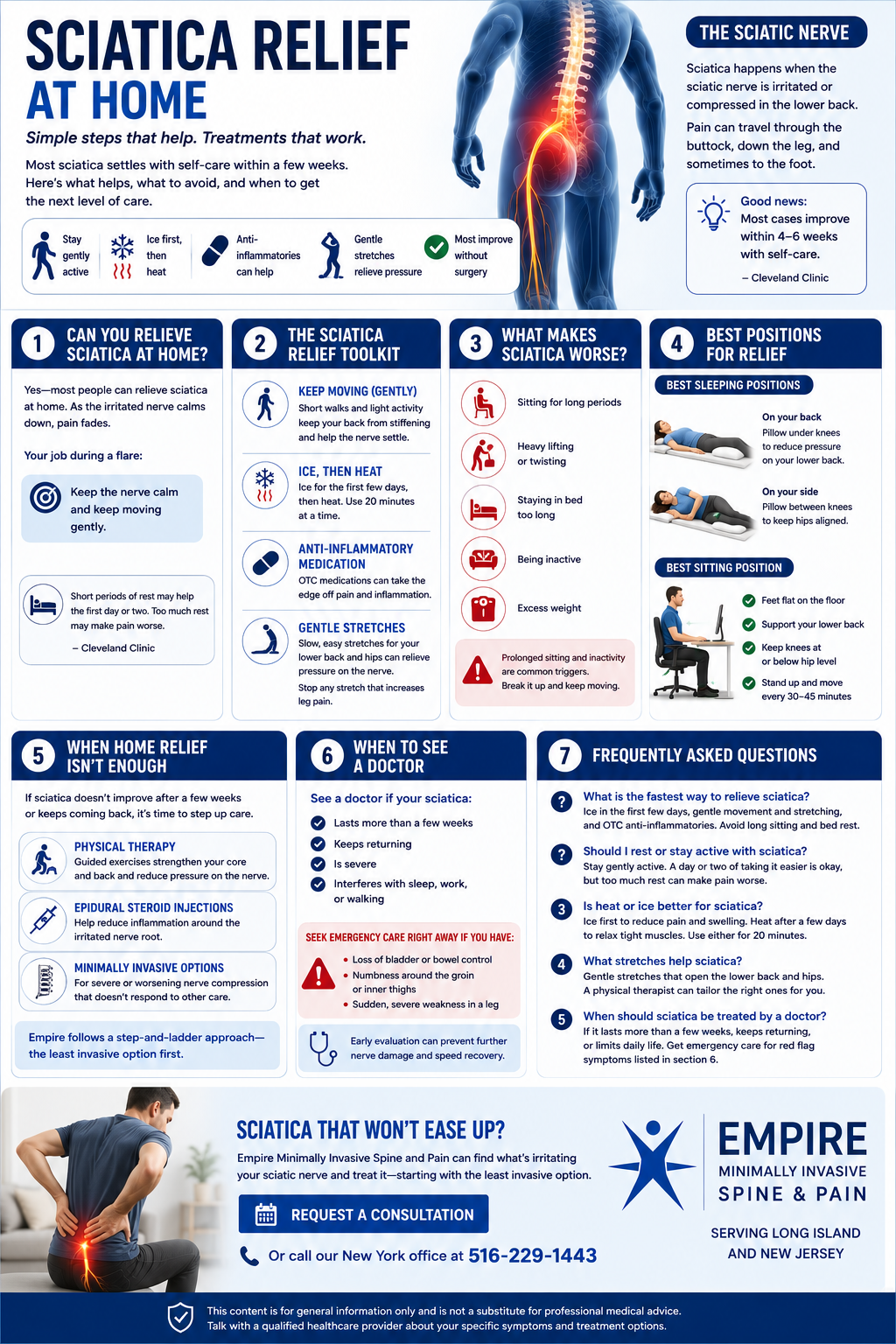
Yes — most people can relieve sciatica at home, because the majority of cases improve on their own with simple care. Sciatica comes from irritation of the sciatic nerve, usually from a pinched nerve in the lower back, and as that irritation calms, the pain fades. Your job during a flare is to keep the nerve calm and keep moving gently.
Cleveland Clinic notes that “stretching and light activity may relieve pressure on the nerve,” and that most cases improve within four to six weeks with self-care (Cleveland Clinic).
The sciatica relief toolkit
These are the at-home measures that help most people through a sciatica flare.
Keep moving (gently)
Light activity like short walks keeps the back from stiffening and helps the nerve settle. A day or two of taking it easier is fine at the start, but long bed rest tends to backfire.
As Cleveland Clinic puts it: “Short periods of rest may help during the first day or two. Too much rest may make pain worse” (Cleveland Clinic).
Ice, then heat
For the first few days, ice can calm pain and swelling; after that, heat helps relax tight muscles. Use either for about 20 minutes at a time, with a cloth between the pack and your skin.
Over-the-counter anti-inflammatories
Nonprescription anti-inflammatory medicine can take the edge off a flare. Use it as directed, and check with your doctor or pharmacist if you have stomach, kidney, or heart concerns.
Gentle stretches
Easy stretches that open the lower back and hips — done slowly and without forcing — can relieve pressure on the nerve. Stop any stretch that sharply increases the leg pain.
What makes sciatica worse?
A few everyday habits tend to aggravate sciatica, and easing off them helps as much as any remedy. Common triggers include sitting for long stretches, heavy or twisting lifts, and staying completely still. Prolonged sitting in particular loads the lower back, so breaking it up with short walks makes a real difference.
Best positions for sleeping and sitting
Small position changes can take pressure off the sciatic nerve. When sleeping, many people are most comfortable on their back with a pillow under the knees, or on their side with a pillow between the knees to keep the hips aligned. When sitting, keep both feet on the floor, support your lower back, and stand up to move every 30–45 minutes.
When home relief isn’t enough
If sciatica hasn’t improved after a few weeks, or it keeps coming back, it’s time to step up care. Empire Minimally Invasive Spine and Pain follows a step-and-ladder approach. Physical therapy is usually next — guided exercises that strengthen the core and back and reduce the pressure on the nerve. If leg pain persists, an epidural steroid injection can calm the inflammation around the irritated nerve root; our guide on how long an epidural injection takes to work for sciatica explains what to expect. For the small number of cases with severe or worsening nerve compression, a minimally invasive procedure may be considered. You can learn more on our sciatica treatment page, and our guide on how long sciatica lasts covers the typical timeline. If you’re in New Jersey, our guide to sciatica treatment in NJ covers care at our Clifton office.
When should you see a doctor?
See a doctor if your sciatica lasts more than a few weeks, keeps returning, or is severe enough to interfere with sleep, work, or walking. Earlier evaluation helps when the pain isn’t following the usual improving pattern.
Seek emergency care right away if you have:
- Loss of bladder or bowel control
- Numbness around the groin or inner thighs
- Sudden, severe weakness in a leg
Sciatica that won’t ease up with home care?
Empire Minimally Invasive Spine and Pain can find what’s irritating your sciatic nerve and treat it — starting with the least invasive option. Serving Long Island and New Jersey.
Request a consultation Or call our New York office at 516-229-1443.Frequently asked questions
What is the fastest way to relieve sciatica?
There’s no instant cure, but the fastest relief for most people comes from calming the flare: ice in the first days, gentle movement and stretching, and over-the-counter anti-inflammatory medicine. Avoid long sitting and bed rest, which tend to prolong it.
Should I rest or stay active with sciatica?
Stay gently active. A day or two of taking it easier is fine, but Cleveland Clinic notes too much rest can make sciatica worse. Light walking and gentle stretching help the nerve settle.
Is heat or ice better for sciatica?
Both, at different times. Ice helps in the first few days by reducing pain and swelling; heat helps after that by relaxing tight muscles. Use either for about 20 minutes with a cloth barrier.
What stretches help sciatica?
Gentle stretches that open the lower back and hips can relieve pressure on the nerve, done slowly and without forcing. A physical therapist can tailor the right ones for your case and make sure you’re not aggravating it.
When should sciatica be treated by a doctor?
See a doctor if it lasts more than a few weeks, keeps returning, or limits daily life. Get emergency care for loss of bladder or bowel control, groin numbness, or sudden severe leg weakness.
This article is for general education and is not a substitute for medical advice. Talk with a qualified clinician about your specific symptoms.
What Our Patients Say

Dr. James Yu
Articles: 11

Our Plainview office has moved
Find us at our new location:
520 Old Country Rd
Plainview, NY 11803
Same doctors, same phone numbers.
Most Major Plans,
No-Fault & Personal Injury.
We accept most major insurance plans across our New York and New Jersey offices. Select your state to see accepted plans.
Accepted at our New York Locations
Workers' Compensation
No-Fault (NY & NJ)
Lien Cases
Medicare
Empire BCBS
BCBS / Anthem
Cigna
Aetna
Empire NYSHIP
Oxford (PPO)
United Health Care
GHI / Emblem Health
Humana (PPO)
Magnacare (PPO)
Northwell Direct
1199 SEIU
Self Pay
Accepted at our New Jersey Locations
No-Fault (NJ)
Lien Cases
Horizon BCBS
Empire NYSHIP
BCBS / Anthem (PPO)
Cigna
Aetna (PPO)
GHI / Emblem (PPO)
Port Authority UHC
Verizon Plan
Carpenter & Trade Unions
Self Pay
Medicare, Medicaid and Workers' Compensation are not accepted at our New Jersey locations. Not sure about your plan? Call us and we'll verify before your visit.
Not sure about your plan?
Call Us — 516-229-1443
Verify Your Coverage for FREE
Enter your information and our team will confirm your benefits before your visit.
✓ HIPAA Compliant
✓ No Obligation
✓ Same-Day Response
Your information is encrypted and secure. By submitting, you consent to receive communications regarding your appointment. You may opt out at any time.
Meet Our Pain Management & Orthopedic Specialists
Board-certified physicians dedicated to accurate diagnosis and minimally invasive care.

Pain Management
John Akhnoukh, M.D.
Board Certified Anesthesiologist & Interventional Pain Management Physician
Visit Profile



Pain Management
James Yu, D.O.
Board Certified Anesthesiologist & Interventional Pain Management Physician
Visit Profile

Pain Management
Benjamin Souferi, D.O.
Fellowship-Trained Interventional Pain Medicine Physician (Cleveland Clinic)
Visit ProfilePain Conditions Affecting Daily Life
Improve your quality of life with our comprehensive approach to pain management
We are dedicated to finding individualized treatment options tailored to fit your needs. Our team is dedicated to helping you lead a productive and active life, free from pain and disruption.
Our Locations
Pain management and orthopedic care across New York and New Jersey.