Spinal Cord Stimulator: Pros and Cons You Should Know
In this article
A spinal cord stimulator can be a powerful option for chronic pain that hasn’t responded to other treatments — but it’s a bigger step than an injection, and it isn’t right for everyone. If you’re weighing one, it helps to see the real pros and cons side by side. This guide lays them out honestly, along with how the trial period lets you test it first.
Key takeaways
- A spinal cord stimulator (SCS) delivers a mild electrical current that helps block chronic pain signals.
- It’s used for chronic back and leg pain, pain after back surgery, nerve pain, and CRPS.
- Pros include meaningful pain relief and often less need for pain medication.
- Cons include surgical risks, possible device issues, and the fact that it doesn’t work for everyone.
- A trial period lets you test the device before deciding on a permanent implant.
What is a spinal cord stimulator?
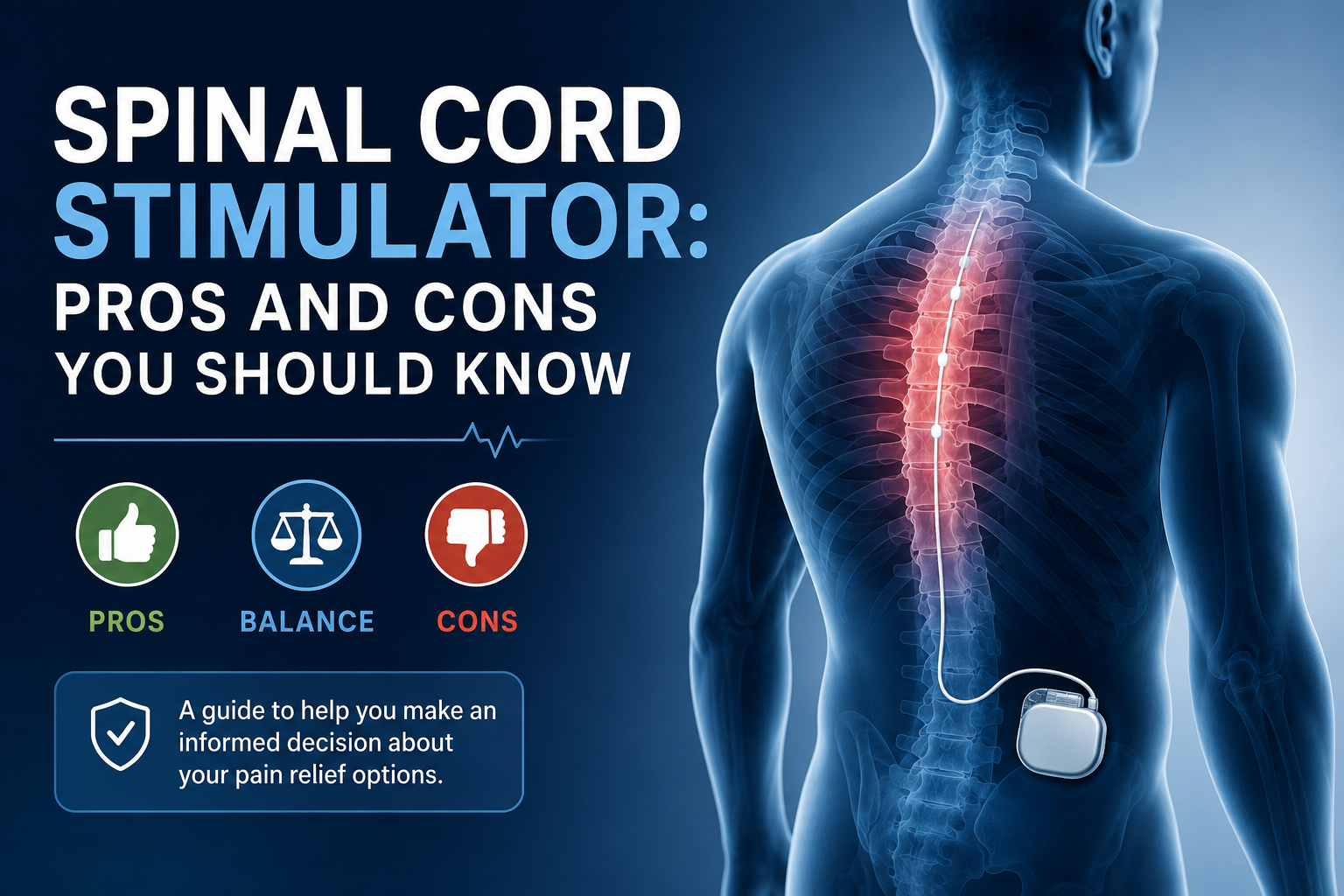
A spinal cord stimulator is a small implanted device that manages chronic pain using gentle electrical pulses. Thin wires (leads) are placed near the spinal cord, connected to a small generator under the skin. When you turn it on, it sends a mild current that changes how pain signals reach your brain. You control the stimulation with a handheld remote.
Cleveland Clinic explains that an SCS “emits a safe, alternate electrical current into your spinal cord that you can control” (Cleveland Clinic).
How does it work?
A spinal cord stimulator works by interrupting the pain messages traveling from your body to your brain. Instead of removing the source of pain, it changes how your nervous system perceives it — a bit like adding background noise that helps the brain tune out an unwanted signal.
According to Cleveland Clinic, the current “can block the chronic pain signals and help your brain ignore them,” similar to the way white noise masks unwanted sound (Cleveland Clinic).
The pros of spinal cord stimulation
For the right person, a spinal cord stimulator offers real advantages over living with unrelieved chronic pain:
- Meaningful pain relief. Many people who respond well get a significant reduction in their chronic pain.
- Less reliance on medication. Better pain control often means a reduced need for pain medicine, including opioids.
- You’re in control. A remote lets you adjust the stimulation to your activity and comfort.
- Reversible. Unlike surgery that changes the spine’s structure, the device can be turned off or removed.
- You test it first. The trial period means you know whether it helps before committing to a permanent implant.
The cons and risks
A spinal cord stimulator is still a surgical implant, so it carries trade-offs worth understanding:
- Surgical risks. As with any procedure, there’s a risk of infection or bleeding.
- Device issues. The leads can shift out of position, and the device or battery may occasionally need adjustment or replacement.
- It doesn’t work for everyone. Some people don’t get enough relief in the trial to move forward, and relief can change over time.
- MRI considerations. Having an implant can place restrictions on future MRI scans, though many newer systems are MRI-compatible under certain conditions.
- It manages pain rather than curing it. The stimulator masks pain signals; it doesn’t fix the underlying problem.
Cleveland Clinic lists potential downsides including infection, lead movement, and device malfunction, and notes that not everyone gets lasting relief (Cleveland Clinic).
The trial period: try before you commit
One of the biggest advantages of spinal cord stimulation is that you don’t commit blindly. Before a permanent implant, you go through a trial. In this stage, temporary leads are placed and connected to an external generator you wear for several days to a week. If the trial gives you good pain relief and you find the stimulation comfortable, you and your physician can move ahead with the permanent implant. If it doesn’t help enough, the temporary leads are simply removed — no permanent device, no lasting change. This test-drive step is a major reason SCS can be a lower-risk decision than it first appears.
Who is a good candidate?
Spinal cord stimulation is generally considered for people with chronic pain that hasn’t responded to more conservative treatments. It’s often used for:
- Chronic back and leg pain
- Ongoing pain after back surgery (sometimes called failed back surgery syndrome)
- Nerve pain, including certain types of neuropathy
- Complex regional pain syndrome (CRPS)
It’s usually a step considered after injections and other treatments — part of a thoughtful ladder rather than a first move. If you’ve already been through back surgery and still have pain, it may be worth discussing. You can learn more on our spinal cord stimulator implant page.
Making the decision
Deciding on a spinal cord stimulator comes down to weighing how much your chronic pain affects your life against the trade-offs of an implanted device — with the reassurance that the trial lets you find out if it works first. A good pain specialist will make sure you’ve exhausted the reasonable conservative options, confirm you’re a suitable candidate, and walk you through what to realistically expect. For broader context on managing ongoing pain, see our overview of back pain care.
Chronic pain that other treatments haven’t solved?
Empire Minimally Invasive Spine and Pain can tell you whether a spinal cord stimulator trial makes sense for your pain. Serving New Jersey and Long Island.
Request a consultation Or call our New Jersey office at 732-630-7246.Frequently asked questions
Is a spinal cord stimulator worth it?
For people whose chronic pain hasn’t responded to other treatments and who get good relief during the trial, it can be very worthwhile. The trial period is what makes this question answerable for you personally — you find out whether it helps before committing.
What is the downside of a spinal cord stimulator?
The main downsides are the risks of any implant — infection, lead movement, or device issues — plus the fact that it doesn’t relieve pain for everyone and manages pain rather than curing the cause. Having an implant can also affect future MRI scans.
How long does a spinal cord stimulator last?
The leads are designed to stay in place long term, and the generator’s battery lasts for years before it may need replacement. Rechargeable and non-rechargeable systems have different lifespans, which your physician can explain.
Does a spinal cord stimulator get rid of pain completely?
Usually it reduces pain substantially rather than removing it entirely. Many people describe going from severe, limiting pain to a much more manageable level, which can make a real difference in daily activity and medication use.
Can a spinal cord stimulator be removed?
Yes. Unlike procedures that permanently change the spine’s structure, the device can be turned off or surgically removed if it isn’t helping or is no longer needed.
This article is for general education and is not a substitute for medical advice. Talk with a qualified clinician about your specific symptoms.
What Our Patients Say

Dr. Monika Misak
Articles: 9

Our Plainview office has moved
Find us at our new location:
520 Old Country Rd
Plainview, NY 11803
Same doctors, same phone numbers.
Most Major Plans,
No-Fault & Personal Injury.
We accept most major insurance plans across our New York and New Jersey offices. Select your state to see accepted plans.
Accepted at our New York Locations
Workers' Compensation
No-Fault (NY & NJ)
Lien Cases
Medicare
Empire BCBS
BCBS / Anthem
Cigna
Aetna
Empire NYSHIP
Oxford (PPO)
United Health Care
GHI / Emblem Health
Humana (PPO)
Magnacare (PPO)
Northwell Direct
1199 SEIU
Self Pay
Accepted at our New Jersey Locations
No-Fault (NJ)
Lien Cases
Horizon BCBS
Empire NYSHIP
BCBS / Anthem (PPO)
Cigna
Aetna (PPO)
GHI / Emblem (PPO)
Port Authority UHC
Verizon Plan
Carpenter & Trade Unions
Self Pay
Medicare, Medicaid and Workers' Compensation are not accepted at our New Jersey locations. Not sure about your plan? Call us and we'll verify before your visit.
Not sure about your plan?
Call Us — 516-229-1443
Verify Your Coverage for FREE
Enter your information and our team will confirm your benefits before your visit.
✓ HIPAA Compliant
✓ No Obligation
✓ Same-Day Response
Your information is encrypted and secure. By submitting, you consent to receive communications regarding your appointment. You may opt out at any time.
Meet Our Pain Management & Orthopedic Specialists
Board-certified physicians dedicated to accurate diagnosis and minimally invasive care.

Pain Management
John Akhnoukh, M.D.
Board Certified Anesthesiologist & Interventional Pain Management Physician
Visit Profile



Pain Management
James Yu, D.O.
Board Certified Anesthesiologist & Interventional Pain Management Physician
Visit Profile

Pain Management
Benjamin Souferi, D.O.
Fellowship-Trained Interventional Pain Medicine Physician (Cleveland Clinic)
Visit ProfilePain Conditions Affecting Daily Life
Improve your quality of life with our comprehensive approach to pain management
We are dedicated to finding individualized treatment options tailored to fit your needs. Our team is dedicated to helping you lead a productive and active life, free from pain and disruption.
Our Locations
Pain management and orthopedic care across New York and New Jersey.