Intracept Procedure for Chronic Low Back Pain: How It Works
In this article
- What is the Intracept procedure?
- What is vertebrogenic back pain?
- How does basivertebral nerve ablation work?
- Who is a candidate?
- Intracept pros and cons
- What happens during the procedure?
- Risks and side effects
- Recovery and results
- Intracept vs. other radiofrequency treatments
- When to see a specialist
- Frequently asked questions
If you have chronic low back pain that hasn’t improved after months of physical therapy, medication, and injections, the source may be inside the vertebrae themselves — not a disc or a joint. The Intracept procedure, also called basivertebral nerve ablation, is a minimally invasive treatment built for exactly that problem. This guide explains what it is, who it helps, its pros and cons, and what recovery looks like.
Key takeaways
- Intracept treats vertebrogenic pain — chronic low back pain coming from damaged vertebral endplates.
- It uses radiofrequency energy to quiet the basivertebral nerve that carries the pain signal.
- It’s designed for people with low back pain lasting six months or more that hasn’t responded to conservative care.
- It’s a minimally invasive, outpatient procedure with a short recovery.
- It only helps when the pain truly comes from the endplates, so careful diagnosis is the most important step.
What is the Intracept procedure?
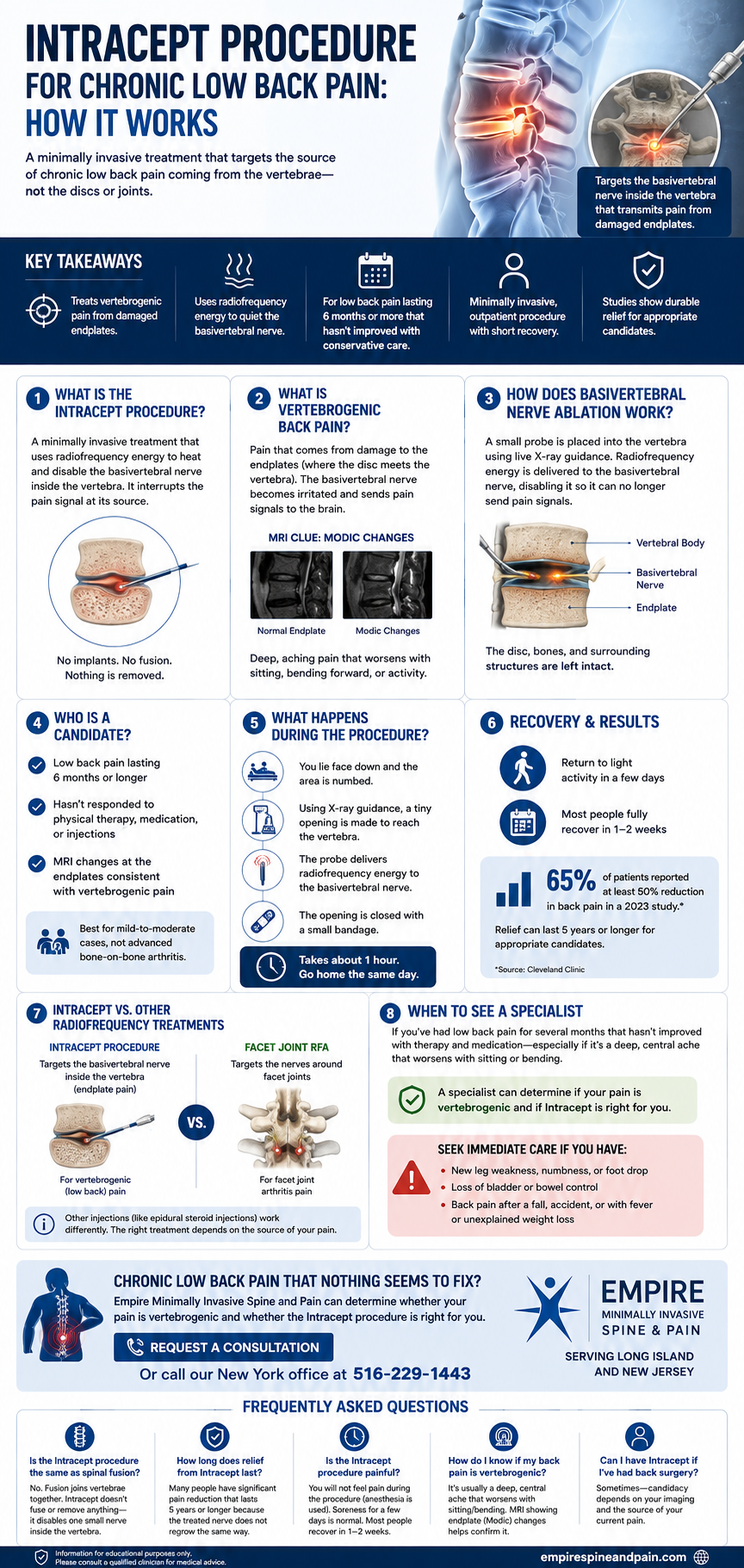
The Intracept procedure is a minimally invasive treatment that targets the basivertebral nerve — a small nerve deep inside the vertebra that carries pain signals from worn vertebral endplates to the brain. Using radiofrequency energy, a pain physician heats and disables that nerve so it can no longer send the pain message. Because it works inside the bone rather than on a disc or joint, it addresses a specific kind of back pain that other treatments often miss.
Cleveland Clinic describes the Intracept procedure as “a minimally invasive alternative to open back surgery” for chronic vertebrogenic low back pain (Cleveland Clinic).
What is vertebrogenic back pain?
Vertebrogenic back pain is chronic low back pain that comes from damage to the endplates — the thin layers of cartilage and bone where a disc meets the vertebra above and below it. When these endplates wear down or become inflamed, the basivertebral nerve inside the vertebra becomes irritated and sends a steady pain signal. This kind of pain is often felt as a deep, aching, midline ache in the lower back that gets worse with sitting, bending forward, or physical activity.
On an MRI, vertebrogenic pain is linked to specific changes at the endplates (known as Modic changes). Because the pain doesn’t come from a pinched nerve or a herniated disc, it can be missed for years — which is why a careful diagnosis matters.
How does basivertebral nerve ablation work?
Basivertebral nerve ablation works by using heat to interrupt the nerve that carries the pain signal. Guided by live X-ray imaging, the physician places a small probe through a tiny opening in the back and into the vertebra, then delivers radiofrequency energy to the basivertebral nerve. That energy disables the nerve so it stops relaying pain from the damaged endplates. The disc, bones, and surrounding structures are left intact — nothing is removed or fused.
Who is a candidate for the Intracept procedure?
The Intracept procedure is meant for people whose chronic low back pain has a vertebrogenic source and hasn’t improved with conservative care. In general, good candidates have:
- Low back pain lasting six months or longer
- Pain that hasn’t responded to physical therapy, medication, or injections
- MRI changes at the vertebral endplates consistent with vertebrogenic pain
Per Cleveland Clinic, the procedure is generally for people with chronic low back pain who “haven’t responded to medications, injections, or physical therapy after at least six months” (Cleveland Clinic).
It’s usually not the right fit when the main problem is a pinched nerve causing leg pain (sciatica), a herniated disc, spinal stenosis, a fracture, or an infection. At Empire Minimally Invasive Spine and Pain, that diagnosis is made carefully — because the treatment only helps when the pain truly comes from the endplates. You can learn more on our basivertebral nerve ablation treatment page.
Intracept pros and cons
Like any procedure, Intracept has real advantages and real limits. Here’s an honest side-by-side.
| Pros | Cons |
|---|---|
| Minimally invasive, outpatient, usually about an hour | Only helps vertebrogenic pain — not sciatica, stenosis, or disc herniation |
| Nothing is fused, removed, or implanted | Requires specific MRI findings, so not everyone qualifies |
| Short recovery; most people are back to normal in one to two weeks | Relief can build gradually over weeks rather than immediately |
| Relief can be long-lasting for the right candidate | Not everyone gets meaningful relief, even when they qualify |
| Can reduce reliance on repeat injections or pain medication | Insurance approval may require documentation of failed conservative care |
The biggest factor in whether Intracept is “worth it” is the diagnosis. When the pain source is right, the balance of pros and cons is favorable for many people. When it isn’t, a different treatment is the better choice.
What happens during the procedure?
The Intracept procedure is done in an outpatient setting and usually takes about an hour. You’re positioned face down, the area is numbed, and using X-ray guidance the physician creates one small opening to reach the vertebra. The radiofrequency probe treats the basivertebral nerve, and the small opening is closed with a bandage — no large incision and no stitches into muscle. Most people go home the same day.
Risks and side effects
Intracept is considered low-risk, but no procedure is risk-free. Possible side effects include:
- Soreness or bruising where the probe was placed, usually for a few days
- A temporary increase in back pain while the area settles
- Infection or bleeding (uncommon)
- Nerve irritation or injury (rare)
- Reaction to anesthesia or medications used during the procedure
Your physician will review your personal risks, medications (such as blood thinners), and health history before scheduling.
Recovery and results
Recovery from the Intracept procedure is typically quick because nothing is fused or removed. Many people return to light activity within a few days and feel fully recovered within a couple of weeks. Pain relief may build gradually over the following weeks as the area settles.
Cleveland Clinic notes “most people fully recover in one to two weeks,” and reports one 2023 study in which “65% of people reported at least a 50% reduction in back pain,” with relief that can last five years or longer for appropriate candidates (Cleveland Clinic).
Intracept vs. other radiofrequency treatments
Radiofrequency energy is used in more than one back-pain treatment, and it helps to know the difference. Radiofrequency ablation (RFA) for facet pain targets the small nerves around arthritic facet joints. The Intracept procedure targets a different nerve — the basivertebral nerve inside the vertebra — for pain coming from the endplates. They treat different sources, so the right one depends on where your pain actually originates. If your pain is from arthritic facet joints instead, see our guide to facet joint syndrome. Injections such as an epidural steroid injection work differently again; our guide on epidural injection vs. radiofrequency ablation explains how those compare.
When should you see a specialist?
See a pain specialist if you’ve had low back pain for several months that hasn’t improved with therapy and medication, especially if it’s a deep, central ache that worsens with sitting or bending. A specialist can determine whether your pain is vertebrogenic and whether a targeted treatment like Intracept fits. Persistent pain deserves a precise diagnosis rather than an endless cycle of temporary fixes — and general back pain care is the starting point. Learn more about seeing a back pain doctor at Empire.
Seek prompt care if you have:
- New leg weakness, numbness, or foot drop
- Loss of bladder or bowel control
- Back pain after a fall, accident, or with fever and weight loss
Chronic low back pain that nothing seems to fix?
Empire Minimally Invasive Spine and Pain can determine whether your pain is vertebrogenic and whether the Intracept procedure is right for you. Serving Long Island and New Jersey.
Request a consultation Or call our New York office at 516-229-1443.Frequently asked questions
What are the pros and cons of the Intracept procedure?
The main pros are that it’s minimally invasive, outpatient, doesn’t fuse or remove anything, and has a short recovery, with relief that can last for years in the right candidate. The main cons are that it only treats vertebrogenic pain, requires specific MRI findings, and doesn’t help everyone who has it.
Is the Intracept procedure the same as spinal fusion?
No. Spinal fusion permanently joins vertebrae together with hardware. The Intracept procedure doesn’t fuse or remove anything — it simply disables one small nerve inside the vertebra. Cleveland Clinic describes it as a minimally invasive alternative to open back surgery.
How long does relief from Intracept last?
For appropriate candidates, the relief is durable. Cleveland Clinic reports that many people have significant pain reduction that lasts five years or longer, because the treated basivertebral nerve does not regrow the way some other nerves do.
Is the Intracept procedure painful?
The procedure is done with anesthesia, so you shouldn’t feel pain during it. Afterward, some soreness at the treatment site is normal for a few days and usually settles quickly. Most people fully recover within one to two weeks.
Is Intracept covered by insurance?
Many plans, including Medicare, may cover the Intracept procedure when medical criteria are met, such as documented chronic low back pain, failed conservative care, and qualifying MRI findings. Coverage varies by plan, so our team verifies your benefits before scheduling.
How do I know if my back pain is vertebrogenic?
Vertebrogenic pain is usually a deep, central low back ache that worsens with sitting and bending and hasn’t responded to standard care. An MRI showing endplate (Modic) changes helps confirm it. A pain specialist puts the picture together before recommending treatment.
Can I have Intracept if I’ve already had back surgery?
Sometimes. Prior back surgery doesn’t automatically rule it out, but candidacy depends on your imaging and the source of your current pain. A specialist will review your history and MRI to decide whether it’s a good fit.
This article is for general education and is not a substitute for medical advice. Talk with a qualified clinician about your specific symptoms.
What Our Patients Say

Dr. John Akhnoukh
Articles: 14

Our Plainview office has moved
Find us at our new location:
520 Old Country Rd
Plainview, NY 11803
Same doctors, same phone numbers.
Most Major Plans,
No-Fault & Personal Injury.
We accept most major insurance plans across our New York and New Jersey offices. Select your state to see accepted plans.
Accepted at our New York Locations
Workers' Compensation
No-Fault (NY & NJ)
Lien Cases
Medicare
Empire BCBS
BCBS / Anthem
Cigna
Aetna
Empire NYSHIP
Oxford (PPO)
United Health Care
GHI / Emblem Health
Humana (PPO)
Magnacare (PPO)
Northwell Direct
1199 SEIU
Self Pay
Accepted at our New Jersey Locations
No-Fault (NJ)
Lien Cases
Horizon BCBS
Empire NYSHIP
BCBS / Anthem (PPO)
Cigna
Aetna (PPO)
GHI / Emblem (PPO)
Port Authority UHC
Verizon Plan
Carpenter & Trade Unions
Self Pay
Medicare, Medicaid and Workers' Compensation are not accepted at our New Jersey locations. Not sure about your plan? Call us and we'll verify before your visit.
Not sure about your plan?
Call Us — 516-229-1443
Verify Your Coverage for FREE
Enter your information and our team will confirm your benefits before your visit.
✓ HIPAA Compliant
✓ No Obligation
✓ Same-Day Response
Your information is encrypted and secure. By submitting, you consent to receive communications regarding your appointment. You may opt out at any time.
Meet Our Pain Management & Orthopedic Specialists
Board-certified physicians dedicated to accurate diagnosis and minimally invasive care.

Pain Management
John Akhnoukh, M.D.
Board Certified Anesthesiologist & Interventional Pain Management Physician
Visit Profile



Pain Management
James Yu, D.O.
Board Certified Anesthesiologist & Interventional Pain Management Physician
Visit Profile

Pain Management
Benjamin Souferi, D.O.
Fellowship-Trained Interventional Pain Medicine Physician (Cleveland Clinic)
Visit ProfilePain Conditions Affecting Daily Life
Improve your quality of life with our comprehensive approach to pain management
We are dedicated to finding individualized treatment options tailored to fit your needs. Our team is dedicated to helping you lead a productive and active life, free from pain and disruption.
Our Locations
Pain management and orthopedic care across New York and New Jersey.